
Key takeaways
- Confusing pound test with diameter: A 30-pound braid from one brand may not occupy the same spool space as another brand’s 30-pound braid.
- Using line that is too light for the cover: Thin braid can cast well but may fail when a fish reaches roots, rocks, or dense vegetation.
- Overfilling the spool: Filling to the very edge can increase backlash and cause loops to fall over the spool lip.
- Underfilling the spool: A shallow fill reduces casting distance and may make the reel feel slower during retrieval.
- Skipping backing: Braid can slip on a bare, slick spool. Backing provides grip and saves line.
- Ignoring the rod and lure: Heavy braid on a light rod does not automatically create a stronger system. Match the line, rod power, lure weight, and drag.
- Using no leader when abrasion is likely: Braid is strong but can be damaged by sharp cover, rocks, and teeth.
The Short Answer
For most baitcasting reels, 30- to 50-pound braided line is the best starting range. Choose 30-pound braid for general freshwater fishing, bass, and lighter lures; move to 40 or 50 pounds for heavy cover, frogs, jigs, and larger pike or musky. For especially large fish or thick vegetation, 65- to 80-pound braid may be appropriate.
The “size” of braid usually refers to its breaking strength in pounds, not a universal physical diameter. Braid is much thinner than monofilament at the same pound rating, but actual diameters vary by brand, strand count, coating, and whether the manufacturer uses an approximate or standardized diameter.
Our top picks

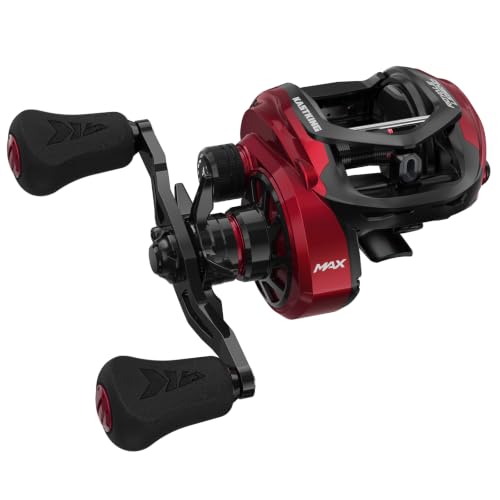

 KastKing Spartacus II Baitcasting Reels
- Hand Orientation: Ambidextrous, Right Hand
- Fishing Technique: Baitcasting
- Gearbox Ratio: 7.2
As an Amazon Associate we earn from qualifying purchases at no extra cost to you.
A practical starting point is 30-pound braid measuring about 0.010 to 0.012 inches (0.25 to 0.30 cm) in diameter. Forty-pound braid is commonly about 0.011 to 0.014 inches (0.28 to 0.36 cm), while 50-pound braid is often around 0.012 to 0.016 inches (0.30 to 0.41 cm). Check the line package and your reel’s capacity chart before buying.
For a typical low-profile baitcaster, fill the spool to approximately 1/16 inch (0.16 cm) below the spool lip. A full, neatly packed spool casts more efficiently than a partially filled one, but overfilling can cause backlash and line spilling.
Standard Sizes
The table below provides useful working ranges rather than exact specifications for every brand. Two braids with the same pound rating can have noticeably different diameters, so use the manufacturer’s listed diameter when calculating capacity.
| Braid rating | Approximate diameter | Approximate diameter | Typical baitcasting use | Suggested leader |
|---|---|---|---|---|
| 10 lb | 0.006–0.008 in | 0.15–0.20 cm | Light lures, finesse fishing, open water | 6–10 lb fluorocarbon |
| 15 lb | 0.007–0.009 in | 0.18–0.23 cm | Light bass tackle and small casting reels | 8–12 lb fluorocarbon |
| 20 lb | 0.008–0.010 in | 0.20–0.25 cm | General open-water bass fishing | 10–15 lb fluorocarbon |
| 30 lb | 0.010–0.012 in | 0.25–0.30 cm | All-purpose bass, topwater, and light cover | 12–20 lb fluorocarbon |
| 40 lb | 0.011–0.014 in | 0.28–0.36 cm | Heavy cover, jigs, and larger lures | 15–25 lb fluorocarbon |
| 50 lb | 0.012–0.016 in | 0.30–0.41 cm | Frogs, thick grass, wood, pike, and inshore use | 20–30 lb fluorocarbon |
| 65–80 lb | 0.015–0.020 in | 0.38–0.51 cm | Heavy vegetation, musky, and very powerful hook sets | 30–60 lb leader |
Most low-profile reels are comfortable with 100 to 150 yards of 20- to 50-pound braid, depending on spool depth and line diameter. A 300-size baitcaster generally accepts more line and is better suited to heavier braid, larger lures, and larger fish. For example, a compact reel such as the Lew’s Classic Pro Speed Spool SLP, listed around $70 to $90, pairs naturally with 20- to 40-pound braid for common bass applications. A 300-size reel such as the KastKing Royale Legend Max 300, commonly priced around $80 to $100, or the Piscifun Alinox 300, often about $100 to $120, offers more room for 40- to 80-pound line.
Do not select braid solely by a reel’s maximum-drag number. Drag pressure, rod power, knots, hooks, and the structure around the fish all affect the useful line rating. A lower-priced reel such as the KastKing Spartacus II, often sold in the $35 to $50 range, can still fish braid effectively when its line capacity and intended lure weight are respected.
How to Measure Your Space
- Measure the spool width. Remove the spool if the reel design allows it, then measure the usable line section from side to side. Record the width in inches or centimeters.
- Measure the spool diameter. Measure across the bare spool, excluding the frame and side plates. A larger diameter generally retrieves more line per handle turn.
- Check the spool depth. Measure from the spool surface to the inner edge of the spool lip. Deep spools can hold more line, but the manufacturer’s capacity chart is more reliable than a visual estimate.
- Find the stated capacity. Look for a marking such as “12 pounds/120 yards” or “40 pounds/150 yards.” This reference is usually based on monofilament, so thicker or thinner braid will change the actual amount.
- Choose the amount to load. For most casting, 100 to 150 yards of braid is sufficient. Add monofilament backing first if the spool needs help reaching the proper fill level.
- Leave a small gap. Stop filling about 1/16 inch (0.16 cm) below the spool lip. Keep tension on the line while spooling so it settles tightly and evenly.
Backing reduces wasted braid and helps prevent the line from spinning around the spool. Use a short section of monofilament tied to the braid with an arbor knot or another compact connection. When using a leader, connect it with a slim knot such as an improved Alberto or FG knot, and keep the leader short enough that the knot does not repeatedly strike the guides unless that setup is intentional.
By Room or Use Case
Open-water bass fishing
Use 20- to 30-pound braid for casting crankbaits, spinnerbaits, buzzbaits, and soft plastics around relatively clean water. Thirty-pound braid is the most versatile choice because it offers manageable diameter, solid casting distance, and enough strength for ordinary hook sets. Pair it with a 10- to 17-pound fluorocarbon leader when abrasion resistance and reduced visibility matter.
Heavy grass, lily pads, and thick cover
Choose 40- to 65-pound braid when fish must be pulled quickly from vegetation. The line’s diameter helps it cut through some grass, while the added strength gives the angler more control during a forceful hook set. A heavy baitcasting rod and a properly adjusted drag are just as important as the line rating. For hollow-body frogs, 50 or 65 pounds is a common range.
Finesse baitcasting
For a specialized BFS-style reel and small lures, 8- to 15-pound braid may work well. Standard baitcasters often perform better with 15- to 20-pound braid because extremely thin line can dig into the spool after a hard pull. Use a 6- to 10-pound fluorocarbon leader for small baits when cover is light.
Pike, musky, and larger freshwater fish
For pike, 40- to 65-pound braid is a reasonable starting range. Musky outfits commonly use 65- to 80-pound braid on a larger spool, particularly when casting heavy lures or fishing around wood and weeds. Because braid is vulnerable to sharp teeth, add an appropriate wire, titanium, or heavy fluorocarbon bite leader.
Inshore and saltwater casting
Use 30- to 50-pound braid for many inshore species, increasing the size when fishing around rocks, docks, oysters, or heavy current. Rinse the reel and line with fresh water after use, and confirm that the reel is designed for the intended saltwater exposure. Braid strength does not eliminate the need for abrasion-resistant leader material.
Common Sizing Mistakes
- Confusing pound test with diameter: A 30-pound braid from one brand may not occupy the same spool space as another brand’s 30-pound braid.
- Using line that is too light for the cover: Thin braid can cast well but may fail when a fish reaches roots, rocks, or dense vegetation.
- Overfilling the spool: Filling to the very edge can increase backlash and cause loops to fall over the spool lip.
- Underfilling the spool: A shallow fill reduces casting distance and may make the reel feel slower during retrieval.
- Skipping backing: Braid can slip on a bare, slick spool. Backing provides grip and saves line.
- Ignoring the rod and lure: Heavy braid on a light rod does not automatically create a stronger system. Match the line, rod power, lure weight, and drag.
- Using no leader when abrasion is likely: Braid is strong but can be damaged by sharp cover, rocks, and teeth.
FAQ
Is 30-pound braid good for a baitcaster?
Yes. Thirty-pound braid is an excellent general-purpose choice for bass and other medium freshwater applications. It balances casting performance, strength, and manageable spool capacity. Move to 40 or 50 pounds when fishing heavy cover.
How much braid should I put on a baitcasting reel?
Load enough to leave approximately 1/16 inch (0.16 cm) between the line and spool lip. In many reels, that equals about 100 to 150 yards of braid, but the exact amount depends on braid diameter and spool size.
Can I use 50-pound braid on any baitcaster?
Most baitcasters can use 50-pound braid, but a shallow or small spool may hold less line. Confirm the reel’s capacity and use a medium-heavy or heavy rod when the application requires powerful hook sets.
Should I use a leader with braided line?
A leader is useful when fishing clear water, abrasive cover, or toothy fish. Fluorocarbon is common for bass and general freshwater use, while heavier fluorocarbon, wire, or titanium may be better for pike and musky. In dirty water or dense cover, some anglers tie braid directly to the lure.
Write Your Review
No reviews yet. Be the first to share your experience!