
Key takeaways
- A listing gives a gear ratio but no inches-per-turn, line capacity, weight, or lure range.
- The product photo shows a right-hand model while the title or options are unclear about retrieve hand.
- The seller advertises a very high bearing count without identifying bearing protection or materials.
- The maximum drag is prominent, but there is no information about drag washers or adjustment range.
- The reel has no visible warranty terms, service contact, or replacement-parts information.
- The spool has excessive side-to-side movement, the handle wobbles, or the thumb bar feels rough before use.
- A very fast ratio is recommended for every technique, including deep crankbaits and other high-resistance lures.
Buying a baitcasting reel by gear ratio alone is one of the easiest ways to spend money twice. A fast 8.1:1 reel may retrieve line quickly, but it can feel tiring when cranking a deep-diving plug. A slower 6.4:1 reel can deliver useful torque, yet may leave too much slack when a fish runs toward the boat. Shoppers also commonly compare ratios without checking spool size, line capacity, drag, handle length, or whether the reel is right- or left-hand retrieve.
This baitcasting reel buying guide gear ratios overview focuses on what those numbers mean in practical fishing situations. The goal is not to choose the most expensive reel or the fastest retrieve. It is to match the reel’s speed, size, construction, and ergonomics to the techniques you actually fish. Prices and product availability can change, so treat the example prices below as typical reference points rather than permanent quotations.
Our top picks
 Piscifun Torrent II Baitcasting Reel
- Innovative Design: The Piscifun Torrent II Low Profile…
- Excellent Durability: The CNC Aircraft-grade hardened, anodized aluminum…
- Fast Retrieve & Multiple Choices: The Torrent II…
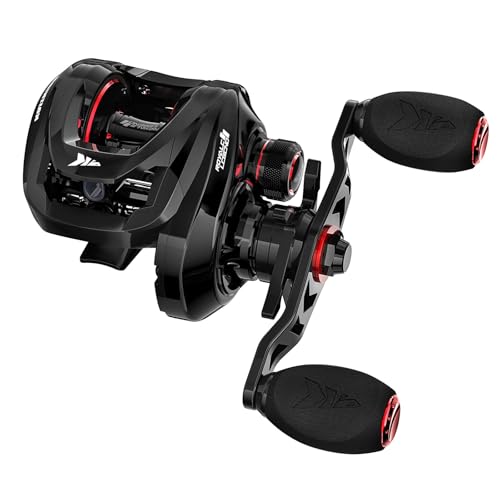
 KastKing Royale Legend II Baitcasting Reels
- Hand Orientation: Right Hand
- Fishing Technique: Baitcasting
- Other Special Features of the Product: Adjustable Braking System
Cross-Fire 8-magnet brake helps cut down on backlash
Ceramic line guide and CNC spool add casting strength
Choice of 5.4:1 or 7.2:1 ratio suits different techniques
Right-hand only build, no left-hand option listed
Six bearings total is modest for a performance reel
 KastKing Megatron 200 Baitcasting Reels
- KastKing MegaTron 200 Baitcasting Reels feature a wider…
- While the new MegaTron 200 casting reels feature…
- Advanced performance and durability of the new MegaTron…
| Product | Key specs | |
|---|---|---|
| Piscifun Torrent II Baitcasting Reel | Innovative Design: The Piscifun Torrent II Low Profile… Excellent Durability: The CNC Aircraft-grade hardened, anodized aluminum… Fast Retrieve & Multiple Choices: The Torrent II… | Check price |
| KastKing Royale Legend II Baitcasting Reels | Hand Orientation: Right Hand Fishing Technique: Baitcasting Other Special Features of the Product: Adjustable Braking System | Check price |
| KastKing Megatron 200 Baitcasting Reels | KastKing MegaTron 200 Baitcasting Reels feature a wider… While the new MegaTron 200 casting reels feature… Advanced performance and durability of the new MegaTron… | Check price |
 KastKing Royale Legend II Baitcasting Reels KastKing Royale Legend II Baitcasting Reels | Check price |
As an Amazon Associate we earn from qualifying purchases at no extra cost to you.
Decide These 3 Things First
- Choose your primary lure techniques. Use a fast reel around 7.1:1 to 8.3:1 for flipping, pitching, buzzbaits, topwater, and quickly picking up slack. Choose about 6.3:1 to 7.0:1 for all-purpose casting, spinnerbaits, swim jigs, and medium-diving crankbaits. Consider 5.4:1 to 6.3:1 for deep crankbaits, large resistance-heavy plugs, and presentations where steady torque matters more than speed.
- Choose your retrieve hand. Right-hand and left-hand models are not interchangeable after purchase. A right-hand retrieve is usually cranked with the right hand after casting with the right. A left-hand model lets many right-handed casters cast with the right hand and retrieve with the left without switching hands.
- Set a realistic line and lure range. A compact reel weighing roughly 6.5 to 7.5 ounces suits lighter bass and freshwater work. A larger 200-size reel, often 7.5 to 9.5 ounces, offers more line capacity and may be better for heavy braid, swimbaits, pike, or inshore applications. Check the manufacturer’s rated lure and line ranges before buying.
Gear Ratio and Retrieve Speed
The gear ratio tells you how many times the spool turns with one complete turn of the handle. An 8.1:1 ratio turns the spool 8.1 times per handle revolution; it does not directly tell you how many inches of line the reel retrieves. Spool diameter also matters. A larger spool can collect more line per rotation, so two reels with the same ratio may have different inches-per-turn figures.
For a general-purpose setup, 6.8:1 to 7.3:1 is a useful middle ground. It is fast enough for many soft plastics and moving baits without being excessively quick for moderate-resistance lures. A reel such as the KastKing Royale Legend II listed at 7.2:1 sits in this versatile range. A Piscifun Torrent II at 8.1:1 is more suited to rapid line pickup, while a KastKing Megatron 200 at 6.4:1 favors controlled, higher-torque retrieves.
Look for an inches-per-turn specification when available. Approximately 28 to 32 inches per turn is a practical all-around target, 32 to 36 inches is fast, and below about 27 inches emphasizes slower power. These are useful categories, not strict rules. A fast reel can still fish a crankbait if you slow your handle cadence, but a slow reel cannot retrieve line quickly when a fish charges the boat.
Size, Spool Capacity, and Weight
Reel size affects balance, capacity, and handling more than the gear ratio does. Compact 100-size baitcasters commonly hold enough line for bass techniques using 10- to 17-pound monofilament or fluorocarbon, or approximately 30- to 50-pound braid, depending on spool depth. A 150-size reel adds capacity without always becoming bulky. A 200-size reel is preferable when you need roughly 120 to 180 yards of heavier braid or want to cast large lures.
For ordinary bass fishing, aim for a reel between 6.5 and 8.0 ounces. Heavier reels can be worthwhile for swimbaits or heavy cover, but an extra 2 ounces becomes noticeable during an eight-hour casting day. Also compare the reel’s width and palm-side profile. A body around 2.5 to 3 inches wide is generally easy to palm; wider frames can provide stronger gearing and more capacity but may feel awkward in smaller hands.
Match the reel to the rod rather than shopping by reel size in isolation. A 6-foot-10-inch medium-heavy rod with a 100- or 150-size reel is a common bass combination. A 7-foot-6-inch heavy rod throwing a 2-ounce swimbait may be better served by a 200-size reel with a longer handle.
Materials and Construction
Most budget baitcasters use a graphite or composite frame and side plates, while midrange and premium models may add an aluminum frame or aluminum side plate. Graphite keeps weight and cost down, but aluminum generally offers a more rigid platform for demanding loads. This does not mean every aluminum reel is automatically better; bearings, gear alignment, drag design, and quality control also matter.
Pay attention to the main gear material. Brass gears are common and provide a good balance of strength, smoothness, and price. Aluminum gears are lighter but may prioritize weight reduction over long-term resistance to high loads. Stainless steel components can improve corrosion resistance, but they still require rinsing and drying after use in saltwater.
For freshwater bass and occasional use, a composite frame can be perfectly sensible. For frequent heavy-cover fishing, large lures, or brackish water, favor a rigid frame, sealed or shielded bearings, corrosion-resistant hardware, and a clear maintenance procedure. Do not confuse a high bearing count with durability; six well-made bearings can be more useful than 11 poorly protected ones.
Comfort, Drag, and Performance
Handle length changes leverage. Handles around 80 to 90 millimeters feel quick and compact for finesse and general bass work. Handles around 95 to 110 millimeters provide more leverage for deep cranks, swimbaits, and heavy cover. Oversized knobs can reduce hand fatigue, especially when a lure creates strong resistance.
A stated maximum drag of 12 to 18 pounds is common in affordable baitcasters, while larger or premium models may list 20 to 25 pounds or more. Maximum drag is not a laboratory measure of smoothness. What matters is whether the drag starts smoothly, remains consistent, and can be adjusted in small increments. For many bass applications, a reliable 10 to 15 pounds of usable drag is adequate.
Look for an externally accessible spool-tension knob and a magnetic, centrifugal, or dual-braking system with several adjustment positions. Beginners often benefit from a braking system that is easy to tune rather than one with the highest theoretical casting range. A six-pin centrifugal system, for example, can offer straightforward mechanical adjustment; a magnetic dial may be easier to change between lure weights. Neither is universally superior.
Anti-reverse play should be minimal, and the thumb bar should engage positively without excessive force. A handle that feels smooth in the store may develop noise if the reel is poorly lubricated, so check whether replacement parts and service instructions are readily available.
Price Tiers: What You Actually Get
Budget baitcasters from about $35 to $60 can provide a useful entry point. The Piscifun Torrent II at a listed $39.99 and the KastKing Royale Legend II at $41.39 represent this category. Expect composite construction, basic bearings, modest drag refinement, and greater variation in factory smoothness. These reels are reasonable for occasional freshwater fishing or as a technique-specific backup.
Midrange reels from roughly $60 to $130 often improve frame rigidity, spool consistency, braking adjustment, handle design, and quality control. They may also have better corrosion protection and more accessible replacement parts. For anglers who fish weekly, this is often the best value tier.
Premium baitcasters generally begin around $150 and can exceed $300. The benefits are usually lower weight, smoother gearing under load, more consistent braking, tighter tolerances, refined drag behavior, and better long-term support. Do not pay premium money simply for a 10.1:1 ratio. Speed is only one specification, and an ultra-fast reel may be the wrong choice for your lures.
Warranty and Service Support
Check the warranty length, exclusions, and return window before opening the package. A one-year limited warranty is common in the budget and midrange market; longer coverage may be available on selected premium products. Confirm whether the warranty covers manufacturing defects only or also includes parts such as the thumb bar, handle, spool, and drag washers.
Look for a service address, replacement-spool availability, exploded parts diagrams, and instructions for basic lubrication. A reel with a two-year warranty is less useful if the manufacturer cannot supply a replacement side plate or handle. Save the receipt and record the model, retrieve hand, and gear ratio immediately after delivery.
Delivery, Inspection, and Basic Setup
When the reel arrives, inspect the frame, side plates, level-wind area, handle, and spool before mounting it. The spool should rotate without scraping, and the side plate should close fully. Confirm that the box contains the correct ratio and retrieve hand; an 8.1:1 right-hand model is not a substitute for an 8.1:1 left-hand model.
Most baitcasters require no assembly beyond attaching or tightening the handle, star drag, or included knobs according to the instructions. Do not over-tighten the handle nut. Spool the reel with approximately 1/8 inch of clearance below the spool lip, then set spool tension until side-to-side play just disappears. Start with stronger braking, use a lure in the reel’s recommended range, and reduce braking gradually as you learn the reel.
Spec Checklist
| Spec | Budget | Mid | Premium |
|---|---|---|---|
| Typical price | $35–$60 | $60–$130 | $150–$350+ |
| Useful ratios | 6.3:1–8.1:1 | 6.4:1–8.1:1 | 6.2:1–9.0:1 |
| Typical weight | 7.0–9.5 oz | 6.5–8.5 oz | 5.5–8.0 oz |
| Frame material | Graphite/composite | Composite or aluminum hybrid | Aluminum or advanced composite |
| Handle length | 80–95 mm | 85–100 mm | 90–110 mm |
| Listed maximum drag | 12–18 lb | 15–20 lb | 18–25+ lb |
| Best use | Occasional freshwater fishing | Frequent all-purpose use | Specialized or demanding use |
Red Flags
- A listing gives a gear ratio but no inches-per-turn, line capacity, weight, or lure range.
- The product photo shows a right-hand model while the title or options are unclear about retrieve hand.
- The seller advertises a very high bearing count without identifying bearing protection or materials.
- The maximum drag is prominent, but there is no information about drag washers or adjustment range.
- The reel has no visible warranty terms, service contact, or replacement-parts information.
- The spool has excessive side-to-side movement, the handle wobbles, or the thumb bar feels rough before use.
- A very fast ratio is recommended for every technique, including deep crankbaits and other high-resistance lures.
FAQ
What gear ratio is best for an all-purpose baitcasting reel?
A ratio between 6.8:1 and 7.3:1 is the safest general-purpose choice for many freshwater anglers. It offers enough speed for soft plastics and topwater while remaining manageable for spinnerbaits, swim jigs, and moderate crankbaits. Check inches per turn too, because spool size changes actual line pickup.
Is an 8.1:1 baitcaster too fast for beginners?
Not necessarily, but it demands more control. An 8.1:1 reel is useful when you need to pick up slack quickly, such as when flipping cover or working a buzzbait. Beginners may find a 6.8:1 to 7.3:1 reel easier to use across a wider mix of lures.
Should I choose a 100-size or 200-size baitcasting reel?
Choose a 100-size reel for compact bass presentations, lighter line, and lower overall weight. Choose a 200-size reel when using heavy braid, large swimbaits, oversized plugs, or long casts that require more line capacity. The larger reel will usually weigh more, often by 1 to 2 ounces.
Do more bearings make a baitcasting reel better?
No. Bearing quality, placement, sealing, lubrication, gear alignment, and braking design matter more than the count printed on the box. A reel with six protected, properly maintained bearings can outperform one with a larger advertised number. Consider smooth operation, warranty support, and serviceability alongside the bearing specification.
Write Your Review
No reviews yet. Be the first to share your experience!