
Key takeaways
- Lower underwater visibility: Fluorocarbon refracts light similarly to water, which can make it harder for fish to notice than standard nylon mono. It is not invisible, but it can be valuable in clear water and under fishing pressure.
- Strong abrasion resistance: It handles contact with rocks, dock edges, mussel beds, and submerged wood better than many light monofilament lines. It is not cut-proof, so inspect it after contacting cover.
- Sinks instead of floating: The line’s density helps it stay below the surface. That can keep a soft-plastic lure or bait behaving more naturally and reduces the visible line angle between rod tip and lure.
- Useful near sharp cover: A properly sized leader gives you a buffer when a fish runs around a rock or branch. This is especially helpful when your main line is thin braid.
- Good knot and lure control when sized correctly: Heavier fluorocarbon can provide a firm connection to hooks, snaps, and swivels. It also resists absorbing water, so its basic properties stay more consistent during a day on the water.
- Easy to customize: You can change leader strength and length without respooling your reel. A few spools in 6-, 10-, and 15-pound test cover many freshwater situations.
The Short Answer
Yes—fluorocarbon leader is worth using in freshwater when fish are line-shy, cover is abrasive, or you need a leader that sinks rather than floats. The one condition is that you use it as a targeted leader, not automatically as your main line for every freshwater setup.
For clear lakes, pressured ponds, trout streams, bass around rocks, and finesse presentations, fluorocarbon can solve real problems. It is less visible underwater than nylon monofilament, resists abrasion, and sinks below the surface. However, it is stiffer, more expensive, and less forgiving than mono. If you fish muddy water, use spinning gear with light line, or are simply trying to keep costs low, a short fluorocarbon leader may deliver nearly all the benefit without replacing your entire spool.
Our top picks
 ZASIE 50lb Fluorocarbon Fishing Leader
- More Sensitive: Fluorocarbon leader is non-permeable to water…
- Higher Abrasion Resistance: The fluorocarbon fishing leaders here…
- Invisible: Light refraction factor of fluorocarbon is very…
As an Amazon Associate we earn from qualifying purchases at no extra cost to you.
What You Actually Get
Fluorocarbon leader is made from polyvinylidene fluoride, a dense material commonly sold as 100% fluorocarbon. Do not confuse it with “fluorocarbon-coated” line, which usually has a nylon core and only a fluorocarbon outer layer. Coated line can be useful and affordable, but it does not behave exactly like true fluorocarbon.
A leader is typically tied between your main line and lure or hook. Common freshwater leader lengths range from 12 to 36 inches. A 20-inch leader is a practical general-purpose starting point for bass, panfish, and many spinning applications. Longer leaders—roughly 3 to 6 feet—can help when fish are especially cautious, but they are more difficult to cast through some rod guides and take longer to replace.
Strength should match the fish, cover, and lure rather than simply being as high as possible. Around 4 to 8 pounds is common for trout, crappie, and finesse fishing; 10 to 15 pounds suits many bass applications; and 20 to 30 pounds may be appropriate around heavy vegetation, wood, or toothy freshwater species. A 50-pound leader, such as the ZASIE 20-inch, 100% fluorocarbon leader sold in a 10-pack for $9.99, is a specialized choice. It may make sense for large fish or severe cover, but it is too heavy for most trout, panfish, and clear-water finesse presentations.
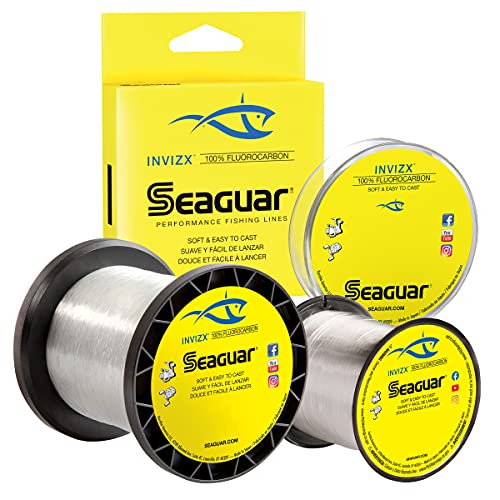
Another option is to spool fluorocarbon as your main line. Seaguar Invizx Freshwater 100% Fluorocarbon, for example, is offered in an 8-pound, 200-yard spool at about $22.95. That approach provides consistent fluorocarbon from reel to lure, but it also exposes you to the material’s stiffness and memory on every cast. For many anglers, a leader is the more economical compromise.
Pros
- Lower underwater visibility: Fluorocarbon refracts light similarly to water, which can make it harder for fish to notice than standard nylon mono. It is not invisible, but it can be valuable in clear water and under fishing pressure.
- Strong abrasion resistance: It handles contact with rocks, dock edges, mussel beds, and submerged wood better than many light monofilament lines. It is not cut-proof, so inspect it after contacting cover.
- Sinks instead of floating: The line’s density helps it stay below the surface. That can keep a soft-plastic lure or bait behaving more naturally and reduces the visible line angle between rod tip and lure.
- Useful near sharp cover: A properly sized leader gives you a buffer when a fish runs around a rock or branch. This is especially helpful when your main line is thin braid.
- Good knot and lure control when sized correctly: Heavier fluorocarbon can provide a firm connection to hooks, snaps, and swivels. It also resists absorbing water, so its basic properties stay more consistent during a day on the water.
- Easy to customize: You can change leader strength and length without respooling your reel. A few spools in 6-, 10-, and 15-pound test cover many freshwater situations.
Cons
- More expensive than mono: Basic monofilament often costs only a few dollars for hundreds of yards, while quality fluorocarbon leader material commonly costs roughly $8 to $20 for a small spool. Premium main-line fluorocarbon may cost about $20 to $35 for 200 yards.
- Stiffness and memory: Fluorocarbon can spring off a spinning reel in coils, particularly at heavier tests or in cold weather. This may cause loops, wind knots, and reduced casting distance.
- Knots require care: Poorly tied or overheated knots can fail. Wet the line before tightening, pull the knot down gradually, and trim the tag end only after checking that the wraps have seated cleanly.
- Less forgiving under sudden shock: Fluorocarbon has limited stretch compared with mono. That sensitivity is useful, but a hard hook-set or sudden strike can break light line if the drag is too tight.
- Not truly invisible: Fish can still detect it, especially when the leader is thick, nicked, or poorly positioned. Choosing an unnecessarily heavy test can cancel out some of the stealth advantage.
- Replacement takes time: Leaders wear out. If you fish rocks, timber, or pike-like teeth, you may need to check the final 12 to 24 inches after every fish or snag.
Who Should Buy It
Buy fluorocarbon leader if you fish clear freshwater and regularly target cautious fish. It is particularly useful for trout, bass, walleye, and panfish when visibility matters. Anglers using braided main line are also strong candidates: braid offers casting distance and sensitivity, while a 12- to 36-inch fluorocarbon leader adds abrasion resistance and a less conspicuous connection.
It is also a sensible purchase if your lures frequently contact rocks, gravel, dock pilings, or submerged branches. In that situation, leader material can be cheaper than repeatedly losing lures and respooling a reel. A general-purpose setup might use 10- to 15-pound fluorocarbon for bass, 6- to 8-pound for trout or finesse fishing, and a longer leader when fish are unusually wary.
For the 2026 season, the best value is usually a small assortment rather than one oversized spool. A $10 to $20 leader spool can cover many trips, while a $22.95, 200-yard main-line spool makes more sense if you specifically want full fluorocarbon performance and are comfortable managing its memory.
Who Should Skip It
Skip fluorocarbon leader if you mostly fish stained or muddy water where stealth is less important. Mono is often adequate for casual casting, live bait, bobber fishing, and species that are not particularly line-shy. It is softer, cheaper, and easier to tie.
You may also want to skip it if you use a light spinning reel and frequently experience line loops. A thin fluorocarbon leader tied to braid can work well, but fluorocarbon used as the entire spool may be frustrating. Anglers fishing heavy vegetation should remember that abrasion resistance is not the same as resistance to being cut by dense grass or sharp cover. In those conditions, lure choice, drag setting, rod power, and line diameter matter just as much.
Cheaper Alternatives
| Option | Cost | Trade-off |
|---|---|---|
| Basic nylon monofilament leader | About $3–$8 per spool | Much cheaper and easier to knot, but more visible, floats more readily, and usually offers less abrasion resistance. |
| Fluorocarbon-coated line | About $6–$15 per spool | Closer to fluorocarbon behavior at a lower price, but it is not 100% fluorocarbon and may not match true leader material for stealth or density. |
| Short 100% fluorocarbon leader sections | About $8–$15 for a multi-pack | Convenient and avoids buying a full spool, but pre-cut lengths can limit customization and may include snaps or swivels you do not need. |
| Use your existing nylon main line | $0 additional cost | Works for many casual freshwater applications, but provides no special advantage for clear water or abrasive cover. |
FAQ
Is fluorocarbon better than monofilament in freshwater?
It is better for specific conditions, not every condition. Fluorocarbon is generally less visible, denser, and more abrasion resistant. Mono is cheaper, softer, easier to cast, and often better for beginners or floating presentations. Choose based on water clarity, cover, target species, and your tackle.
How long should a freshwater fluorocarbon leader be?
Start with 18 to 24 inches for a general-purpose leader. Use 12 to 18 inches when you want simple casting and quick changes, or extend it to 3 to 6 feet for clear water and wary fish. If the knot repeatedly enters the rod guides, shorten the leader or use a slimmer connection knot.
What pound-test fluorocarbon leader should I use?
Use approximately 4 to 8 pounds for trout and light panfish, 8 to 15 pounds for many bass and walleye applications, and 15 to 30 pounds around serious cover or larger fish. A 50-pound leader is a specialty choice, not a universal upgrade. Oversizing can reduce lure action and make the line easier to see.
Can I use regular fluorocarbon fishing line as leader material?
Yes, if it is labeled 100% fluorocarbon. Main-line fluorocarbon and leader fluorocarbon share the same basic material, although leader material is often formulated or packaged for short, abrasion-focused sections. For most freshwater anglers, regular 100% fluorocarbon line works well as a leader and can be the most economical way to test the technique.


Write Your Review
No reviews yet. Be the first to share your experience!