
Key takeaways
- Confusing #10 with 10/0: These are nearly opposite ends of the sizing system. #10 is very small; 10/0 is very large.
- Covering the hook point: More bait does not always mean more bites. Concealing the point can prevent a solid hookup.
- Using a giant hook for small bait: An oversized hook can overpower live bait and make prepared bait fall apart during a cast.
- Choosing by fish length only: Bait thickness and the fish’s mouth size matter more than a predicted weight.
- Ignoring hook style: A 4/0 circle hook, J hook, and treble hook can have noticeably different gaps and overall dimensions.
- Forgetting local regulations: Hook type, baitfish, treble hooks, and circle-hook requirements vary by state and waterway. Check the current rules before fishing in 2026.
The Short Answer
For most catfish bait, start with a size 2/0 to 5/0 hook. Use a size 2/0 or 3/0 for chicken liver, shrimp, cut bait, and small live bait. Move to a 4/0 or 5/0 for larger chunks of shad, skipjack, carp, or live bluegill. For trophy flathead catfish and very large live bait, an 8/0 to 10/0 circle hook may be appropriate.
Hook sizing is counterintuitive: as numbered hooks get smaller, the hook gets physically smaller. A size #10 is much smaller than a size #2. Once hooks reach size 1, the system changes to aught sizing. A 1/0 is larger than a size 1, and a 10/0 is substantially larger than a 1/0.
Our top picks


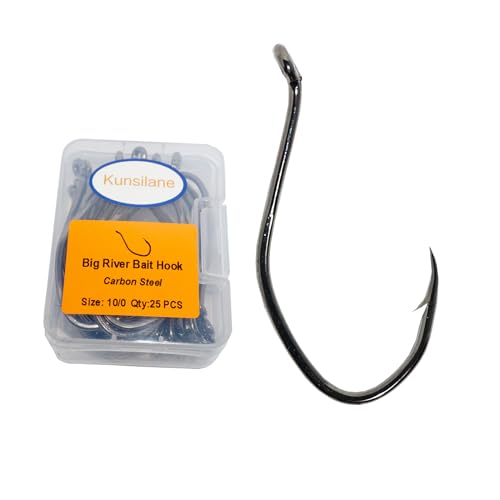
As an Amazon Associate we earn from qualifying purchases at no extra cost to you.
The best choice depends on bait size, catfish species, current, and whether you are using a circle, J, treble, or specialty bait hook. The hook should hold the bait securely while leaving enough point and gap exposed for a reliable hookup.
Standard Sizes
The measurements below are practical estimates for common catfish hooks. Exact dimensions vary by manufacturer, wire thickness, bend, point style, and whether the hook is a circle or J pattern. “Gap” means the inside distance from the hook shank to the point; “overall length” measures from the eye to the end of the point or bend area.
| Hook size | Approx. overall length | Approx. gap | Best bait or use |
|---|---|---|---|
| #10 | 0.55 in (1.4 cm) | 0.20 in (0.5 cm) | Small dough bait, dip bait, tiny creek bait |
| #6 | 0.75 in (1.9 cm) | 0.28 in (0.7 cm) | Small worms, small pieces of liver, channel catfish |
| #2 | 1.00 in (2.5 cm) | 0.40 in (1.0 cm) | Worm bundles, shrimp, small cut bait |
| 1/0 | 1.20 in (3.0 cm) | 0.50 in (1.3 cm) | Chicken liver, dip bait, small live bait |
| 2/0 | 1.35 in (3.4 cm) | 0.60 in (1.5 cm) | Cut bait and average-size live bait |
| 3/0 | 1.55 in (3.9 cm) | 0.70 in (1.8 cm) | Shad chunks, shrimp, bluegill under about 4 in |
| 4/0 | 1.75 in (4.4 cm) | 0.80 in (2.0 cm) | Large cut bait and medium live bait |
| 5/0 | 2.00 in (5.1 cm) | 0.90 in (2.3 cm) | Large channel cats and blue catfish |
| 7/0 | 2.35 in (6.0 cm) | 1.05 in (2.7 cm) | Large live bait, heavy current, big blue cats |
| 10/0 | 2.80 in (7.1 cm) | 1.25 in (3.2 cm) | Very large bait and trophy flathead fishing |
For dough, punch, and dip bait, a smaller hook can work because the bait is molded around the shank. Size #6 through 1/0 is common for small channel catfish, while #2/0 through #5/0 is more versatile for general catfishing. A product such as a size #10 spring-style bait hook may suit compact dough bait, but it is usually too small for a large piece of cut shad or a live bluegill.
Circle hooks are often preferred when fishing natural bait because they can catch in the corner of the fish’s mouth when the angler allows the line to tighten rather than making a hard, traditional hookset. Check local regulations before fishing; some waters require circle hooks for specific catfish fisheries.
How to Measure Your Space
Instead of choosing a hook by bait weight alone, measure the amount of room the hook needs to work. The critical space is the hook gap around the bait, not simply the total length of the hook.
- Measure the bait’s thickest point. A two-inch chunk of skipjack may be thin enough for a 3/0 hook, while a two-inch-wide piece of carp may need a 5/0 or 6/0.
- Compare bait width with the hook gap. As a general rule, the exposed gap should be at least 1/4 inch (0.6 cm) wider than the bait’s thickness. For bulky bait, allow closer to 1/2 inch (1.3 cm).
- Leave the point exposed. Do not bury the point in liver, dough, or a thick strip of cut bait. The point and barb need a clear path to the fish’s mouth.
- Check the hook eye and leader clearance. A thick leader knot, swivel, or snell should not press against the bait or restrict the hook’s turning motion.
- Test the rig in shallow water. Pull the bait gently through the water. If it spins excessively, hides the point, or slips down the shank, adjust the bait or move up one hook size.
- Match hook strength to tackle. Heavy wire helps with large fish and rough cover, but an oversized, heavy hook can make small live bait sluggish and reduce natural movement.
By Room or Use Case
Small channel catfish and dough bait
Choose size #6 through 1/0 for small channel cats in ponds, creeks, and stocked lakes. A #10 hook can work with a small ball of prepared bait, but it offers limited gap for a fish with a larger mouth. A spring or bait-holder design can keep soft dough attached longer. Retail packs in this category commonly cost about $7 to $12, depending on quantity and specialty features.
Chicken liver, shrimp, and worms
A size 1/0 to 3/0 hook is a reliable starting range. Use the smaller end for a single shrimp, thin liver strip, or one worm. Use 2/0 or 3/0 when threading several worms together or adding a thicker liver piece. Bait-holder barbs, spring coils, and short-shank designs can help, but do not cover the entire hook point.
Cut bait for blue catfish
For chunks of shad, skipjack, carp, or white perch, use a 3/0 to 6/0 circle hook. Size 4/0 is a useful general-purpose choice for medium cut bait. Move to 5/0 or 6/0 when the bait is thick, the current is strong, or larger blue catfish are the target. A durable hook and abrasion-resistant leader are more important than simply selecting the biggest available hook.
Live bait for flathead catfish
Flathead anglers commonly use 5/0 through 10/0 hooks, depending on the live bait’s size and local rules. A 5/0 or 6/0 may fit a small bluegill or other baitfish, while an 8/0 or 10/0 can provide the gap needed for a larger bait. Hook the baitfish lightly through the lips, nose, or behind the dorsal fin according to the rig and current. Avoid a hook so heavy that it quickly weakens or kills the bait.
Treble hooks and dip bait tubes
Treble-hook rigs and vented dip-bait tubes are designed to hold soft, scented bait rather than present a large live or cut bait. They can be useful for channel catfish, especially when casting prepared bait. A multipack with several trebles and tubes may cost roughly $8 to $15. These rigs are not a direct substitute for a large single circle hook when targeting trophy blue or flathead catfish.
Common Sizing Mistakes
- Confusing #10 with 10/0: These are nearly opposite ends of the sizing system. #10 is very small; 10/0 is very large.
- Covering the hook point: More bait does not always mean more bites. Concealing the point can prevent a solid hookup.
- Using a giant hook for small bait: An oversized hook can overpower live bait and make prepared bait fall apart during a cast.
- Choosing by fish length only: Bait thickness and the fish’s mouth size matter more than a predicted weight.
- Ignoring hook style: A 4/0 circle hook, J hook, and treble hook can have noticeably different gaps and overall dimensions.
- Forgetting local regulations: Hook type, baitfish, treble hooks, and circle-hook requirements vary by state and waterway. Check the current rules before fishing in 2026.
FAQ
What is the best all-around catfish hook size?
A 3/0 or 4/0 circle hook is a practical all-around choice for cut bait, shrimp, chicken liver, and medium live bait. Choose 2/0 for smaller bait and 5/0 or larger for bulky bait or bigger fish.
Is a 10/0 hook too big for catfish?
It is too large for most small channel-catfish bait, but it can be suitable for trophy flathead or blue catfish with large live bait. The bait should be large enough that the hook gap remains open and the point stays exposed.
What size hook should I use for catfish dip bait?
Use size #6 through 1/0 for compact dough or dip bait, or select a purpose-built dip-bait tube with a treble hook. For larger catfish and thicker bait, move up to size 1/0 or 2/0.
Are circle hooks better for catfish?
Circle hooks can be very effective with natural bait because they often lodge in the corner of the mouth when the fish moves off under steady tension. They require a smooth lift or reel-down motion instead of a forceful snap. Always follow applicable fishing regulations.



Write Your Review
No reviews yet. Be the first to share your experience!