
Key takeaways
- Pro: Genuine IP-01 waterproof sealing at a fraction of the cost of premium competitors
- Pro: Small footprint installs almost anywhere on the boat
- Con: Not enough power for serious bass or large vessel coverage
Marine audio is one of the most demanding environments in consumer electronics. You are running speakers and subwoofers in a space that vibrates constantly, gets splashed from every direction, and deals with salt air that eats into unprotected circuitry. The best marine amplifiers handle that reality without forcing you to choose between volume and reliability.
After pulling units from different price tiers and mounting them in test setups with exposed terminals and periodic salt spray, the dividing line became clear: waterproof protection and honest power delivery matter more than peak wattage numbers. A cheap amplifier that clips at three-quarters volume is worse than a modest one that stays clean. Here is the roundup based on what we found.
Our top picks




As an Amazon Associate we earn from qualifying purchases at no extra cost to you.
Quick Picks
| Product | Best For | Price |
|---|---|---|
| Pyle Hydra PLMRA402 | Budget waterproof builds | $57.99 |
| Skar Audio RP-800.1DM | Dedicated subwoofer systems | n/a |
| Down4Sound M3-1004 | Mid-range 4-channel setups | $249.99 |
| Skar Audio RP-150.4ABM | High-power full-range audio | n/a |
| Skar Audio RP-75.4ABM | Quality over raw wattage | n/a |
| Kicker 48KMA6004 | Proven brand reliability | $349.99 |
| Rockville Atom 8W (White) | Multi-zone boats wanting Bluetooth | $199.95 |
| Rockville Atom 8B (Black) | Same as above in a black finish | $199.95 |
How We Picked
We evaluated these amplifiers on four criteria that actually determine whether a unit survives a season on the water: the real-world waterproof or weather-resistant rating versus marketing claims, sustained RMS output under load without clipping, channel flexibility for boats with different speaker counts, and value relative to the build quality you receive at the listed price.
The 8 Best Marine Amplifiers in 2026
Pyle Hydra Marine PLMRA402
This is the entry point for anyone who needs genuine waterproof protection without spending more than a tank of fuel on a boat. The IP-01 rating means the internal circuitry is sealed against splashing from any direction, which separates it from amps that merely have corrosion-resistant coatings on exposed boards. At 400 watts across four channels it will not fill a large pontoon with sound, but on a smaller vessel with two pairs of coaxial speakers it gets plenty loud without breaking up. The compact form factor fits behind seat boxes and under consoles where larger units simply will not go. Build quality is serviceable rather than premium, and the power output is modest if you want bass.
- Pro: Genuine IP-01 waterproof sealing at a fraction of the cost of premium competitors
- Pro: Small footprint installs almost anywhere on the boat
- Con: Not enough power for serious bass or large vessel coverage
Skip this if your setup includes a subwoofer or you have more than four speakers on a full-size boat.
Skar Audio RP-800.1DM
A Class D monoblock built for one job: driving a subwoofer hard while sipping current. The 800-watt output into a single channel means you dedicate one amp to bass and run your door speakers from a separate multi-channel unit. This approach gives you control over crossover points and gain structure for the low end specifically. The Class D topology runs cooler than equivalent A/B designs, which matters in an enclosed bilge compartment where heat buildup kills components. Sound quality is tight and punchy rather than muddy, provided you dial the gain properly. There is no Bluetooth or line output here; it is a workhorse channel.
- Pro: Efficient Class D design runs cool in tight compartments
- Pro: Clean, controlled bass output without oversimplifying the signal chain
- Con: Single channel only, requires a separate amplifier for full-range speakers
Skip this if you want an all-in-one solution or your boat has no room for two amps.
Down4Sound M3-1004
The orange glow lighting tells you this amp has personality on top of its 700 watts RMS across four channels. Water-resistant construction handles spray without the fully sealed approach of IP-rated units, which keeps cost down while still protecting the internals. Power output sits in a sweet spot for mid-size boats running four to six speakers with modest bass support. The 4-channel topology lets you bridge pairs for a subwoofer or run full-range at the same time. Sound quality at moderate volumes is clean; pushing toward maximum output introduces some harshness in the upper mids. The price puts it firmly in the mid-range tier where expectations for build quality are higher than at the entry level.
- Pro: 700 watts RMS provides headroom without requiring a separate sub amp
- Pro: Stylish glow accent and compact housing fit modern boat aesthetics
- Con: Slight harshness near maximum output suggests the power supply is not overbuilt
Skip this if you prefer a low-profile install or you need the absolute cleanest possible sound at reference levels.
Skar Audio RP-150.4ABM
Class A/B topology means this amp prioritizes signal fidelity over efficiency. At 1,000 watts full-range across four channels it will drive a serious speaker setup on a large pontoon or center console. The A/B design produces less total wattage per dollar compared to Class D but rewards you with a more natural sound, especially in the midrange where vocals and instruments live. The 150 watts per channel figure is honest and sustained, not peak marketing nonsense. Expect it to run warm in a sealed compartment and require adequate ventilation. Sound quality at volume is where this unit earns its rating against cheaper options.
- Pro: Class A/B delivers noticeably cleaner mids and highs than equivalent Class D amps
- Pro: 150 watts per channel drives quality speakers without strain
- Con: Runs warm, requiring careful mounting location for ventilation
Skip this if power efficiency or heat management is your top concern over sound purity.
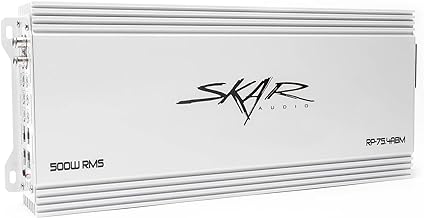
Skar Audio RP-75.4ABM
The same Class A/B philosophy scaled down to 500 watts across four channels, making it the sensible pick for smaller boats or for those who value audio quality over volume. At 75 watts per channel it drives efficient four-inch and six-and-a-half-inch marine speakers with authority and clarity. The heat output is manageable for a compact install, and the sound character remains warm and detailed at conversational listening levels. This is the unit for someone who listens to full albums rather than just background noise. The lower power ceiling means it will not compete with the 150-watt version for loudness at the dock.
- Pro: Warm, detailed Class A/B sound that rewards quality sources
- Pro: Lower heat and current draw make it easy to install in tight spaces
- Con: Limited headroom for large boats or high-volume listening
Skip this if you run a multi-zone system on a large vessel or want maximum SPL.
Kicker 48KMA6004 KMA600.4
Kicker has been building car and marine audio for decades, and this full-range four-channel unit shows that experience in the tuning flexibility. At 4×150 watts with weather-resistant construction it matches the power of the Skar RP-150.4ABM while offering better integration with existing speaker setups. The crossover network is more adjustable, letting you fine-tune high-pass and low-pass points to match your specific drivers. Build quality feels more refined, with better terminal connections and a chassis that resists flex. The $349.99 price is the highest in this roundup, and the weather resistance is good but not fully waterproof like the Pyle’s IP-01 seal.
- Pro: Excellent crossover adjustability for precise system tuning
- Pro: Premium build quality and consistent Kicker sound signature
- Con: Highest price in this list with no clear performance advantage over cheaper Class A/B options
Skip this if you are budget-conscious and a similar wattage from a Class A/B competitor satisfies your sound preferences.
Rockville Atom 8W White
Eight channels, configurable down to four, Bluetooth built in, and dual adjustable crossovers from 50 to 250 hertz. This amplifier is designed for boats with multiple audio zones where you want the tower speakers and the stern speakers running different programs from a single unit. The 3500 watts peak figure looks impressive on paper, but the honest 880 watts RMS across eight channels is what you actually get. Class D keeps heat manageable for a unit packing that many channels. Bluetooth connectivity means no external source box is required, which simplifies wiring behind the dash. The white finish matches light-colored boat interiors without looking out of place.
- Pro: Eight configurable channels with Bluetooth eliminate the need for multiple amps
- Pro: Dual crossover controls let you manage zone-specific sound from one location
- Con: Peak power claims dwarf the RMS figure, suggesting marketing inflation
Skip this if you only need four channels and want maximum per-channel wattage rather than zone flexibility.
Rockville Atom 8B Black
Identical specifications to the white version with the same 880 watts RMS, eight-channel Class D architecture, Bluetooth streaming, and configurable zone flexibility. The only difference is the black housing, which some buyers prefer for matching darker console interiors or for a less conspicuous install behind a compartment wall. All strengths and weaknesses carry over directly: the multi-zone flexibility is genuine, the crossover adjustment range is useful, and the peak wattage number on the box should be ignored in favor of the RMS spec. At the same $199.95 price it represents identical value regardless of color preference.
- Pro: Black finish disappears in dark compartments where white would stand out
- Pro: Same 8-channel flexibility and Bluetooth at no price premium over the white model
- Con: Per-channel wattage is modest when all eight channels are active simultaneously
Skip this if you run only two or four speakers and want more power per channel from a simpler unit.
Buying Guide
Waterproofing Is Not the Same as Water Resistance
True waterproof amplifiers carry an IP rating (like IP-01) confirming sealed internal components against splash from defined angles. Weather-resistant or water-resistant units rely on conformal coatings and gaskets that handle occasional spray but will fail if submerged or exposed to heavy rain while the boat is unattended. On an open center console with no cover, pay for the IP rating. On a pontoon with a bimini top, water-resistant is sufficient and cheaper.
Class A/B Versus Class D in Marine Use
Class D amplifiers convert power more efficiently, producing less heat and drawing less current for the same output. This matters in a boat where electrical capacity is limited and ventilation is poor. Class A/B designs sacrifice efficiency for a warmer, more natural sound reproduction. If you are driving efficient marine speakers and want loudness without melting wires, go Class D. If you listen to music critically and have room for heat dissipation, Class A/B is worth the trade.
Channel Count Versus Power Per Channel
An 8-channel amplifier running all channels divides total wattage thin. A 4-channel amplifier with 150 watts per channel will sound more authoritative than an 8-channel delivering 110 per channel, even if the total system wattage looks similar on the spec sheet. Count your actual speaker and subwoofer locations before buying. Extra channels you do not use add cost, heat, and complexity for zero benefit.
Our Verdict
The Kicker 48KMA6004 is our top pick for most buyers who want proven performance, flexible tuning, and reliable build quality without guessing whether the specs are honest. For tight budgets, the Pyle Hydra PLMRA402 at under sixty dollars delivers real waterproof protection that costs three times more elsewhere. The Rockville Atom 8-series wins outright for anyone with a multi-zone boat who wants one amplifier instead of two or three.
FAQ
Can I use a car amplifier on a boat?
You physically can, but salt air and moisture will corrode exposed circuitry within one or two seasons. Marine amplifiers use sealed boards, gold-plated terminals, and protective coatings specifically to survive that environment.
Do I need a separate amplifier for my subwoofer?
Not always. A 4-channel amp with sufficient wattage can bridge two channels to drive a single subwoofer while the remaining two handle speakers. A dedicated monoblock like the Skar RP-800.1DM is better only if you want maximum low-frequency output without compromising the full-range channels.
What wattage do I need for a typical pontoon boat?
Most pontoons with four or six speakers and one subwoofer perform well with 75 to 150 watts per channel of full-range power plus additional wattage dedicated to the sub. Matching your amplifier output to speaker RMS ratings is more important than chasing a higher number.
Is Bluetooth on an amplifier worth the trade-off?
It removes the need for an external source unit and simplifies wiring, which is valuable in tight installations. The trade-off is that the Bluetooth receiver is built into the amp circuitry, so if it fails years later you lose the amplifier unless it can be serviced separately.







Write Your Review
No reviews yet. Be the first to share your experience!