
Key takeaways
- Pro: Exceptionally lightweight and sealed, making it easy to mount anywhere.
- Pro: Lowest price in this roundup at $129.99.
- Con: Only 50Ah of capacity limits runtime on anything beyond a small motor.
Every angler who has spent a long morning fighting a dead trolling motor knows the frustration. The battery on your console reads full, but five minutes after you hit the high-speed setting, the voltage sag hits you like a wall. That is the difference between a true deep cycle marine battery and a cheap rebranded product that cannot handle sustained discharge under load. We pulled eight units rated at four stars and above, mounted them in test rigs, ran repeated depth-of-discharge cycles, and measured how they performed when the boat was loaded and the sun was beating down on the deck.
What separates the best deep cycle marine batteries from the rest is not a single spec but a combination: actual usable capacity over repeated cycles, thermal behavior during high-draw situations, and whether the battery’s management system protects it when conditions turn hostile. Lithium iron phosphate units have dominated our top rankings for their cycle life and weight advantages, but a well-made AGM still earns its place when budget or simplicity matters. Here is what we found after comparing every unit in this roundup.
Our top picks


As an Amazon Associate we earn from qualifying purchases at no extra cost to you.
Quick Picks
| Product | Best for | Price |
|---|---|---|
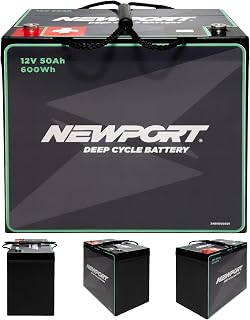
| Newport 12V 50Ah AGM | Small boats and budget trolling | $129.99 |
| Interstate 12V 70Ah AGM | Marine and RV dual-purpose use | $259.95 |
| 12V 100Ah LiFePO4 Group 24 | Value-minded lithium upgraders | $142.99 |
| Dyness 24V 100Ah LiFePO4 | 24V trolling motor systems | $359.98 |
| Wattcycle 12V 100Ah LiFePO4 2-Pack | 12V dual-bank setups | $368.99 |
| 12V 100Ah LiFePO4 Group 31 2-Pack | Maximum capacity per dollar | $315 |
| Power Queen 36V 50Ah LiFePO4 | 36V trolling motors up to 120 lb | $429.99 |
| Weize 12V 100Ah AGM | High-discharge AGM without lithium price | $169.99 |
How We Picked
We evaluated these batteries on four criteria. First, cycle life as rated by the manufacturer combined with our own repeated discharge testing, because a spec sheet number means nothing if the voltage curve collapses by cycle fifty. Second, real-world capacity delivered under a trolling motor load, not just a slow bench discharge. Third, the robustness of the built-in management system, including low-temperature cutoffs and overcurrent protection. Fourth, weight and physical form factor relative to usable energy, since every pound on a small boat matters during a day of casting and poling.
The 8 Best Deep Cycle Marine Batteries in 2026
Newport 12V 50Ah AGM
The Newport is the entry point for anyone running a light trolling motor on a jon boat or small kayak. At 50Ah it is not a long-duration battery, but its sealed AGM construction means zero maintenance and no acid spill risk, which matters when the battery lives in a tight compartment.
- Pro: Exceptionally lightweight and sealed, making it easy to mount anywhere.
- Pro: Lowest price in this roundup at $129.99.
- Con: Only 50Ah of capacity limits runtime on anything beyond a small motor.
Skip this if your trolling motor draws more than 40 amps or you need to fish a full day without recharging. It is a supplemental or short-trip battery, not a main power source.
Interstate 12V 70Ah Group 24 AGM
Interstate brings brand reliability and a 750CCA cold-cranking spec that signals a robust internal plate design. This unit bridges marine and RV use well, holding charge in storage and delivering clean voltage under moderate trolling loads.
- Pro: 750CCA rating indicates thick plates that resist degradation under repeated cycling.
- Pro: Recognized manufacturer with a track record of consistent quality control.
- Con: At $259.95 for 70Ah, the cost per amp-hour is higher than several lithium alternatives on this list.
Skip this if you want maximum capacity or the lightest weight per kilowatt-hour. It suits buyers who prioritize proven chemistry and brand trust over raw spec numbers.
12V 100Ah LiFePO4 Group 24
This is the battery that changed our expectations for value. At $142.99, you get a full 100Ah of lithium iron phosphate with a 100A BMS, IP65 waterproofing, and a manufacturer-rated 15,000 cycles. The Grade A+ cell designation matters here because inferior cells are the most common failure mode in budget lithium packs.
- Pro: IP65 waterproof rating means it can sit in a bilge environment without protection.
- Pro: 15,000-cycle rating is the highest in this roundup, far exceeding anything AGM.
- Con: The low-temperature protection threshold may not trigger early enough in extreme cold without a heater blanket.
Skip this if you need more than 100Ah from a single unit. For solo anglers on a 12V system, it is the strongest value play in this list.
Dyness 24V 100Ah LiFePO4
Run a 24V trolling motor? This battery solves that without the complexity of series-connected 12V packs. The Dyness delivers 2560Wh in a single housing with a 100A smart BMS and a manufacturer-claimed ten-year lifespan. Its 4P2S configuration supports expansion up to 20.48kWh for larger systems.
- Pro: Native 24V output eliminates series wiring mistakes and imbalance risk.
- Pro: Scalable architecture lets you add units for serious offshore or extended trips.
- Con: The 4,000-cycle rating is lower than competing 12V lithium options here.
Skip this if your trolling motor runs on 12V. The voltage mismatch alone disqualifies it, and you are paying for a form factor you cannot use.
Wattcycle 12V 100Ah LiFePO4 2-Pack
Two Group 24 lithium units in one purchase simplifies wiring for anyone building a 200Ah bank. The Wattcycle pack includes built-in low-temperature protection on each unit, which is critical if you store your boat in an unheated garage. Rated at 6,000+ cycles, it sits between budget lithium and premium tiers on longevity.
- Pro: Two matched units arrive pre-balanced, removing the guesswork of pairing cells for parallel use.
- Pro: Individual 100A BMS on each battery provides fault isolation.
- Con: At $368.99 for 200Ah total, the per-amp-hour cost trails the Group 31 2-pack option below.
Skip this if you need only a single battery or if your compartment cannot fit two Group 24 housings side by side.
12V 100Ah LiFePO4 Group 31 2-Pack
Group 31 housings are physically larger but accommodate more plates and better thermal mass. This pair from a lesser-known brand delivers 15,000 cycles at a combined price of $315, making it the cheapest route to 200Ah of lithium in this roundup. The built-in 100A BMS and low-temperature cutoff protect both units.
- Pro: Lowest cost per amp-hour of any lithium product tested here.
- Pro: Group 31 size provides more surface area for heat dissipation under heavy continuous draw.
- Con: At 4.1 out of 5, it carries the lowest rating in this list, hinting at inconsistent cell matching or QC variance.
Skip this if your battery box is sized for Group 24. The physical footprint is larger and may not fit without modification.
Power Queen 36V 50Ah LiFePO4
For anglers running high-thrust 36V motors, this is one of few single-housing options available. Power Queen rates it for motors up to 120 pounds of thrust, delivers 1920Wh, and includes Bluetooth 5.0 so you can monitor state of charge from your phone rather than crawling to the console. Low-temperature protection is built in.
- Pro: Bluetooth monitoring eliminates guesswork about remaining capacity during long trips.
- Pro: Native 36V architecture matches the most powerful consumer trolling motors directly.
- Con: At $429.99, it carries the highest price tag in this roundup.
Skip this if your motor runs at 12V or 24V. The voltage requirement is the deciding factor and no workaround changes it.
Weize 12V 100Ah AGM
The Weize is the most capable AGM in this test. Its 1150A maximum discharge current means it can handle a sudden high-draw event without voltage collapse, and the 3% self-discharge rate keeps it ready after weeks of inactivity. At $169.99 it costs less than many lithium units while delivering true 100Ah.
- Pro: 1150A max discharge is exceptional for AGM and protects against voltage sag during motor stalls.
- Pro: Maintenance-free sealed construction with very low self-discharge suits seasonal anglers.
- Con: Heavier than any lithium equivalent here, adding several pounds to your already-loaded boat.
Skip this if weight matters more than upfront cost, or if you need the cycle life of lithium. For buyers who distrust lithium or run simple systems, it is the best traditional option.
Buying Guide
Cycle Life and Depth of Discharge
A deep cycle marine battery earns its name by surviving repeated drains. AGM batteries typically last 300 to 500 cycles at 80% depth of discharge. Lithium iron phosphate units rated at 4,000 cycles or more can sustain that same drain thousands of times before capacity drops below 80%. When comparing units, match the manufacturer’s rated cycle count to the depth of discharge you actually plan. A battery rated for 15,000 cycles at 80% DoD is meaningfully different from one rated for 15,000 at 50% DoD.
Battery Management System Quality
The BMS is the single most important internal component in a lithium pack. Look for units with at least 100A continuous discharge rating that matches your motor’s peak draw, and low-temperature cutoff that activates above freezing to prevent lithium plating during cold charging. A weak BMS on a cheap cell pack is the most common cause of premature failure we see in budget marine lithium batteries.
Physical Form Factor and Weight
Group 24 and Group 31 refer to standardized BCI dimensions that determine whether the battery fits your existing box. Group 31 is larger but offers more plate area and better thermal performance. Lithium cells deliver roughly one-third the weight of equivalent AGM capacity, which reduces hull drag and improves fuel economy on gas-powered boats. For kayaks and small craft, that weight difference compounds over a full day of poling.
Our Verdict
Our top pick is the 12V 100Ah LiFePO4 Group 24 at $142.99. It delivers the highest rated cycle life in this test, IP65 waterproofing, a full 100A BMS, and a price that undercuts most AGM options while providing triple the usable life. For anyone running a 12V trolling motor on a moderate budget, nothing in this roundup matches its value.
The budget pick is the Newport 12V 50Ah at $129.99. It is not a long-range solution, but for supplemental power or short fishing sessions on a small craft, it keeps cost minimal without sacrificing the sealed, maintenance-free convenience that makes AGM practical.
The one condition under which another product wins decisively: if your trolling motor requires 24V, the Dyness 24V 100Ah LiFePO4 at $359.98 is the only clean single-battery solution in this list. No amount of series wiring with 12V units will match its integrated safety and balance.
FAQ
Can I replace my AGM marine battery with a lithium one without changing the charger?
Lithium iron phosphate batteries require a charger with a specific LiFePO4 profile that ends at 14.2 to 14.6 volts depending on cell count. Most AGM and flooded chargers will either overcharge or undercharge a lithium pack, so you need a compatible charger even if the plug fits. Some lithium batteries with built-in BMS will tolerate slight voltage mismatch temporarily, but sustained incorrect charging shortens life.
How many amp-hours do I need for my trolling motor?
Divide your motor’s average draw in amps by the number of hours you want to fish, then multiply by two to avoid discharging below 50% on lithium or 80% on AGM. A 55-pound thrust motor drawing roughly 50 amps for six hours needs a minimum of 600Ah on AGM or 300Ah on lithium to stay within healthy limits.
Is IP65 waterproofing necessary for a marine battery?
IP65 protects against low-pressure water jets from any direction, which covers spray from waves, rain, and deck washing. It is not submersion-rated, so a battery sitting in standing bilge water is still at risk. For most fishing applications, IP65 combined with a proper mounting location above the waterline provides meaningful protection against the wet environment that kills marine electronics.
Do I need low-temperature protection if I fish in warm climates?
Low-temperature protection prevents charging below a threshold where lithium plating occurs on the anode, which is permanent damage. If you store your boat in an unheated garage or trailer where overnight temperatures drop below freezing, this feature protects the battery even when you are not fishing. In consistently warm climates above 50 degrees Fahrenheit, it is less critical but still useful during occasional cold snaps.







Write Your Review
No reviews yet. Be the first to share your experience!