
Choosing the right power source for your boat often feels like wading through an endless swamp of marketing jargon, deceptive capacity ratings, and conflicting advice from dockside experts. Whether you are rigging a high-thrust trolling motor, running multi-screen live-sonar electronics, or simply trying to ensure your house loads do not leave you stranded miles off the coast, your deep cycle battery bank is the foundation of your time on the water. Investing in the wrong configuration does not just waste cash; it causes cutouts in heavy current, forces premature replacements, and cuts fishing trips short.
In this guide, we strip away the spec-sheet noise to focus on what genuinely impacts on-water performance, cycle longevity, and onboard safety. We will break down the chemistries available today, explain which battery metrics dictate real runtime, outline sizing math that prevents mid-day voltage sag, and highlight the critical system compatibility checks you must make before bolting anything into your bilge.
As an Amazon Associate we earn from qualifying purchases at no extra cost to you.
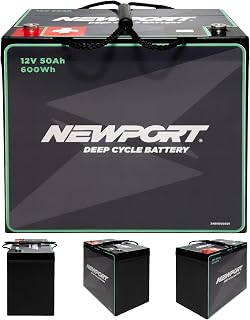
Chemistries Compared: Flooded Lead-Acid vs. AGM vs. LiFePO4
Deep cycle marine batteries are broadly categorized into three core chemistries: traditional flooded lead-acid, Absorbed Glass Mat (AGM), and Lithium Iron Phosphate (LiFePO4). Traditional flooded batteries remain the lowest initial cost entry point. However, they demand routine maintenance, including topping off electrolyte levels with distilled water, ensuring upright installation to avoid acid spills, and accepting a heavy weight penalty relative to usable energy.
AGM batteries improve significantly on flooded designs by suspending the electrolyte in fiberglass separators. They are completely sealed, spill-proof, resistant to heavy chop and hull vibration, and support a noticeably lower self-discharge rate when parked in off-season storage. Still, they remain heavy and share the primary drawback of all lead platforms: drawing them down past half their nominal capacity degrades their service life rapidly.
Lithium Iron Phosphate (LiFePO4) has evolved into the dominant standard for performance boaters. While the upfront investment is significantly higher, LiFePO4 cells deliver true deep cycling capabilities down to full discharge without immediate cellular damage, shed roughly sixty percent of the weight of lead-acid equivalents, and sustain a flat discharge curve that prevents performance drop-offs as the day wears on.
The Specs That Actually Dictate Real-World Runtime
Manufacturer spec sheets feature dozens of acronyms, but only two directly dictate your fishing runtime: Amp-Hours (Ah) and usable Depth of Discharge (DoD). Amp-hours measure the total current volume a battery can supply over a standardized duration, typically twenty hours. A higher Ah number translates to a larger fuel tank for your electronics and motors.
However, Ah ratings are meaningless without understanding usable Depth of Discharge. A 100Ah lead-acid or AGM battery should realistically only be discharged to fifty percent of its rating to avoid cutting its operational lifespan short, leaving you with roughly 50Ah of practical power. Conversely, a quality 100Ah LiFePO4 battery safely yields ninety to one hundred percent of its listed capacity. Do not compare batteries based solely on the face-value Ah stamped on the label without calculating the true usable energy after factoring in DoD.
Specs You Can Safely Ignore (And One You Must Not)
Cold Cranking Amps (CCA) and Marine Cranking Amps (MCA) are critical metrics for an engine-starting battery, measuring burst current delivery over a span of thirty seconds. For a true deep cycle bank powering accessories or an electric trolling motor, high CCA numbers are completely irrelevant. Marketing that touts massive cranking power on a deep cycle unit often indicates thinner internal lead plates, which sacrifice long-term cyclical endurance to achieve brief high-current bursts.
The metric you cannot ignore is the Continuous Discharge Current rating, enforced by the Battery Management System (BMS) in lithium packs. Trolling motors at full throttle draw steady, high amperage over extended runs. If your motor pulls fifty-five continuous amps at peak output, but your chosen battery’s internal circuitry caps continuous current at fifty amps, the safety mechanism will trip, killing power instantly while you are navigating heavy currents or holding position on structure.
Sizing Your Bank for Modern Electronics and Motors
Modern fishing layouts put immense strain on battery banks, especially configurations with multiple large chartplotters, continuous networking hubs, and forward-facing sonar black boxes. To size your house system properly, calculate the combined amp draw of your electronics and multiply that figure by your target hours of operation. Running three multi-function displays and an active sonar module commonly draws between five and eight amps continuously, draining forty to sixty amp-hours across an eight-hour tournament day.
Trolling motors demand their own dedicated power strategy. For twelve-volt, twenty-four-volt, or thirty-six-volt trolling platforms, system voltage dictates the required series wiring, but overall battery capacity dictates operational time. Running undersized banks under continuous wind or current causes severe voltage sag, resulting in reduced thrust output and premature low-voltage cutoffs on modern digital motor controls.
Critical Charger and Alternator Compatibility Checks
Dropping upgraded battery chemistry into a boat without evaluating your charging infrastructure is a recipe for ruined equipment. Lead-acid, AGM, and LiFePO4 chemistries demand distinct multi-stage charging algorithms. Pumping an aggressive lead-acid equalization charge into an AGM battery dries out its internal mats, while using a standard lead charger on lithium cells often fails to fully saturate the pack or trigger necessary cell-balancing routines.
If you connect your house or deep cycle bank to an outboard charging lead or an onboard DC-to-DC alternator charging system, verify that the current regulator matches your battery specifications. Older marine alternators can overheat when tasked with dumping unrestricted current into hungry, low-resistance lithium banks, making dedicated DC-to-DC chargers essential for protecting your engine components.
When to Spend More and When to Save
Investing in top-tier lithium technology makes undisputed sense if boat weight directly compromises hull drafting, shallow-water capability, or trailering balance. It is also the correct path for anglers running power-dense electrical rigs who log dozens of high-draw days per season, where the thousands of cycle lives amortize the premium price over time.
Conversely, spending top dollar on advanced chemistries is poor value for casual weekend boaters running modest setups consisting of an aerator pump, running lights, and a single modest fishfinder. For these low-draw duties, an affordable, rugged AGM battery provides reliable operation, zero maintenance, and exceptional value without the requirement of overhauling your existing charging electronics.
Related Guides
To view our hands-on field testing results and discover which models survived our rigorous on-water evaluations, check out our roundup of the best deep cycle marine batteries in 2026, or explore chemistry-specific options with our dedicated guide to the best lithium marine batteries available for modern boaters.
FAQ
Can I mix different battery brands or chemistries in the same bank?
No, you should never mix different battery chemistries, capacities, or ages within the same battery bank. Incompatible internal resistances and charging characteristics will cause uneven power distribution, chronic undercharging, and rapid premature cell failure.
What is the difference between a dual-purpose and a true deep cycle battery?
A true deep cycle battery utilizes thicker plates engineered specifically to endure repeated, heavy discharges over long durations. Dual-purpose batteries compromise between plate thickness and surface area to offer modest starting power alongside light cycling duty, making them less durable for sustained trolling motor or house loads.
Do I need a special battery tray for marine-grade installations?
Yes, marine applications require acid-resistant, mechanically secured trays or tie-down boxes that comply with Coast Guard regulations. Securing your batteries prevents heavy physical shock damage from boat wake and stops shifting that can short-circuit high-amperage terminals.
How cold is too cold to charge a lithium deep cycle battery?
Standard LiFePO4 cells should never be charged when the internal cell temperatures fall below freezing (32 degrees Fahrenheit or 0 degrees Celsius). Attempting to force current into freezing lithium cells causes irreversible lithium plating on the anodes, destroying the pack unless it features an integrated internal heating element.








Write Your Review
No reviews yet. Be the first to share your experience!