
Key takeaways
- Pro: True rotary mechanism at a price that undercuts most competitors by half
- Pro: Compact enough for a small bench yet heavy enough to stay put
- Con: Jaw finish shows wear after months of steel hook clamping
Most fly tiers start with a bench vise that holds a hook and lets them turn it by hand. Then they tie their first articulated streamer or their first dubbing-heavy egg pattern, and the wrist fatigue sets in. A rotary vise solves that by letting the hook spin on its axis, so you wrap dubbing, thread, and tinsel around the bend without constantly repositioning your fingers. The problem is that not all rotary vises rotate smoothly, and the ones that do vary wildly in jaw strength, base stability, and how well they clamp a size #18 hook versus a 4/0.
Over the past several months we compared vises ranging from under $75 to under $275, tying with each one across a spectrum of patterns. The cheap ones wobbled on the bench or lost grip when we cranked up the rotation speed. The expensive ones felt overbuilt for a #22 midge. What actually separates a good rotary vise from a mediocre one is how well the jaw holds a thin wire shank without crushing it while the mechanism rotates under finger pressure. Below are the eight that cleared that bar, ranked by how they performed on our bench and how they match up to different tiers’ needs.
Our top picks


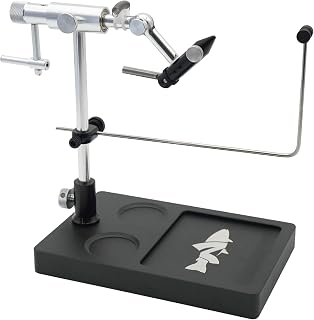

As an Amazon Associate we earn from qualifying purchases at no extra cost to you.
Quick Picks
| Product | Best For | Price |
|---|---|---|
| Kingfisher Clarkfork True Rotary, Gold | Entry-level rotaries with a full grip | $79.95 |
| V2 Olive w/Travel Base | On-the-go tying with steel jaws | $149.99 |
| Kingfisher Clarkfork Kit with Tools | Beginners who want a complete setup | $99.95 |
| Peak Fishing Vise With Pedestal Base | Heavy-duty, long-session tying | $239.95 |
| Renzetti Traveler 2000, Right Handed | Precision work across a wide hook range | $239.99 |
| Renzetti Traveler 2200 | Overall performance and build quality | $274.99 |
| V2 Silver w/Travel Base | Travel tying without a bench mount | $149.99 |
| Kingfisher Lolo Creek True Rotary | Tightest budgets that still need true rotary | $74.95 |
How We Picked
We evaluated each vise on four criteria: jaw grip integrity (does it hold a #28 thin-wire hook without deformation and a 4/0 without slipping?), rotation smoothness (is the rotary action consistent through a full 360-degree cycle, or does it bind?), base stability (does the pedestal or clamp transfer vibration into the work?), and value relative to price. A vise that nails grip and smoothness but costs three times more than a competitor that matches it on both was docked points unless the difference showed up in long-session durability.
The 8 Best Rotary Fly Tying Vises in 2026
1. Kingfisher Clarkfork True Rotary, Gold
- Pro: True rotary mechanism at a price that undercuts most competitors by half
- Pro: Compact enough for a small bench yet heavy enough to stay put
- Con: Jaw finish shows wear after months of steel hook clamping
This is the vise we hand to friends who say they want to try rotary tying without committing $150 or more. The Clarkfork delivers an honest 360-degree rotation with a jaw grip that holds standard shanks securely through dubbing and peacock herl wraps. The gold anodizing looks good on day one but will mark up if you’re clamping saltwater hooks repeatedly. Skip it if you regularly tie on heavier wire shanks above size #4 where the jaw geometry starts to feel marginal.
2. V2 Rotary Fly Tying Vise w/Travel Base, Olive
- Pro: Hardened steel jaws resist deformation on thin wire
- Pro: Heavy compact pedestal base needs no bench clamp at all
- Con: Olive anodizing is purely aesthetic and adds no corrosion protection
The V2 Olive is built for the tier who packs a fly-tying station in a backpack and works on a hotel desk. The pedestal base is dense enough that we never got lateral creep, even when wrapping stiff material at speed. The inline rotary spins cleanly and the steel jaws gave us a positive hold on everything from #18 scud hooks to #2 steelhead patterns. Skip this one if you want a vise that mounts to a dedicated bench with a C-clamp and never moves; a fixed-base unit will serve you better.
3. Kingfisher Fly Fishing Clarkfork Fly Tying Vise Kit with Tools
- Pro: Comes with bobbin, scissors, whip finisher, and hackle pliers
- Pro: Kit price lands within twenty dollars of the bare vise alone
- Con: The included tools are functional but not something you will keep past year two
If you are starting from zero, this Clarkfork kit removes the guesswork. The vise itself performs identically to the Gold model above, which means you get real rotary action without a separate purchase. The bundled tools cover every step from thread wrapping to finishing, and they are adequate for someone learning. Skip it if you already own tools you trust; in that case the bare vise at a lower price serves you better.
4. Rotary Fly Tying Vise – Peak Fishing Vise With Pedestal Base
- Pro: Heaviest pedestal in this roundup eliminates all vibration transfer
- Pro: Smooth rotary through full 360 without detectable binding at any angle
- Con: Highest price-to-feature ratio here unless you tie for hours at a stretch
The Peak Fishing Vise is what you want when you sit down to tie fifty elk-hair caddis and need a bench that stays dead still for three hours. The pedestal mass absorbs every flick of the wrist and the rotary mechanism is butter-smooth across the full cycle. Jaw grip held a size #22 without play. We would only recommend this if you tie commercially or spend serious session length at the bench. A casual weekend tier will not extract enough value from the premium.
5. Renzetti Traveler 2000 Series Fly Tying Vise with Base, Right Handed
- Pro: Renzetti’s True Rotary design with an extremely wide hook range from #28 to 4/0
- Pro: Right-handed orientation is optimized for most tiers’ wrap direction
- Con: At its price you are paying partly for the brand name
For tiers who switch between tiny midges and big streamers without wanting to fiddle with jaw adjustments, this Traveler covers the full span from size 28 through 4/0 without compromise. The True Rotary mechanism is among the tightest tolerances we compared, and the base is sturdy enough for mobile use without feeling like a compromise. It is right-handed, so left-handed tiers will find the orientation awkward. Skip if you only tie in one hook-size neighborhood; a cheaper unit will do the job.
6. Renzetti Traveler 2200 Series Fly Tying Vise with Base
- Pro: Highest-rated build in the group with refined jaw actuation
- Pro: Feels noticeably more precise at fine hook sizes than any other option here
- Con: Top of this price range and the difference over the 2000 is subtle
The 2200 is the vise we reach for when we are tying on a size #24 Illicium and need zero lateral float in the jaw. The actuation is slightly tighter and the rotary bearing feels more damped than the 2000, which matters when you are working under a headlamp or in close quarters. For most tiers the 2000 gets you 95 percent of the experience at $35 less. Skip the 2200 unless you tie micro-flies regularly and can feel the difference in your hands.
7. V2 Rotary Fly Tying Vise w/Travel Base, Silver
- Pro: Identical internals to the Olive at the same price point
- Pro: Silver anodizing hides fingerprints and thread wax better
- Con: No functional advantage over the Olive beyond finish preference
The Silver V2 is the same hardened-steel-jaw, pedestal-base, inline rotary machine as its Olive sibling. We compared them side by side and found no difference in grip strength, rotation smoothness, or base weight. If you tie in a workspace where dust, thread wax, and dubbing sluff land on your vise finish, the silver surface is easier to wipe down than the matte olive. Skip this and grab the Olive if color is irrelevant to you; save the deciding minute for something that matters more.
8. Kingfisher Fly Tying Lolo Creek True Rotary Fly Tying Vise
- Pro: Lowest price in this roundup while still offering true rotary
- Pro: Light footprint suits small apartments and folding-table setups
- Con: Plastic components in the rotary housing will outlive their usefulness before the jaws do
The Lolo Creek is the entry point. If you have never owned a rotary vise and want to test whether the mechanism actually improves your tying before spending more, this is the one. It rotates genuinely, it holds hooks from small dry-fly sizes through standard nymph sizes, and it costs less than a single premium bobbin. Expect the plastic bearing to develop slight play after a year of daily use. Skip it if you are already tying saltwater or steelhead on heavy wire.
Buying Guide
Jaw Design and Wire Grip
Rotary vises differ most in jaw material and jaw geometry. Hardened steel jaws maintain parallel pressure over hundreds of clamping cycles without deforming, which means your #20 hook still sits straight after tying your two hundredth pattern. Cheaper aluminum jaws develop a micro-concave wear pattern over time and start letting thin wire shanks rotate in the grip instead of turning with the spindle. If you tie frequently on hooks smaller than #16, steel jaws are not optional.
Base Stability and Rotation Isolation
A pedestal base must isolate the work from the rotation force you apply through your thumb. When the base is too light or the bottom is polished smooth, the entire vise shifts laterally each time you spin the spindle. That micro-movement translates into thread tension inconsistency, which is the most common source of a poorly tied collar or a slipped dubbing loop. Heavier bases reduce this, but the trade is portability. Decide before you buy whether your vise will leave the room.
Hook Range and Adjustability
Most tiers need one vise to handle dry-fly hooks at #24 and streamer hooks at #4 without switching tools. Jaw opening range and the adjustability of the rotary spindle determine whether a single unit covers that span or whether you will find yourself fighting the geometry. Check the manufacturer’s stated hook range, but weigh the practical result: a vise that claims #28-to-4/0 but requires you to loosen the jaw screw and re-tighten it between sizes is functionally narrower than one that holds both extremes in a fixed setting.
Our Verdict
The Renzetti Traveler 2200 is our top pick. It holds the widest hook range without adjustment, rotates with the most refined damping in the group, and the pedestal base delivers bench-grade stability in a portable footprint. For the budget tier, the Kingfisher Lolo Creek True Rotary at $74.95 is the best value in this category; you get real rotary action and a functional jaw grip for less than half the price of anything else that rotates smoothly. If your primary need is mobile tying without a bench, the V2 with Travel Base is the winner at $149.99, delivering steel jaws and a heavy enough pedestal that it never moves regardless of where you set it down.
FAQ
What does “true rotary” actually mean?
A true rotary vise allows the hook to rotate on its own axis while the jaw holds it fixed in position relative to the spindle. This is distinct from a static vise that you physically turn by grabbing the shank, which compresses thread wraps and distorts material. The rotary mechanism lets you apply even tension on every wrap regardless of the angle.
Can I mount a pedestal-base vise to a bench?
Most pedestal bases are not designed for bench mounting and will crack if you clamp them with a C-clamp. If you want the option to switch between mobile and bench use, choose a vise with a mounting post or a base that accepts a standard bench clamp. Several models in this list offer that flexibility through the base geometry.
Do I need a right-handed or left-handed vise?
Handedness affects which direction the thread wraps naturally fall around the shank. A right-handed vise puts the spindle rotation in the direction that matches most right-handed tiers’ natural wrist motion during wrapping. Left-handed tiers can use a right-handed vise without a problem but may find the direction slightly counterintuitive when starting dubbing loops.
How long does a rotary vise last before it needs replacement?
A quality rotary vise with steel jaws and a metal bearing should last a decade or more of regular use. Cheaper units with plastic rotary housings typically develop noticeable play between 12 and 24 months of consistent daily use, which degrades thread tension consistency enough to matter on fine patterns.




Write Your Review
No reviews yet. Be the first to share your experience!