
Our Top Picks
As an Amazon Associate we earn from qualifying purchases.
A console rod holder decides where your rods live while you run and troll, and that placement shapes every minute on the water. Rods left loose on the deck slide underfoot, bang against the console, and snap tips when the boat hits a wake. Rods parked in the wrong holder point at the wrong angle or sit too far from the helm to reach when a fish hits. The real buying decision is not which holder looks toughest in a photo, but which mount fits your console and which angle matches the way you fish.
This guide is written for center console owners setting up a helm for trolling, bass and flats anglers who want rods close without drilling into a thin console wall, and boaters who need secure rod storage while running between spots. It compares the mount styles, angles, materials, and fit checks that decide whether a holder works on your boat, so you can match the hardware to your console before you order anything.
How to Choose
Match the mount to your console before anything else
A console rod holder is only as good as the surface it attaches to, so start by looking at your console rather than at product listings. A flush-mount holder needs a hole cut through the console wall and clear space below deck for the tube, which rules it out on thin-walled consoles and on any console packed with wiring and rigging tubes behind the panel. A deck-mount holder bolts onto a flat area of the console or gunwale and needs only a solid flat spot and room for the base screws. A clamp-on holder grips a rail or tube and needs no holes at all, which suits rented boats and anyone who moves the holder between rails.
Pick the angle for the fishing you actually do
The angle of the tube decides where the rod tip points and how hard a striking fish pulls on the holder. A vertical, zero-degree holder keeps the rod upright and works for storage while running and for rods you want to grab quickly at the helm. A fifteen-degree holder tilts the rod slightly outward and suits general trolling and drifting, keeping lines clear of the console. A thirty-degree holder angles the rod well out to the side and is the common choice for trolling spreads, where lines need to run away from the boat and from each other. Decide your main use first: an angle perfect for a spread can be awkward for a rod you grab every few minutes.
Choose materials for the water you fish
Saltwater punishes cheap metal fast, so material choice matters more on a console holder than on most boat accessories. Marine-grade 316 stainless steel resists salt corrosion better than lower grades and is the standard for flush-mount and tournament-style holders that stay on the boat year-round. Anodized aluminum is lighter and still holds up well when the coating is intact, but any scratch through the anodize becomes a corrosion point in salt air. Fiber-reinforced nylon never rusts, costs less, and absorbs shock, yet it can flex under a heavy trolling load and may grow brittle after seasons of sun. Freshwater anglers can choose more freely, while saltwater boaters should treat 316 stainless as the safe default.
Check rod, reel, and butt fit before you buy
A holder that fits the mount but not the rod is useless, so check the tube against the rods you actually own. Measure the diameter of your rod butts and reel seats, and compare them with the inside diameter of the holder tube; thick EVA grips and large conventional reel seats need more room than slim spinning handles. Check tube depth too: a short tube lets the rod wobble, while a deep tube supports the blank but needs more clearance below deck on a flush mount. Look for a gimbal pin, a locking ring, or a rubber insert that stops the rod from rotating; a spinning rod tangles lines and wears the grip.
Console Rod Holder Mount Types
Console holders fall into four mounting families, and each one trades permanence for flexibility in a different way.
| Mount type | How it attaches | Best when | Limitation |
|---|---|---|---|
| Flush mount | Tube passes through a cut hole in the console wall | You want a clean, permanent trolling setup | Needs below-deck clearance and drilling |
| Deck or surface mount | Base bolts onto a flat console or gunwale surface | You have a flat spot and want a fixed holder | Base footprint crowds small consoles |
| Clamp-on | Clamps grip a rail or tube on the console frame | You cannot or do not want to drill | Limited by rail diameter and clamp range |
| Track mount | Holder slides into a gear track on the console | You move holders between positions often | Needs a compatible track installed first |
Flush-mount holders give the cleanest helm and the strongest hold for trolling, since the tube is supported by the console wall itself and the rod sits low and stable. Deck-mount holders are the simplest permanent option when the console top or side offers a flat area, though their bases take up space that might otherwise hold a phone, a chart, or a drink. Clamp-on holders are the only choice that leaves the boat unmarked, and they move between the console rail, a T-top leg, and a leaning post in seconds. Track mounts suit anglers who rearrange the helm for different trips, but the track itself must be installed first, which is its own drilling job. Work out which family fits your console, then compare holders inside that family rather than across it.
Before you order, run a final fit check: measure the console wall or rail, confirm the tube diameter against your rod butts, and check the space around the mount for the reel handle swing. A holder that clears the wheel and the screen on paper can still foul a reel handle when a rod is lifted out at an angle. If you fish saltwater, confirm the mounting hardware is stainless too, since a rustproof tube on mild steel bolts still stains the console and seizes over time.
Which One Fits Your Situation
Trolling from a center console
Choose a flush-mount stainless holder in a fifteen- or thirty-degree angle when trolling is your main use. The tube sits through the console wall, the rod runs out to the side at a trolling angle, and a gimbal pin stops the butt from rotating when a fish strikes. Mount one holder on each side of the console so lines run clear of the motor and of each other.
A small boat where you refuse to drill
Choose a clamp-on holder that grips the console rail when you want no holes in the boat. Measure the rail diameter first and confirm it falls inside the clamp range the manufacturer publishes, because a clamp that is even slightly too small will not close and one that is too large will slip under load. A clamp-on holder moves to a different rail in seconds, so it also suits anglers who fish from more than one boat.
Rods that must stay secure while you run
Choose a deep-tube deck-mount holder with a locking ring when rods ride on the console between fishing spots. The deep tube supports the blank against pounding, the lock keeps the rod from lifting out in a wave, and the fixed base means nothing shifts when the boat comes off plane. Point the rods aft or straight up so tips stay clear of the windshield, the T-top, and anyone moving around the helm.
A crowded console with electronics everywhere
Choose a compact track-mount or small-footprint clamp-on holder when the console already holds a fish finder, gauges, switches, and a steering wheel. A track mount lets you slide the holder to the one open stretch of console edge, while a clamp-on holder uses the rail instead of flat panel space. Keep the holder clear of the wheel’s turning arc and the screen’s viewing angle so rods never block the helm.
Common Mistakes
- Cutting a flush-mount hole before checking what sits behind the console panel, then finding wiring, a rigging tube, or a fuel line in the way.
- Buying a clamp-on holder without measuring the rail, then discovering the clamp range does not cover the tube it must grip.
- Choosing a thirty-degree trolling angle for rods you grab constantly, so every lift becomes an awkward pull across the console.
- Mixing rod butt diameters with one tube size, so slim spinning rods rattle while thick conventional butts will not seat at all.
- Ignoring corrosion in saltwater by fitting mild steel or uncoated hardware, then finding seized screws and rust stains after one season.
Rod Holder Styles Worth Comparing
Choose by mounting style: flush mount into the deck, rail mount to a tube, or an upright console or T-top rack.
EQUSPUR 30 Degree Stainless Steel Rod Holders, 2-Pack
Flush-mount holders in 316 stainless steel, angled to keep rods ready for trolling.

30 Degree Fishing Rod Holder 2 Pack, 316 Stainless Steel Rod Holders for Fishing Boat, Flush Mount, Heavy Duty
One of the home product options compared in this guide.
View on AmazonYaeMarine 30 Degree Stainless Rod Holders, 4-Pack
Four flush-mount holders with rubber liners to protect the rod butts.

YaeMarine 4Pcs 30 Deg. Stainless Rod Holders with Rubber Cap Liner Gasket | 30 degree Stainless Steel Rod Holders Flush mounted rod holder for boat marine
One of the home product options compared in this guide.
View on AmazonAmarine Made Rod Holder for Rails 1-1/4″ to 2″, 2-Pack
Clamp-on stainless holders for rail-mounted storage.
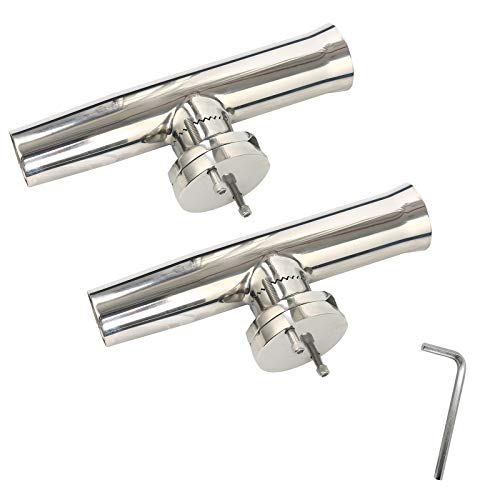
Amarine Made Fishing Rod Holder for Rails 1-1/4" to 2" (2 Pack) | Stainless Tournament Style Clamp on Rod Holder, Rail Mount Fishing Pole Holder,Stainless Rod Holder
One of the home product options compared in this guide.
View on AmazonMARTEXBUY Stainless Steel 5 Rod Holder for T-Top Consoles
A multi-rod rack for console or T-top use.

Stainless Steel 5 Rod Holder, T Top Rod Holder, Adjustable Fishing Console Boat T Top Rocket Launcher 2" Clamp for Rails 1''-1-1/4''
One of the home product options compared in this guide.
View on AmazonFrequently Asked Questions
What angle rod holder should I choose for trolling?
A fifteen-degree holder suits general trolling and drifting, keeping the rod tilted outboard. A thirty-degree holder angles the rod further out to the side and works better for spreading lines in a trolling pattern, where lines must run clear of the boat and of each other. Vertical holders suit storage and rods you grab often, since the rod lifts straight up without dragging across the console.
Can I mount a rod holder on my console without drilling?
Yes, clamp-on holders grip a rail or tube on the console frame with no holes, and track-mount holders slide into a gear track if one is already fitted. Measure the rail diameter and compare it with the clamp range the manufacturer publishes, because a clamp outside its range will slip or will not close. Clamp-on holders also move between positions, which helps when you fish from more than one boat.
Will a flush-mount holder fit my console wall?
A flush-mount holder needs a hole through the console wall and open space below deck for the full tube depth, so measure both before you cut. Check the wall thickness against the holder’s requirements and look behind the panel for wiring, gauges, and rigging tubes that the tube could hit. If the console is thin-walled or crowded behind the panel, a deck-mount or clamp-on holder is the safer choice.
Stainless steel or plastic rod holders for saltwater?
Marine-grade 316 stainless steel is the safer saltwater choice, since it resists corrosion far better than lower steel grades and holds up under heavy trolling loads. Fiber-reinforced nylon never rusts and costs less, but it can flex under a strong fish and may degrade after long sun exposure. Anodized aluminum sits between the two, provided the coating stays intact. Rinse any holder with fresh water after saltwater trips.
FAQ
What angle rod holder should I choose for trolling?
Can I mount a rod holder on my console without drilling?
Will a flush-mount holder fit my console wall?
Stainless steel or plastic rod holders for saltwater?
More from Amazon
Programs that pair well with the guide above. Offers and eligibility are set by Amazon and may change.
Free shipping on eligible items, Prime Video and more. Eligible new members can start with a free trial.
Start a Prime free trialA Prime membership for ages 18-24 with a trial period. Eligibility is set by Amazon.
See Prime for Young AdultsAudiobooks and podcasts to listen to on the go. Eligible new members can start with a free trial.
Try Audible freeAd-free music streaming. Eligible new subscribers can start with a free trial.
Try Music Unlimited freeAs an Amazon Associate we earn from qualifying purchases.



Write Your Review
No reviews yet. Be the first to share your experience!