
Our Top Picks
 OCEANBROAD Kayak Paddle Leash with D-Ring Stretchable Bungee4-7ft (1 pcs)7.09 x 4.72 x 0.71 inches0.15 poundsCheck on Amazon
As an Amazon Associate we earn from qualifying purchases.
A kayak sail promises free distance, but it only delivers that when the wind, the water, and the direction you need to travel happen to agree. The decision that matters is not which sail looks cleverest; it is whether you mostly travel downwind on open water, whether your kayak can carry a mast and stay balanced under it, and whether you can get the sail down quickly when conditions change or another boat crosses your path.
This guide is for recreational paddlers who want help on long lake crossings, fishing kayakers covering water between spots, and touring paddlers considering a rig for open stretches. It explains the main sail types, how size and mounting affect a small boat, how steering and paddling work alongside a sail, and the limits that should make you stow the sail and paddle instead.
What a Kayak Sail Can and Cannot Do
The wind direction decides most of the story
Most kayak sails are at their best with the wind behind you or coming over a rear quarter. On those points of sail the rig simply pushes the boat forward, the paddler adds strokes for steering and extra speed, and long crossings become noticeably less tiring. As you turn across the wind, demands rise: the boat wants to heel and turn, and you need technique and hardware to manage side force. Trying to sail toward the wind is a different sport altogether and only purpose-built upwind rigs with a board or foil to resist sideways drift make real progress that way.
Be honest about your usual routes. If your typical day is an out-and-back trip along a sheltered river, a sail helps on one leg at most and adds clutter for the rest. If you regularly cross a lake in the morning and return with an afternoon breeze behind you, the same sail earns its place. Wind on real water is rarely steady, so plan on paddling as the primary engine and treating the sail as an assistant that you deploy when conditions suit, not as a replacement for fitness, a paddle, or a realistic route plan.
A sail changes the boat’s balance and your workload
Adding a mast raises weight and windage above the deck, which affects a narrow boat far more than it affects a wide, stable fishing platform. Gusts arrive as a push high on the rig and become a heeling force at the hull, so a sail that feels gentle in a steady breeze can become a handful when the wind funnels between headlands or spills off a shoreline. Your workload changes too: instead of simply paddling, you are watching the wind, trimming the sail, steering, and staying ready to release or lower the rig.
That workload is manageable when you practise it deliberately in mild conditions near shore. It is a poor idea to learn it on a long exposed crossing, in cold water, or in traffic. Keep the ability to drop or furl the sail quickly at the centre of every setup decision, because the value of a rig you can stow in seconds is far greater than a small gain in sail area you cannot control when a gust or a ferry arrives.
The Main Types of Kayak Sail
Simple downwind sails
The simplest rigs are small sails designed to pop up, catch a following wind, and fold away flat on the deck when not in use. Circular and V-shaped downwind sails fall into this family. They usually need no mast step drilling beyond a few deck fittings, they are light, and they ask little of the paddler beyond steering with the paddle and an occasional correction. Their limits match their simplicity: they are mainly useful downwind, they offer modest power, and they do not turn a kayak into a sailing boat across or toward the wind.
These sails suit recreational and fishing kayaks on lakes and wide, slow rivers where the return leg runs with the breeze. Because they stow flat, they interfere least with casting, landing fish, or getting back into the boat after a swim. If you are sail-curious and want to learn how your kayak behaves with wind assistance before committing to a larger rig, this is the sensible starting point, and for many paddlers it is also the finishing point.
V sails and sprit-style rigs
A step up in structure, V sails and small sprit or leg-of-mutton style rigs use a mast and booms to hold a more defined shape. A better-shaped sail extracts more from a quartering wind, holds its form in lighter air, and gives the paddler a sheet to trim rather than a sail that is simply up or down. In exchange you accept more lines on deck, a mast that must be stepped and secured, and more thought about where the hardware sits relative to your paddle stroke, your fishing rods, and your re-entry after a capsize.
These rigs reward a paddler who sails often enough to develop habits: easing the sheet in a gust, steering with a combination of paddle strokes and body weight, and stowing the rig without tangling. They still remain downwind and reaching tools for most kayaks rather than true upwind systems, so judge them by how well they cover your downwind miles, not by an ambition to tack across a bay against the breeze.
Upwind-capable rigs with lateral resistance
A kayak that tries to sail across or toward the wind needs something in the water to stop it sliding sideways. Upwind-capable systems therefore pair a larger, more efficient sail with a leeboard, centreboard, or a substantial rudder and skeg arrangement, plus a mast and rigging strong enough for the higher loads. Fitted to a suitable touring kayak, such a system can genuinely sail on more points of the compass and turn a crossing into a sailing exercise rather than a paddling one with assistance.
The costs are weight, complexity, set-up time, and consequences when something breaks far from shore. These rigs belong with experienced paddlers who have practised capsize recovery with the rig fitted, who understand sailing basics, and whose routes justify the hardware. They are rarely the right answer for a fishing kayak loaded with rods and a drive unit, where deck space and stability are already spoken for and the sailing legs are incidental to the day’s purpose.
Choosing Size, Mounting, and Controls
Match sail area to the boat and to your confidence
Bigger is not better by default. A larger sail produces more drive in light air and more trouble in a gust, and on a kayak there is no keel and no crew weight to hold it down. Consider the width and stability of your kayak, your own weight and experience, and the winds you actually meet rather than the calmest morning you remember. A modest sail you can leave up through small gusts teaches you more and tires you less than a large one you must drop at the first sign of pressure.
Fishing kayaks, being wide and stable, tolerate a sail differently from narrow touring boats, but they also carry more windage and more deck clutter. Touring kayaks are more efficient through the water yet respond faster to heel. In both cases, start smaller than you think you need, learn the rig in conditions well inside your comfort, and only consider more area when you can explain exactly what limitation the smaller sail imposed on a real trip.
Mounting must spread load and allow a fast stow
A mast step and its fittings concentrate force on a small area of deck, so follow the rig maker’s mounting guidance, spread the load as directed, and check that fasteners and deck material are suited to the job before drilling anything. Position the mast where it does not foul your paddle stroke, your feet, a pedal drive, rod holders, or a fish finder, and where the lowered sail will lie without covering hatches you need or creating a tangle you must solve while drifting.
Test the full cycle on land first: step the mast, raise the sail, lower it, and stow it, wearing the gloves and clothing you paddle in. Then repeat it on calm water close to shore. If any step needs two free hands for a long time, a tool, or a stretch you cannot make from a seated position in waves, change the arrangement before you rely on it. Lines should run cleanly, cleats should release under load, and nothing should be able to trap a finger, a paddle leash, or your spray skirt release.
Steering still comes from you
A sail does not steer the boat by itself. Most paddlers steer with paddle strokes, edging, and a stern rudder stroke, and kayaks fitted with a rudder gain a useful tool for holding a course while both the sail and the paddle are working. Expect the boat to want to turn toward the wind as pressure builds, and correct early with small inputs rather than waiting for a large swing. Practise holding a course across a light wind, turning downwind under sail, and lowering the sail and resuming normal paddling without stopping dead in an awkward place.
Keep a paddle in your hands or immediately ready at all times. The sail is assistance, and the moment the wind dies, shifts onto your bow, or becomes more than the rig can handle, you are a paddler again. A paddle parked under bungees while you manage lines with both hands is a setup that will eventually catch you out in a gust, a wake, or a narrow channel where you suddenly need to move or stop.
Safety, Rules, and Good Judgement
Set a wind limit and keep it
Decide, before you launch, the conditions in which you will not raise the sail at all: a forecast above a wind strength you have practised in, whitecaps building, an offshore wind on a coast or large lake, thunder in the area, or cold water where a capsize under a tangled rig would be serious. An offshore breeze deserves special respect because it makes the outward leg feel effortless while building the hardest possible return. Check the forecast for the whole trip window, not just the launch hour, since afternoon winds often strengthen exactly when you turn for home.
Wear a personal flotation device, dress for immersion, and carry the same signalling and communication gear you would carry for the crossing without a sail. Practise recovering from a capsize with the rig fitted, in controlled conditions, so you know whether the mast and lines hinder re-entry or can trap anything. If the rig makes self-rescue doubtful, that is a decisive argument against using it on exposed water, whatever its sailing performance.
Other water users and local rules
A kayak under sail is faster, quieter, and less manoeuvrable than it looks to others, and your sail can hide you from a boat approaching from the side the sail blocks. Keep a lookout over and around the rig, give way early and clearly, and lower the sail in congested channels, near ramps and marinas, and anywhere precise manoeuvring matters. Some waters have rules about sailing craft, registration, or equipment, and a kayak fitted with a sail may be treated differently from a paddle-only kayak in some jurisdictions, so check the rules for the water you use.
Also consider visibility. A sail can make you easier to see from a distance and harder to see from one particular angle, so bright clothing, a flag where appropriate, and a light in low visibility remain worthwhile. Never let the convenience of a downwind run carry you past your planned turn point into water, weather, or darkness you had decided to avoid.
Common Mistakes
- Buying the largest sail available instead of one matched to the kayak’s stability and the winds actually paddled in.
- Mounting a mast where the lowered sail blocks hatches, fouls the paddle stroke, or tangles with fishing gear.
- Learning to use a new rig on a long exposed crossing instead of practising raising, lowering, and capsizing near shore.
- Treating a following wind as free progress and ignoring that an offshore breeze makes the return leg far harder.
- Putting the paddle away while managing lines, leaving no immediate way to steer, stop, or brace.
Kayak Sails and Accessories to Consider
A downwind sail adds speed on a favorable breeze, while a leash keeps the paddle secure. These are common starting points.
Advanced Elements Rapid-Up Kayak Sail
A brand-name sail that pops up in seconds and folds down when the wind turns, suited to recreational kayaks.
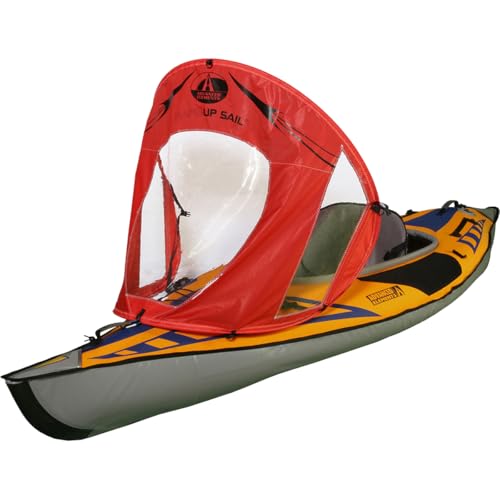
ADVANCED ELEMENTS Rapid-Up Kayak Sail
One of the home product options compared in this guide.
View on AmazonKeenso 42-Inch Downwind Kayak Sail
A popup downwind sail with a compact fold for paddlers who want to try sailing at a lower cost.

Keenso Kayak Sail,42" Downwind Wind Sail Paddle Board Instant Popup for Kayak Boat
One of the home product options compared in this guide.
View on AmazonVGEBY 42-Inch Foldable Downwind Sail Kit
A foldable sail kit that works on kayaks and paddle boards in light to moderate wind.

VGEBY 42Inch Wind Sail, Foldable Popup Board Paddle Downwind Sail Kit for Kayaks, Canoes, Inflatable Boats, Paddle Board Kayak Sail PVC Kayak Sail Blue Kayak Sail Kayak Sail Kayak Sail
Chosen because it lists an explicit depth/thickness.
View on AmazonOCEANBROAD Kayak Paddle Leash
A stretchable bungee leash that keeps the paddle attached while hands are busy handling the sail.
OCEANBROAD Kayak Paddle Leash with D-Ring Stretchable Bungee Strap Lanyard Rope for SUP Kayaking Boating Canoeing Fishing Pole Rod 4-7 Feet Black 1 Pack
One of the home product options compared in this guide.
View on AmazonFrequently Asked Questions
Can a kayak sail into the wind?
Most kayak sails cannot make useful progress directly toward the wind. Simple downwind and V sails are designed for wind behind or beside the stern, and they lose drive and push the boat sideways as you turn toward the wind. Only larger upwind rigs with a leeboard or similar lateral resistance can sail on closer angles, and they add significant weight and complexity. For most paddlers, plan routes so the sail assists rather than expecting it to replace paddling upwind.
Will a sail work on a fishing kayak?
It can, and wide fishing kayaks are stable platforms for a small downwind sail on the run between spots or back to the ramp. The constraints are deck space and clutter: the mast, lines, and lowered sail must not foul rods, a pedal drive, electronics, or your ability to land a fish and re-enter the boat. Start with a modest sail that stows flat, mount it clear of your fishing layout, and practise stowing it quickly before relying on it.
How do I stop quickly when sailing a kayak?
Lower or release the sail first, which removes the driving force, then use the paddle to turn and slow the boat with sweep and stopping strokes. That sequence is why a rig you can drop in seconds matters more than a small difference in sail area. Practise it in open, calm water until it is automatic, and always lower the sail early in channels, near ramps, and around other boats rather than carrying speed into a crowded area.
Is a rudder necessary with a kayak sail?
A rudder is not required for a small downwind sail, since paddle strokes and edging can hold a course on a run. It becomes more helpful as sail size and the range of wind angles increase, because it lets you correct the boat’s tendency to turn toward the wind while you keep paddling and trimming. Whether it is worth fitting depends on your kayak and rig; good technique and a modest sail matter more than adding hardware first.
FAQ
Can a kayak sail into the wind?
Will a sail work on a fishing kayak?
How do I stop quickly when sailing a kayak?
Is a rudder necessary with a kayak sail?
More from Amazon
Programs that pair well with the guide above. Offers and eligibility are set by Amazon and may change.
Free shipping on eligible items, Prime Video and more. Eligible new members can start with a free trial.
Start a Prime free trialA Prime membership for ages 18-24 with a trial period. Eligibility is set by Amazon.
See Prime for Young AdultsAudiobooks and podcasts to listen to on the go. Eligible new members can start with a free trial.
Try Audible freeAd-free music streaming. Eligible new subscribers can start with a free trial.
Try Music Unlimited freeAs an Amazon Associate we earn from qualifying purchases.



Write Your Review
No reviews yet. Be the first to share your experience!