
Our Top Picks
Pros & cons
- Set includes a tackle box for easy storage and carry
- Ten lures cover a range of weights from 3 to 7 grams
- Blades create continuous flash and vibration to draw strikes
- Treble hooks require careful handling to avoid snags
- Lightweight 3 to 7 gram lures limit casting distance
Pros & cons
- Horizontal fall action sets it apart from standard jigs
- Pocket-sized box fits easily in a vest or tackle bag
- Eighty-two pieces give plenty of grub bodies and hooks
- Only size 8 hooks included, no other hook sizes
- Neon color bodies limit choices for natural presentations
Pros & cons
- Scent dispersion draws fish in from greater distances
- Glitter finish mimics fish scales for added visibility
- Soft, moldable dough shapes easily onto hooks or jigs
- Dissolves over time, so it needs reapplication while fishing
- Single jar format means carrying extra for long trips


The best rainbow trout fishing lure for most anglers is the Rapala Countdown Minnow, because its controlled sink rate lets you reach fish in lakes and larger rivers and repeat the same depth on every cast. In small streams and riffles, an inline spinner usually outfishes it, so this guide pairs the minnow with spinners, a micro jig kit, and a jointed minnow. A rainbow trout lure is any artificial that swims, flashes, or wobbles like a small baitfish or insect. We also include one dough bait as a clearly labeled runner-up for stocked fish, since it competes with lures on many put-and-take waters.
Quick List
- Rapala Countdown Minnow 2-3/4″ – best for lakes, pools, and controlled depth
- TRUSCEND rooster-tail style spinners – best for streams with steady current
- Inline spinner 3-pack (BigWormFishing) – best for comparing several blades in one trip
- HISOO brass-blade trout spinners – best for lake and river casting
- HISOO 10-piece metal spinner kit – best for a lure box that covers many conditions
- Trout Magnet 82-piece kit – best for micro-jig fishing on ultralight gear
- Rapala Jointed 07 Rainbow Trout – best for a floating, jointed baitfish look
- Berkley PowerBait Trout Dough – runner-up bait for stocked fish
Which One Is Right for You?
| If you… | Choose |
|---|---|
| Need to reach trout holding 5 to 8 feet down | Rapala Countdown Minnow 2-3/4″ |
| Fish a stream with steady current | TRUSCEND rooster-tail style spinners |
| Want a small set of spinners to compare | Inline spinner 3-pack (BigWormFishing) |
| Cast from a lake shore or river bank | HISOO brass-blade trout spinners |
| Want many lures in one tackle box | HISOO 10-piece metal spinner kit |
| Use 2 to 4 pound line and fish slowly | Trout Magnet 82-piece kit |
| Prefer a minnow that floats at rest and twitches on the retrieve | Rapala Jointed 07 Rainbow Trout |
| Fish stocked ponds where lures draw few strikes | Berkley PowerBait Trout Dough |
If you can carry only two items, bring one spinner and one minnow. The spinner covers moving water and riffles, and the minnow covers deeper holes. Add the micro jig kit when the fish turn finicky and ignore larger lures.
All 8 Picks in Detail
1. Rapala Countdown Minnow 2-3/4″ – Best for Lakes, Pools, and Controlled Depth
As an Amazon Associate we earn from qualifying purchases at no extra cost to you.
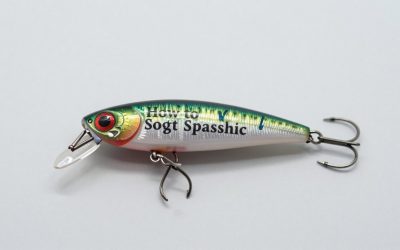
The listing is a 2-3/4 inch Countdown in a Rainbow Trout finish, a sinking balsa minnow sold for trout, bass, and walleye. That size matches the CD7 in Rapala’s lineup, which weighs about 1/4 ounce and works roughly 5 to 8 feet down on a retrieve. Rapala says the Countdown sinks about one foot per second, so a count of six puts it near six feet. That repeatable depth is its edge: when a strike comes on a count of eight, you can return to eight on the next cast. It suits lake, reservoir, and large-river anglers who need to find fish holding below the surface. Confirm the color and size on the listing, because the same page covers several variations.
- Sinking hard bait with controlled depth (listing)
- Sink rate about one foot per second (Rapala)
- CD7 size: 2-3/4 in, about 1/4 oz, roughly 5 to 8 ft
- Retrieve with small rod-tip snaps and pauses
- Treble hooks
Pros
- Count-down method gives repeatable depth
- Natural rainbow finish suits clear water
Cons
- Heavy for rods rated below about 1/4 ounce
- Snags on rocky bottoms if you let it sink too long
Nearest alternative: the jointed minnow, which floats at rest and stays shallower.
2. TRUSCEND Rooster-Tail Style Spinners – Best for Streams With Steady Current

The listing is a spinner set in the rooster-tail style, marketed for trout, bass, walleye, crappie, and salmon in fresh and salt water. Confirm the weights and piece count on the page, since the title is long and partly cut off. In streams, most guides favor 1/16 to 1/8 ounce spinners on 4 to 6 pound mono, with 1/8 ounce called the workhorse. Cast about 45 degrees upstream so the blade engages as the lure swings across, and retrieve only as fast as needed to keep the blade turning. It suits anglers who want quick coverage of riffles, runs, and seams.
- Spinner set in rooster-tail style
- Marketed for trout, bass, walleye, crappie, and salmon
- Stream weights: 1/16 to 1/8 oz are common
- Swing across current, then slow the retrieve in pools
- Confirm blade size and weight on the listing
Pros
- Simple to fish and effective in current
- Feathered tails add a natural look
Cons
- Treble hooks are harder on fish you release
- Weights in a multi-species set may run heavy for small streams
Nearest alternative: the 3-pack of plain inline spinners, which gives fewer pieces for a simpler box.
3. Inline Spinner 3-Pack (BigWormFishing) – Best for Comparing Blades in One Trip

Three inline spinners for trout, salmon, panfish, bass, crappie, and perch make an easy way to compare blade colors. Because the title gives no weights, confirm the size on the page. Blade size changes the behavior: sizes 0 to 1 suit slow current, clear water, and cold conditions, while sizes 2 to 4 vibrate more and handle faster, stained water. Silver blades work best in bright sun and clear water, while gold blades suit low light and stain. It suits anglers who want to learn what trout prefer on a given day before buying a larger set.
- Three inline spinners
- Marketed for trout, salmon, panfish, bass, crappie, and perch
- Silver for sun and clear water; gold for stain and low light
- Blade size 0 to 1 for slow clear water
- Confirm weights on the listing
Pros
- Small pack makes it easy to compare colors
- Works on both streams and lake shores
Cons
- Only three lures, so one snag can wipe out a third of the set
- Weights and hook sizes are not clear from the title
Nearest alternative: the 10-piece kit gives more variety but dilutes the focus.
4. HISOO Brass-Blade Trout Spinners – Best for Lake and River Casting

The title calls these trout spinners with a brass spinner for lake and river fishing, and lists bass, salmon, pike, and smallmouth as other targets. Brass blades flash a warm, gold tone that suits low light and stained water, which is where gold blades typically do better than silver. The listing mixes “fly” and “spinner” language, so confirm what you receive. For lakes, many guides recommend 1/4 ounce spinners because they cast farther and run deeper, while 1/8 ounce works for stocked trout in streams. It suits anglers who fish both lakes and rivers and want one spinner style for each. Fish the lighter ones in current and save the heavier ones for casting distance on lake shores, where a long cast puts the lure past spooked shoreline fish.
- Brass spinner blades
- Marketed for trout, bass, salmon, pike
- Lake weight: about 1/4 oz casts farther
- Stream weight: about 1/8 oz
- Confirm size and quantity on the listing
- Retrieve steadily past weed edges and drop-offs
Pros
- Gold-toned blade helps in stained water
- One style covers lakes and streams
Cons
- Multi-species marketing makes sizes unclear
- Gold-toned flash may be too bold for gin-clear, pressured water
Nearest alternative: the TRUSCEND set, which adds a feathered tail.
5. HISOO 10-Piece Metal Spinner Kit – Best for a Lure Box That Covers Many Conditions
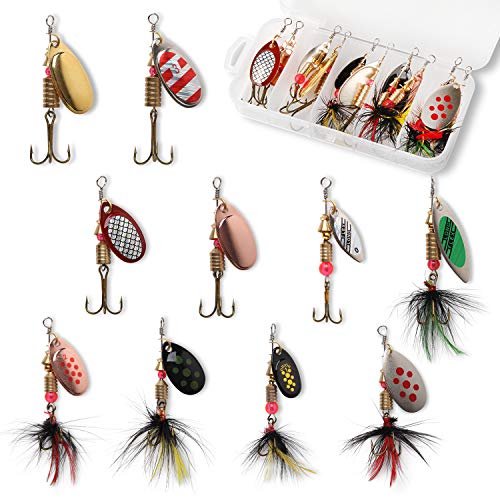
This kit bundles ten hard metal spinner baits with tackle boxes, marketed for bass, trout, and salmon. It is a quantity pick. The upside is variety in color and weight, so you can test what trout want without buying individual lures. The downside is that multi-species kits often include sizes meant for bass, so sort out the lighter ones for streams. Use 1/8 ounce or lighter for small streams and 1/4 ounce for lakes. It suits anglers building a first lure box who accept some trial and error. A practical way to use it is to weigh each lure, tag the light ones for streams, and set the heavy ones aside for lakes.
- Ten metal spinner baits with tackle boxes
- Marketed for bass, trout, and salmon
- Sort by weight: light for streams, heavier for lakes
- Treble hooks typical
- Swap stock hooks for sharper ones if they look dull
- Confirm weights and blade types on the listing
Pros
- Variety lets you test colors and blade sizes
- Boxes organize the lures
Cons
- Some pieces may be too heavy for trout streams
- Hook and blade quality can vary within a kit
Nearest alternative: the 3-pack, which is simpler and easier to fish.
6. Trout Magnet 82-Piece Kit – Best for Micro-Jig Fishing on Ultralight Gear

Where a spinner is too fast and a minnow too large, a micro jig keeps fish interested. The kit lists 82 pieces: 70 neon grub bodies and 12 size 8 hooks. Trout Magnet describes its jig head as 1/64 ounce, with a long-shank size 8 hook, and recommends light line, ideally 2 pound with a fluorocarbon leader. Use it under a small float for a drag-free drift, or cast and retrieve it slowly near the bottom with pauses. It suits anglers who fish ultralight rods in clear water where trout see lots of hardware. If the fish are deeper than your float depth allows, add a small split shot about 12 inches above the jig, though extra weight can dull the action.
- 70 grub bodies and 12 size 8 hooks listed
- Maker’s jig head: 1/64 oz, size 8 long-shank hook
- Use 2 to 4 lb line for best action
- Float rig or slow retrieve
- Set the jig to ride just above the bottom
- Confirm head weights in the kit on the listing
Pros
- Subtle presentation works when trout ignore spinners
- Many bodies in different colors
Cons
- Light head cannot reach deep water without extra weight
- Needs an ultralight outfit for good casting
Nearest alternative: a small spinner, which covers water faster but is less subtle.
7. Rapala Jointed 07 Rainbow Trout – Best for a Floating, Jointed Baitfish Look
The Jointed 07 is a 2.75 inch floating minnow in a Rainbow Trout pattern, with a segmented body that gives it a wide wobble. Floating jointed minnows rest at the surface and dive when you reel, so they suit shallow water, early morning, and low light. The listing identifies the lure, but not the dive depth, so confirm that before you buy. It suits river and lake anglers who like to twitch a minnow along weed edges and shorelines. Fish it with a pause after each twitch so the minnow holds in the strike zone. Cast toward the bank in rivers, quartering slightly downstream, and let the current work it.
- 2.75 in floating jointed minnow
- Rainbow Trout finish
- Segmented body for wobble
- Dive depth: confirm on listing
- Pairs well with 4 lb line and a light-power rod
- Twitch, pause, and repeat along cover
- Retrieve slowly in cold water and faster as the water warms
- Treble hooks
Pros
- Floats at rest, so it avoids snags between twitches
- Rainbow pattern suits clear water
Cons
- Cannot reach deep water like a sinking minnow
- Treble hooks can injure released fish
Nearest alternative: the Countdown, which sinks and gets deeper.
8. Berkley PowerBait Trout Dough – Runner-Up Bait for Stocked Fish
This is a bait, not a lure, so it ranks as a labeled runner-up. On stocked waters it often outfishes artificials because the dough floats and sits still near the bottom. The standard rig uses a free-sliding egg sinker, a bead, a swivel, and a leader of about 18 to 24 inches, with a small treble or single hook. Yakima Bait suggests size 12 or 14 trebles. It suits bank anglers who want to cast and wait. Local rules may restrict scented baits or treble hooks, so check them first. Keep a little slack in the line so a fish can pick up the bait and swim off without feeling resistance, then set the hook when the line tightens or the rod tip dips.
- Dough bait that floats when molded on a small hook
- Typical leader 18 to 24 in
- Sinker 1/4 to 1/2 oz
- Hook size 12 to 14 treble or single hooks
- Confirm color on the listing
- Check that the ball floats before every cast
Pros
- Excellent for stocked trout and beginners
- Simple, stationary rig
Cons
- Not a lure, so it will not cover water
- Messy and may be restricted in some waters
Nearest alternative: the Trout Magnet kit, which is also subtle but more active.
Specs Compared
| Product | Type | Size or weight | Best use |
|---|---|---|---|
| Rapala Countdown Minnow | Sinking minnow | 2-3/4 in; about 1/4 oz (CD7) | Lakes, pools, depth control |
| TRUSCEND spinners | Rooster-tail style spinners | Confirm on listing | Streams and runs |
| BigWormFishing 3-pack | Inline spinners | Confirm on listing | Comparing blades |
| HISOO brass-blade spinners | Inline spinners | Confirm on listing | Lakes and rivers |
| HISOO 10-piece kit | Metal spinner baits | Confirm on listing | General lure box |
| Trout Magnet 82-piece kit | Micro jig bodies | 1/64 oz head per maker | Ultralight fishing |
| Rapala Jointed 07 | Floating jointed minnow | 2.75 in | Shallow water, low light |
| PowerBait Trout Dough | Dough bait | Not applicable | Stocked waters |
How We Chose These
This list comes from desk research, not from fishing each lure. We started with the eight listed products and checked their descriptions against manufacturer pages, retailer specification tables, and trout-fishing guidance about spinner weights, Countdown depth tables, and color choices. We then matched each product to a specific job: depth control, current, comparison, quantity, finesse, floating action, or stocked-fish bait. Where a listing was vague about weight or contents, we said “confirm on listing” rather than guess, and we noted when a product is an assortment instead of a single proven lure. We did not rank by brand reputation alone; we asked which product best solves a problem trout anglers face.
What to Look For
Lure Types and When to Use Them
| Lure | Best conditions | Strength |
|---|---|---|
| Inline spinner | Streams, riffles, lake shores | Fast coverage, easy retrieve |
| Sinking minnow | Lakes, deep pools | Repeatable depth |
| Floating jointed minnow | Shallow edges, low light | Surface and shallow action |
| Micro jig | Clear, slow, pressured water | Subtle and slow |
Spinner Size Chart
Brands do not number spinners the same way, so use weight. Panther Martin lists a size 1 at 1/32 ounce, size 2 at 1/16, size 4 at 1/8, and size 6 at 1/4 ounce. Mepps uses a different scale, so check the brand chart. For small streams, 1/16 to 1/8 ounce on 4 to 6 pound mono is typical. For lakes and larger rivers, 1/4 ounce casts farther and runs deeper. Start with 1/8 ounce for stocked fish and adjust.
Countdown Depth Chart
| Model | Length | Approx. running depth |
|---|---|---|
| CD3 | 1.5 in | 2 to 3 ft |
| CD5 | 2 in | 3 to 6 ft |
| CD7 | 2.75 in | 5 to 8 ft |
Count down about one second per foot. If you count to six and get a strike, repeat the same count on the next cast. On inland lakes, CD5 or CD7 is a reasonable all-around size.
Rod, Reel, and Line for Lure Fishing
A 6 to 7 foot ultralight or light spinning rod, a 1000 to 2500 reel, and 4 pound mono is the usual trout outfit. In clear water, 4 to 6 pound fluorocarbon is less visible, and some anglers run 8 pound braid with a 2 to 6 pound fluorocarbon leader for extra sensitivity. Check the rod’s lure rating against what you plan to throw. For example, Pflueger rates its 5 foot 6 inch ultralight Monarch rod at 1/16 to 3/8 ounce, which covers a 1/8 ounce spinner and a 1/4 ounce CD7, while a rod rated only to 1/8 ounce will struggle with the minnow.
Color and Water Clarity
In clear water and bright sun, use natural finishes such as silver, olive, brown, and rainbow patterns. In stained water or low light, use brighter colors or flash, such as chartreuse, orange, gold, or copper. Stocked fish often respond to bright colors first, then to natural tones after pressure. Fix depth, size, and speed before changing color.
| Water | Starting color | Why |
|---|---|---|
| Clear and sunny | Silver, olive, rainbow pattern | Looks like natural prey |
| Stained or murky | Gold, copper, chartreuse, orange | More visible |
| Low light | Gold or black-and-gold blade | Contrast at dawn and dusk |
| Stocked, little pressure | Pink, white, orange, glow | Often triggers strikes |
Retrieve Speed and Direction
Retrieve spinners just fast enough to keep the blade turning, faster in strong current and slower in cold water. Cast upstream or across and let the current swing the lure. Avoid casting downstream and retrieving upstream, because trout face into the current. If fish follow without striking, add a brief pause so the blade flutters. For minnows, use small snaps of the rod tip and pause.
Hooks and Water Temperature
Hook choice affects fish survival as well as hookups. Trebles hold well but are harder to remove, so singles or smaller trebles make sense for fish you plan to release, and local rules may limit hook types. Temperature matters just as much. Rainbow trout generally feed best in the 50s into the mid 60s degrees Fahrenheit, and they slow down in colder water, so shorten your retrieve and use smaller lures. Above about 68 degrees, warm water holds less oxygen and many anglers stop fishing for the fish’s sake.
Questions
What size lure is best for rainbow trout?
Spinners of 1/8 ounce work for stocked and stream trout, while 1/4 ounce suits lakes. Minnows in the 2 to 2.75 inch range are common choices.
Should I use single or treble hooks?
Treble hooks hold fish well but are harder to remove and cause more damage, so many anglers choose singles for fish they plan to release. Check local rules, since some waters restrict hook types.
How fast should I retrieve?
Reel only as fast as needed to keep a spinner blade turning. In cold water, slow down, and add pauses for minnows.
Which color works best in clear water?
Natural finishes such as silver, olive, and rainbow patterns work best in clear water and bright sun. Use brighter colors in stained water or low light.
What line should I use?
Four pound mono or fluorocarbon is a standard choice, with 2 pound for micro jigs. Heavier line can reduce strikes from wary trout.
When is trout water too warm to fish?
Rainbow trout feed best in the 50s into the mid 60s degrees Fahrenheit. Many sources advise stopping once water reaches about 68 degrees, since warm water holds less oxygen.
Update History
- October 15, 2026 – Updated with specification checks and a revised product comparison.
- Check the product page for current specifications and availability before buying.
Sources
- Rapala CountDown product information and trout-fishing article
- Panther Martin spinner size chart
- Bass Pro Shops inline spinner trout tactics
- Trout Magnet manufacturer information
- Yakima Bait PowerBait rigging guide
- Field and Stream spin fishing for trout
- Manufacturer and retailer listing text for each product



Write Your Review
No reviews yet. Be the first to share your experience!