
Key takeaways
- Real spacing: Allow roughly 2 to 3 inches per rod position for small reels and 3 to 4 inches for bulky baitcasting or offshore reels.
- Soft contact points: EVA foam, rubber, or flexible polymer protects finishes better than bare metal.
- Positive retention: A lip, elastic strap, or closed slot keeps rods in place when a garage door vibrates or equipment bumps the rack.
- Stud-compatible holes: A loaded rack should transfer force into studs or solid blocking rather than relying only on drywall anchors.
Best Fishing Rod Racks for Garages, Boats, and Small Spaces
The best fishing rod racks are chosen by available wall or deck space first, then by rod length, reel clearance, capacity, and how securely the rack can be mounted. A vertical garage rack usually offers the highest capacity per dollar, while a low-profile horizontal rack works better under shelves and a marine-grade system is the safer choice on a boat.
Quick comparison: which rack fits your space?
| Rack type | Typical capacity | Rod-length fit | Common materials | Best mounting method | Typical market range |
|---|---|---|---|---|---|
| Vertical floor-to-wall rack | 8–24 rods | 5–10 ft, depending on ceiling height | Plastic, powder-coated steel, aluminum | Studs or masonry anchors | $25–$90 |
| Horizontal wall rack | 4–12 rods | 5–9 ft | Foam, rubber, molded plastic, wood | Studs, blocking, or heavy-duty anchors | $20–$100 |
| Ceiling rack | 6–16 rods | Usually one-piece or separated rods | Steel, aluminum, reinforced plastic | Ceiling joists or structural blocking | $35–$130 |
| Boat-mounted rod storage | 2–8 rods | Usually 6–8 ft; check cockpit clearance | Marine-grade aluminum, stainless steel, UV-resistant polymer | Through-bolts, backing plate, or track hardware | $35–$180 |
| Compact travel or cabinet rack | 2–6 rods | Short rods or two-piece rods | Foam, fabric, plastic, aluminum | Cabinet, vehicle, locker, or freestanding base | $15–$80 |
Capacity figures describe practical storage, not merely the number of molded slots. A rack advertised for 12 rods may hold fewer when large spinning reels, baitcasters, rod socks, or thick handles are installed. For everyday access, leave at least one empty position for every five rods.
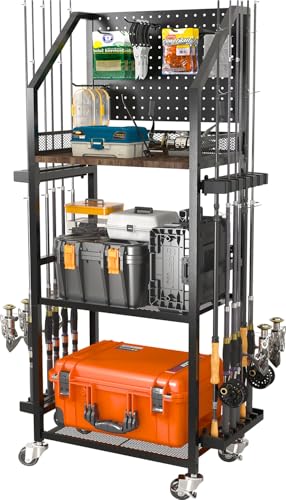
SOYEEZE Fishing Rod Holders for Garage, Fishing Pole Holders Up to 12 Rods with Pegboard and Hooks,Rolling Fishing Cart with Wheels, Fishing Gear Storage For Tackle Box & Reel Organization-6 Hooks
Included for 'Best Fishing Rod Racks for Garages, Boats, and Small Spaces' because the listing specifies Fishing Pole Holders Up to 12 Rods with Pegboard and Hooks and Rolling Fishing Cart with Wheels, details this guide uses to compare options.
View on Amazon
PLUSINNO V9 Vertical Fishing Rod Holder, Wall Mounted Fishing Rod Rack, Fishing Pole Holder Holds Up to 9 Rods or Combos, Fishing Rod Holders for Garage,Fishing Gear and fishing Gifts for Men
Included for 'Best Fishing Rod Racks for Garages, Boats, and Small Spaces' because the listing specifies Wall Mounted Fishing Rod Rack and Fishing Pole Holder Holds Up to 9 Rods or Combos, details this guide uses to compare options.
View on Amazon
Rush Creek Creations 16-Rod Round Fishing Rod Holder for Garage, Tackle Box
Included for 'Best Fishing Rod Racks for Garages, Boats, and Small Spaces' because the listing specifies Tackle Box, details this guide uses to compare options.
View on Amazon
Ghosthorn Holds Up to 12 Rods Fishing Pole Rod Racks Wall or Ceiling Mounted Fishing Pole Rod Holders for Garage Storage Organizer Fishing Gear Equipment for Men Women
Included for 'Best Fishing Rod Racks for Garages, Boats, and Small Spaces' as a relevant option in this category; details come from the product listing.
View on AmazonBest choice for a garage: vertical storage with separated butt and tip supports
A vertical rack is usually the best fishing rod rack for a garage because it uses narrow wall space and keeps rod blanks away from vehicles, bicycles, and floor clutter. Two-part designs are preferable: a lower cradle holds the butt sections while an upper strip prevents the tips from swinging into one another.
Measure from the floor to the lowest obstruction before buying. A 7-foot rod generally needs about 7 feet 4 inches of clear height when stored vertically, allowing room for the rack, handle, and a little removal clearance. For 8-foot and 9-foot rods, a horizontal or ceiling-mounted design may be more practical.
What to look for
- Real spacing: Allow roughly 2 to 3 inches per rod position for small reels and 3 to 4 inches for bulky baitcasting or offshore reels.
- Soft contact points: EVA foam, rubber, or flexible polymer protects finishes better than bare metal.
- Positive retention: A lip, elastic strap, or closed slot keeps rods in place when a garage door vibrates or equipment bumps the rack.
- Stud-compatible holes: A loaded rack should transfer force into studs or solid blocking rather than relying only on drywall anchors.
For example, a 12-position rack with 3-inch center spacing needs about 33 inches of usable width once end clearance is included. That is considerably wider than a six-position rack, so measure the wall before choosing capacity.
Best for low ceilings and small spaces: horizontal or ceiling-mounted racks
A horizontal wall rack works beneath cabinets, along a basement wall, or above a workbench. It is also easier to use when long rods cannot stand upright. The main tradeoff is wall length: a rack holding eight 7-foot rods may require 24 to 32 inches of width, depending on reel spacing and the shape of the supports.
Ceiling racks preserve wall and floor space, but installation matters more. A loaded rack can become a falling hazard if it is fastened only to thin ceiling panels or drywall. Locate joists with a stud finder and use screws long enough to penetrate the structural member without interfering with wiring or plumbing. When joist locations do not align with the rack, install a properly secured wood crosspiece first.
Small-space sizing calculation
Suppose a closet has 30 inches of available wall width and you want to store six rods. Dividing 30 inches by six gives 5 inches per rod position, which is generous for most freshwater setups. If you need to store 10 rods in the same space, each position receives only 3 inches. That can work for slim spinning reels, but it is likely cramped for large baitcasters. In that situation, use two staggered rows, store rods without reels, or select a ceiling rack.
Best for boats: compact, corrosion-resistant mounting
Boat storage must resist vibration, spray, ultraviolet exposure, and repeated handling. Look for stainless steel fasteners, anodized aluminum, or UV-stabilized polymer. Ordinary plated hardware can rust quickly in a saltwater environment, and unprotected steel may stain the deck or seize during removal.
A boat rack should keep rods from touching the gunwale, console, hatch edges, or motor controls. Check both the stored position and the removal path. A rod that technically fits may still be unusable if the tip catches on a windshield or the reel collides with a seat.
Through-bolting with a backing plate is the most secure option for high-load or high-vibration locations. Screws may be adequate for light freshwater storage when they enter solid fiberglass backing or a properly installed mounting track. Avoid drilling into unknown areas of a hull or deck; consult the boat manufacturer’s layout information when available.
Boat-specific buying checklist
- Choose closed or strap-secured slots if the boat travels on a trailer.
- Use fasteners and washers rated for the water conditions.
- Confirm that the rack does not block hatches, cleats, navigation equipment, or emergency gear.
- Prefer drainage-friendly designs that do not trap water around rod handles.
- Leave enough clearance for reels to be removed without scraping adjacent rods.
Head-to-head: foam, plastic, aluminum, and steel racks
Foam racks are gentle, quiet, and inexpensive. They are suitable for indoor storage, but foam can compress, tear, or absorb water. It should not be the only retention method on a bouncing boat or trailer.
Molded plastic racks resist ordinary moisture and are easy to clean. Quality varies: thin plastic can flex under a full load, while reinforced polymer can be a durable choice for freshwater boats and garages. Inspect the screw bosses and mounting flange, since these often fail before the rod slots.
Aluminum racks provide a strong-to-weight advantage and are well suited to boats. Anodizing helps protect the surface, but it does not make every fastener combination corrosion-proof. Use compatible hardware and rinse salt residue away.
Powder-coated steel racks are rigid and affordable for garages. Scratches expose the underlying metal, so touch up damaged areas and keep the rack dry. Steel is usually unnecessary for a light indoor rack but useful when many heavy rods are stored in one location.
Decision matrix for common fishing setups
| Your situation | Recommended rack | Target specifications | Why |
|---|---|---|---|
| Occasional angler with 3–5 rods | Small horizontal wall rack | 4–6 positions, padded contact points, under 3 lb | Low cost and easy access without overbuilding |
| Frequent freshwater angler with 8–12 rods | Two-point vertical rack | 8–12 positions, 2.5–3.5 inch spacing, stud mounting | High capacity in a narrow garage footprint |
| Saltwater boat owner | Marine-grade horizontal or track-mounted rack | 2–6 positions, UV-resistant body, stainless hardware, straps | Better vibration and corrosion resistance |
| Apartment or low-ceiling storage | Cabinet, closet, or compact two-piece rack | 2–6 positions, short depth, removable mounting | Fits limited height and minimizes wall damage |
| Large collection with mixed reels | Wide vertical rack or modular system | 12–24 positions, 3–4 inch spacing, expandable sections | Prevents reel interference and allows future growth |
Installation and maintenance that prevent damage
- Map the clearance. Place a rod on the wall or deck with the reel attached. Mark the tip, handle, reel, doors, and nearby walkways.
- Find structural support. Use studs, joists, solid blocking, or an appropriate backing plate. Do not assume a drywall anchor can support a fully loaded rack.
- Pre-drill accurately. A pilot hole reduces cracked wood, wandering screws, and damaged fiberglass. Seal any boat penetration with a suitable marine sealant.
- Load gradually. Add the heaviest rods first, then check whether the rack tilts, flexes, or pulls away from the wall.
- Inspect twice a year. Tighten loose fasteners, replace torn straps, and examine foam for compression. On boats, rinse salt and sand away with fresh water and dry the rack before storage.
The parts that wear first are normally foam edges, elastic retainers, plastic screw bosses, and fasteners exposed to salt. Replacing a strap or washer is inexpensive; allowing a loose rack to remain loaded can damage rods and reels. Keep rods clean and dry before storage, and avoid forcing a large reel into a narrow slot.
Final recommendation
Choose a stud-mounted vertical rack for the highest garage capacity, a padded horizontal rack when ceiling height or wall placement is limited, and a corrosion-resistant, positively secured rack for a boat. Size the rack around the largest reel and longest rod you actually own—not the smallest combination—and leave spare capacity so removal does not turn into a tangle. That approach produces safer storage and better long-term value than choosing by slot count alone.




Write Your Review
No reviews yet. Be the first to share your experience!