
Key takeaways
- No clearly stated hand orientation, line capacity, or return policy.
- Claims that digital or magnetic braking makes backlashes impossible.
- A very high bearing count with no information about sealing, materials, or service.
- Excessively low price paired with unusually high drag, extreme lightness, and premium construction claims.
- A reel that feels gritty, has side-to-side spool play, or shows a bent handle straight out of the box.
- Unclear warranty coverage or no source for replacement parts.
- Using a heavy, deep-spool reel for tiny lures simply because it has a larger advertised line capacity.
A baitcasting reel can make accurate casts and controlled retrieves feel effortless—but the wrong one can produce constant backlashes, hand fatigue, and wasted money. Beginners often choose by gear ratio alone, assume a higher drag number means better performance, or buy the lightest reel without checking whether it balances their rod. Another common mistake is treating “anti-backlash” as a guarantee that a reel cannot bird’s-nest. Braking systems reduce spool overruns; they do not replace correct tension, thumb control, line choice, or practice.
This baitcasting reel buying guide for beginners focuses on the specifications that affect everyday fishing: spool size, braking, drag, ergonomics, construction, and support. The goal is not to find the reel with the longest feature list. It is to find a reel that matches your lures, rod, hand, and budget. Prices and product availability can change, so use the figures below as practical buying ranges rather than permanent price quotes.
Our top picks
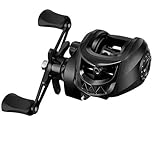
 Sougayilang Baitcasting Reel with Digital Anti-Backlash Control
- Hand Orientation: Left Hand
- Fishing Technique: Casting
- Other Special Features of the Product: Adjustable Braking System
 KastKing Spartacus II Baitcasting Reels
- Hand Orientation: Ambidextrous, Right Hand
- Fishing Technique: Baitcasting
- Gearbox Ratio: 7.2
 Piscifun Torrent Baitcasting Reel 18LB Carbon Fiber
- Hand Orientation: Right Hand
- Fishing Technique: Baitcasting
- Gearbox Ratio: 7.1
| Product | Key specs | Amazon rating | |
|---|---|---|---|
| Sougayilang Baitcasting Reel with Digital Anti-Backlash Control | Hand Orientation: Left Hand Fishing Technique: Casting Other Special Features of the Product: Adjustable Braking System | 3.5★ | Check price |
| KastKing Spartacus II Baitcasting Reels | Hand Orientation: Ambidextrous, Right Hand Fishing Technique: Baitcasting Gearbox Ratio: 7.2 | 4.5★ | Check price |
| Piscifun Torrent Baitcasting Reel 18LB Carbon Fiber | Hand Orientation: Right Hand Fishing Technique: Baitcasting Gearbox Ratio: 7.1 | 4.5★ | Check price |
 KastKing Centron Lite Baitcasting Fishing Reels KastKing Centron Lite Baitcasting Fishing Reels | Hand Orientation: Right Hand Fishing Technique: Baitcasting Gearbox Ratio: 7.1 | 4.5★ | Check price |
As an Amazon Associate we earn from qualifying purchases at no extra cost to you. Ratings are shown as listed on Amazon.
Decide These 3 Things First
- What will you throw? Lures from 3/8 to 1 ounce are the easiest starting range for a standard bass baitcaster. If you regularly fish 1/4-ounce lures or lighter, look for a shallow or finesse-oriented spool instead of a large, deep spool.
- What retrieve speed do you need? A 6.3:1 to 7.2:1 reel is the most versatile choice. Choose around 5.3:1 to 6.3:1 for crankbaits and other resistance-heavy lures, and around 7.1:1 to 8.1:1 for jigs, worms, frogs, and quickly picking up slack.
- Which hand will retrieve? “Right-handed” generally means the handle is on the right side, while “left-handed” means the handle is on the left. Pick the side that lets you cast and control the rod comfortably. Do not assume you must match your writing hand.
Size: Match the Reel to Your Rod and Lures
Most general-purpose baitcasters fall into a compact 100- to 150-size class. These reels commonly weigh about 6.5 to 8.5 ounces and pair well with a 6-foot-6-inch to 7-foot-3-inch medium or medium-heavy casting rod. That combination covers many bass techniques and is easier for a beginner to control than an oversized reel.
Reel size is not a universal measurement between brands, so compare the actual weight, line capacity, and physical dimensions when available. A reel carrying roughly 100 to 150 yards of 12- to 16-pound monofilament or fluorocarbon is usually sufficient for freshwater bass. Larger 200-size reels make more sense for heavier lures, thick cover, or line above about 17 pounds, but they may feel bulky on a light rod.
Balance matters as much as ounces. A reel that weighs 7.5 ounces can be comfortable on one rod and nose-heavy on another. Hold the assembled rod with your index finger near the trigger. If the tip drops sharply when you release your supporting hand, consider a lighter reel or a rod with a different balance point.
Material: Aluminum Frames Usually Offer the Best Starting Point
A rigid aluminum frame and side plates help keep the spool, pinion gear, and bearings aligned under load. For a beginner’s general-purpose reel, an aluminum frame or an aluminum main frame with composite side covers is a sensible target. It generally provides a sturdier feel than an all-plastic housing without automatically pushing the price into premium territory.
Composite materials are not inherently poor. They can reduce weight and cost, and a well-designed composite reel may be perfectly adequate for occasional fishing. The concern is flex: if the frame twists when you tighten the drag or crank against a heavy lure, gear alignment and retrieve smoothness can suffer.
Look for a corrosion-resistant finish if you fish brackish or salt water, but no coating eliminates maintenance. After saltwater use, lightly rinse the exterior with fresh water, dry it, and follow the manufacturer’s lubrication instructions. Avoid blasting water directly into the reel, which can drive salt and debris farther inside.
Construction: Braking, Spool, and Drag Matter More Than Marketing Claims
Beginners should prioritize an adjustable braking system. Magnetic brakes are simple to tune from an external dial. Centrifugal brakes can provide strong control during the early, fastest part of a cast. Dual-braking systems combine both approaches. Digital anti-backlash systems may automatically adjust braking, but they still require correct spool tension and thumb control, and they may add cost, battery dependence, or electronic complexity.
For a first reel, favor a spool with a practical line capacity rather than an unusually deep spool designed for long-distance or heavy-line fishing. A spool that holds approximately 100 to 150 yards of your intended line is adequate for most bass applications. A line guide that moves smoothly across the spool helps distribute line during retrieval.
Drag ratings are often advertised at 15 to 25 pounds in this category. That does not mean you should set the drag to the maximum number. A starting setting of roughly 25 to 30 percent of the line’s rated strength is more useful: about 3 to 5 pounds for 12- to 17-pound line. Tighten or loosen it based on cover, hook style, and fish behavior. Carbon-fiber drag washers are a worthwhile feature, but the number of washers and the reel’s overall alignment also affect feel.
For reference, the example reels in this price group include the Sougayilang model with digital anti-backlash control, 7.2:1 gearing, and an advertised 18.5-pound maximum drag; the KastKing Spartacus II at 7.2:1; the Piscifun Torrent at 7.1:1 with an advertised 18-pound carbon-fiber drag; and the KastKing Centron Lite. These specifications are useful comparisons, not proof that one reel will cast better for every angler.
Comfort and Performance: Choose Features You Can Actually Control
A comfortable handle and predictable controls are more valuable than a high bearing count. Look for a handle around 3.5 to 4.5 inches, knobs that remain secure when wet, and a star drag that can be adjusted without taking your hand off the rod. A swept handle can reduce the amount of wrist movement required during a retrieve.
Bearing counts deserve context. A reel advertised with 7 or 10 bearings is not automatically smoother than a reel with 5. Bearing quality, sealing, lubrication, gear alignment, and maintenance all matter. For a beginner, a smooth retrieve, an audible and positive spool-tension knob, and an external brake dial are more important than counting bearings.
Gear ratio should match lure resistance. A 7.1:1 or 7.2:1 reel retrieves approximately 30 to 33 inches of line per handle turn, depending on spool fill and spool diameter. That speed is useful for moving a lure quickly and clearing slack. A 6.3:1 reel may retrieve approximately 26 to 29 inches per turn, while a 5.3:1 reel is slower and often easier to use with deep-diving crankbaits. Manufacturers measure retrieve rates differently, so treat these as estimates.
Price Tiers: Spend for Control, Not Just More Features
Budget, about $25 to $50: This is enough for a first baitcaster. The listed example prices—approximately $29.98 for the Sougayilang, $40.79 for the KastKing Spartacus II, $34.99 for the Piscifun Torrent, and $32.28 for the KastKing Centron Lite—fit this tier. Expect basic frames, serviceable braking, and more variation in factory smoothness. Inspect the reel promptly and keep expectations realistic.
Midrange, about $60 to $130: This tier commonly buys better tolerances, more consistent braking, improved knobs and drag adjustment, and stronger warranty or parts support. It is often the best value for someone who fishes several times a month and wants fewer compromises.
Premium, about $150 to $350 or more: Premium reels may be lighter, smoother under load, more refined in braking, and better sealed. These benefits are easiest to appreciate with frequent use, specialized techniques, or demanding conditions. A premium reel will not prevent a backlash caused by an overfilled spool or poorly adjusted brakes.
Warranty: Check the Fine Print Before the First Cast
Warranty length is only part of the decision. Look for at least a one-year limited warranty and confirm whether it covers manufacturing defects, the frame, gears, drag, and braking components. Many warranties exclude normal wear, corrosion, accidental damage, misuse, and modifications.
Save the receipt, order confirmation, serial number, and original packaging until you have inspected and tested the reel. Check whether warranty service is handled by the seller or the manufacturer, whether the buyer pays shipping, and whether replacement parts are available. A brand that sells handles, drag stars, side-plate screws, and spool components can be easier to live with than one that offers only a full replacement.
Delivery and Assembly: Test the Reel Before You Spool It Fully
Inspect the reel within the retailer’s return window. Turn the handle slowly and listen for grinding, clicking, or uneven resistance. Confirm that the clutch disengages and re-engages cleanly, the spool spins freely when the brakes are reduced, and the handle and star drag do not wobble. Check that the line guide travels across the spool.
Before filling the spool, attach the reel to the rod and adjust the seat. Add backing if necessary, then fill the main line to approximately 1/16 inch below the spool lip. Overfilling increases overruns; underfilling reduces casting distance. Start with the manufacturer’s recommended spool tension, set the brake higher than you think you need, and practice with a 3/8- to 1/2-ounce plug in an open area. Reduce braking gradually rather than changing several settings at once.
Spec Checklist
| Spec | Budget | Mid | Premium |
|---|---|---|---|
| Typical price | $25–$50 | $60–$130 | $150–$350+ |
| Reel weight | 7–9 oz | 6.5–8 oz | 5.5–7.5 oz |
| Best general gear ratio | 6.3:1–7.2:1 | 6.3:1–7.4:1 | 6.3:1–8.1:1 |
| Useful line capacity | 100–150 yd of 12–16 lb line | 100–150 yd of 12–17 lb line | 100–180 yd, depending on technique |
| Braking | Adjustable magnetic or centrifugal | Magnetic, centrifugal, or dual | Highly tunable dual or electronic system |
| Frame target | Composite or aluminum frame | Aluminum main frame preferred | Rigid aluminum or lightweight alloy |
| Drag range advertised | 15–20 lb | 15–25 lb | 18–25+ lb |
Red Flags
- No clearly stated hand orientation, line capacity, or return policy.
- Claims that digital or magnetic braking makes backlashes impossible.
- A very high bearing count with no information about sealing, materials, or service.
- Excessively low price paired with unusually high drag, extreme lightness, and premium construction claims.
- A reel that feels gritty, has side-to-side spool play, or shows a bent handle straight out of the box.
- Unclear warranty coverage or no source for replacement parts.
- Using a heavy, deep-spool reel for tiny lures simply because it has a larger advertised line capacity.
FAQ
What is the best gear ratio for a beginner?
A 6.3:1 to 7.2:1 reel is the most flexible starting point. It handles soft plastics, jigs, spinnerbaits, and many moving baits. Choose slower gearing if crankbaits are your priority, or faster gearing if you frequently fish frogs and heavy cover.
Is a baitcaster harder to use than a spinning reel?
Initially, yes. A baitcaster requires spool-tension and brake adjustments plus thumb control. Begin with a heavier practice lure, use a higher brake setting, and make smooth sidearm casts. Most beginners improve faster by changing one adjustment at a time.
How much drag do I need for bass fishing?
An advertised maximum of 15 to 20 pounds is plenty for typical bass fishing. Set actual drag pressure near 25 to 30 percent of your line strength, then adjust for cover and hook style. Maximum drag is a specification, not a recommended everyday setting.
Should I buy a digital anti-backlash reel?
It can be helpful if you want automated assistance, but it is not essential. A reliable manually adjustable magnetic or centrifugal system costs less and teaches the fundamentals. Buy digital control for convenience, not because you expect it to eliminate poor spool settings or thumb technique.



Write Your Review
No reviews yet. Be the first to share your experience!