
Key takeaways
- A 500-size reel with no stated line capacity or weight.
- A plastic spool if you plan to use braided line regularly.
- Drag adjustment that jumps from loose to tight in only a few clicks.
- A rough line roller, bent bail wire, or spool lip with a visible nick.
- Marketing centered on “10 bearings” without details on spool material, drag, or line capacity.
- A reel heavier than 9 ounces paired with a 5.5- to 6-foot ultralight rod.
- Buying a large 3000-size reel simply because it is discounted; it is usually unnecessary for panfish.
Choosing a panfish spinning reel seems simple until you are standing in front of a wall of tiny 500, 1000, 1500, 2000, and “size 50” labels that do not match from brand to brand. The most common mistake is buying the smallest reel available because bluegill, crappie, perch, and sunfish are small. An ultra-small reel can be fun, but it may have a shallow spool, a short handle, limited drag adjustment, and line capacity that becomes frustrating when you use heavier line, fish around docks, or hook an incidental bass.
The opposite mistake is choosing a 3000-size or larger reel already sitting in the garage. It will catch panfish, but the extra 3 to 6 ounces can make a light rod feel tip-heavy and reduce the sensitivity that makes ultralight fishing enjoyable. A good panfish reel should balance the rod, manage thin line cleanly, and have a smooth-enough drag to protect 2- to 6-pound-test line. For most anglers in 2026, that points to a 500 to 1500 size reel, with 1000 size being the easy all-around answer.
Our top picks
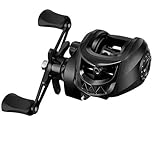
 Daiwa Crossfire LT Spinning Reel
- Hand Orientation: Ambidextrous
- Material: Metal
- Fishing Technique: Spinning


As an Amazon Associate we earn from qualifying purchases at no extra cost to you. Ratings are shown as listed on Amazon.
Decide These 3 Things First
- Choose your main panfish technique. For 1/32- to 1/16-ounce jigs, ice-fishing-style micro plastics, and small live baits, start with a 500 or 1000 reel. For bobbers, 1/8-ounce spinners, and fishing around cover, a 1000 or 1500 gives more useful line capacity.
- Match the reel to line, not just fish size. A reel that holds about 100 yards of 4-pound monofilament or 80 to 120 yards of 8-pound braid is practical for most open-water panfish fishing. If you prefer 6-pound mono, avoid extremely shallow spools unless the capacity is clearly listed.
- Weigh the reel against your rod. A 5.5- to 7-foot ultralight rod usually feels best with a reel weighing roughly 5.5 to 7.5 ounces. A 7- to 7-foot 6-inch light-power rod can comfortably carry a 6.5- to 8.5-ounce 1000 or 1500 reel.
Reel Size: Focus on Spool Capacity and Balance
There is no universal reel-size standard. One company’s 1000 may be close to another company’s 1500, while a reel labeled “size 50” may not resemble a conventional 5000-size saltwater reel at all. Read the manufacturer’s line-capacity chart and reel weight before trusting the number printed on the body.
For finesse panfish fishing, a 500-size reel commonly weighs about 5 to 6.5 ounces. It is a strong choice for small streams, short 5- to 6-foot rods, and anglers who primarily cast 2- or 4-pound mono. The tradeoff is capacity: some 500 reels hold only 70 to 90 yards of 4-pound line, which leaves little room for backing or repeated line trimming.
A 1000-size reel is the sweet spot for most buyers. Expect approximately 6 to 8 ounces, depending on materials and construction. Look for capacity near 100 to 140 yards of 4-pound mono, 80 to 120 yards of 6-pound mono, or roughly 110 to 160 yards of 8-pound braid. This range works well on 6- to 7-foot ultralight and light rods.
A 1500 or 2000-size reel is useful if you fish larger lakes, cast 1/8-ounce lures, use 6-pound mono, or regularly encounter bass, channel catfish, and walleye in the same water. These models often weigh 7 to 9 ounces. They are still light enough for a light-power rod but can feel oversized on a very soft ultralight blank.
For reference, a KastKing Centron 1000-size reel is positioned as an affordable all-purpose small reel, while the KastKing Zephyr 500 size targets a more compact ultralight setup. The Lew’s Mr. Crappie size 50 is designed around crappie fishing, but buyers should compare its stated capacity and weight directly with standard 500- and 1000-size models.
Material: Prioritize a Rigid Body Over Cosmetic Finish
At panfish sizes, low weight matters, but the lightest-looking reel is not automatically the best value. The body material affects gear alignment, durability, and how solid the reel feels when retrieving a lure.
Graphite or composite bodies dominate reels below $50 because they are light and affordable. A 1000-size composite reel can land in the 6- to 7.5-ounce range. This is entirely suitable for bluegill and crappie, especially when the reel is not abused or stored wet. The downside is that lower-cost composite frames can flex more under load than metal frames.
Aluminum spools are worth seeking out. They hold up better to braided line and typically provide a smoother line lay than plastic spools. Most quality panfish reels now include an aluminum spool even when the body is composite. A spare aluminum spool is useful, but not essential, if you want one reel set up with 4-pound mono and another with 8-pound braid.
Aluminum, magnesium, or carbon-reinforced frames are generally found from about $70 upward. They can improve rigidity without adding much weight. For a dedicated panfish outfit, do not pay a premium for exotic materials unless you fish often enough to appreciate the smoother feel, tighter tolerances, and longer service life.
Construction: Check the Parts That Control Line Management
Panfish anglers often use thin, limp line, which exposes poor spool design quickly. Construction details matter more than a high bearing count printed on the box.
Start with the spool lip and oscillation system. A smooth, rounded spool lip helps 2- to 6-pound mono and 6- to 10-pound braid leave the spool with less friction. Even line lay, with no pronounced ridges or deep valleys, reduces loose loops and wind knots. A long-stroke spool may improve line lay, but it is not mandatory on a compact reel.
Then inspect the bail and line roller. The bail should open and close positively without feeling loose. The line roller should turn freely and have no sharp edges. This small part sees constant contact with line, so a rough or sticky roller can twist light monofilament.
For the drag, a realistic target is a maximum rating of about 4 to 8 pounds on a 500 or 1000 reel. You will rarely use more than 1 to 2 pounds of actual drag with 4-pound line, but a drag that adjusts smoothly across that low range is more important than a large maximum number. The Daiwa Crossfire LT’s ATD Type-L drag is an example of the kind of controlled, light-line-oriented drag feature worth considering at an entry-level price.
Finally, favor sealed or corrosion-resistant components if you fish from a kayak, in frequent rain, or near brackish water. For ordinary freshwater use, basic maintenance—loosening the drag after a trip, drying the reel, and replacing old line—often matters more than paying for extensive sealing.
Comfort and Performance: Gear Ratio, Handle, and Retrieve Feel
A gear ratio between 5.0:1 and 6.2:1 covers nearly every panfish technique. A 5.0:1 reel, such as the listed Lew’s Mr. Crappie model, is a sensible choice for slow jig presentations, slip-float fishing, and live bait. Depending on spool diameter, it may retrieve roughly 20 to 25 inches of line per turn.
A 5.2:1 to 5.8:1 ratio is the versatile middle ground. It retrieves slowly enough for a marabou jig but quickly enough to pick up slack after a fish runs toward the boat. Faster ratios around 6.0:1 to 6.2:1 can be useful for small spinners, shallow-running crankbaits, and active perch, but they are not inherently better.
Handle comfort is easy to overlook when shopping online. On a compact reel, look for a handle arm around 1.75 to 2.25 inches from the center shaft to the knob and a knob large enough to grip with cold or wet fingers. A small EVA, rubber, or soft-touch knob is typically more comfortable than a hard, narrow plastic nub. If possible, choose a reversible handle so left- and right-handed anglers can set it up comfortably.
Do not overpay solely for bearings. A 3+1 or 4+1 bearing reel can perform well when its gears, bail, and line roller are properly made. A 6+1 or 7+1 model may feel smoother initially, as with some compact Zephyr configurations, but maintenance and overall construction remain more important than the count.
Price Tiers: Spend for Smoothness Only When You Will Use It
Budget: $20 to $40. This range includes options such as the approximately $24.99 Lew’s Mr. Crappie reel, the $25.19 KastKing Centron 1000, and the roughly $31.53 Daiwa Crossfire LT. Expect composite bodies, aluminum spools on many models, basic drag systems, and weights around 6 to 9 ounces in common panfish sizes. This is the right tier for occasional fishing, kids’ setups, loaner rods, and a first ultralight combo.
Midrange: $40 to $90. Expect smoother gearing, improved line lay, more refined drags, and sometimes better sealing or lighter frame materials. Typical 1000-size weights are 5.5 to 7.5 ounces. This is the best value range for anglers fishing weekly through spring, summer, and fall.
Premium: $90 to $180 or more. Premium small reels can weigh 5 to 7 ounces while maintaining a rigid body, precise drag adjustment, and excellent line management. They make sense for dedicated ultralight anglers, but they will not make a bluegill bite more often. Put part of the budget toward quality line, small jigs, and a rod with a sensitive tip.
Warranty: Read the Service Terms Before Paying More
Warranty length varies widely, from 1 year on entry-level reels to 3, 5, or limited lifetime coverage on higher-end lines. The number alone is not enough. Check whether the brand requires a receipt, charges a service fee, or excludes normal wear items such as line rollers, bail springs, drag washers, and handles.
For a $25 to $40 panfish reel, replacement can be more practical than paid repair once the warranty ends. For a $75 to $150 reel, access to parts and an authorized service department adds meaningful value. Keep the box label or take a photo of the reel’s model number; small-size versions can be difficult to identify later.
Delivery and Assembly: Avoid a Bad First Trip
A spinning reel arrives mostly assembled, but it still needs a five-minute setup. Install the handle, confirm the anti-reverse switch is in the desired position, and check that the bail closes smoothly. Fill the spool to within about 1/16 to 1/8 inch of the spool lip. Underfilling reduces casting distance; overfilling is a leading cause of loops and tangles.
For a 1000-size panfish reel, use about 80 to 120 yards of line. Four-pound monofilament is ideal for clear water and small jigs. Six-pound mono gives more abrasion resistance around docks. Eight-pound braid with a 3- to 6-foot fluorocarbon or mono leader is a practical option for long casts, though braid can make tiny hooks easier to pull free if the drag is set too tight.
On delivery, inspect the spool edge for dents, rotate the handle for grinding or tight spots, and make sure the reel foot fits your rod seat before spooling line. Report shipping damage immediately rather than trying to straighten a bent spool lip at home.
Spec Checklist
| Spec | Budget | Mid | Premium |
|---|---|---|---|
| Recommended size | 500–1500 | 500–1500 | 500–1000 |
| Weight for 1000 size | 6.5–8.5 oz. | 5.8–7.5 oz. | 5–7 oz. |
| Line capacity target | 100+ yd. of 4-lb. mono | 110–140 yd. of 4-lb. mono | 100–140 yd. of 4-lb. mono |
| Gear ratio | 5.0:1–5.8:1 | 5.2:1–6.0:1 | 5.2:1–6.2:1 |
| Drag target | Smooth at 1–2 lb. | Fine low-range adjustment | Fine low-range adjustment and strong startup smoothness |
| Typical price | $20–$40 | $40–$90 | $90–$180+ |
Red Flags
- A 500-size reel with no stated line capacity or weight.
- A plastic spool if you plan to use braided line regularly.
- Drag adjustment that jumps from loose to tight in only a few clicks.
- A rough line roller, bent bail wire, or spool lip with a visible nick.
- Marketing centered on “10 bearings” without details on spool material, drag, or line capacity.
- A reel heavier than 9 ounces paired with a 5.5- to 6-foot ultralight rod.
- Buying a large 3000-size reel simply because it is discounted; it is usually unnecessary for panfish.
FAQ
What spinning reel size is best for panfish?
A 1000-size reel is the safest all-around choice for bluegill, crappie, perch, and sunfish. Choose a 500 size for the lightest 2- to 4-pound line setups, or a 1500 size when using 6-pound line and fishing heavier cover.
Can I use a 2000-size reel for crappie?
Yes. A 2000-size reel works well for crappie, especially on a 7-foot light-power rod or when casting long distances. It is simply larger than necessary for a compact ultralight rod and may reduce balance.
Is 4-pound or 6-pound line better for panfish?
Use 4-pound mono for clear water, small jigs, and cautious fish. Use 6-pound mono around vegetation, brush piles, docks, and mixed-species water. Both fit well on most 1000-size reels when capacity is at least 100 yards of 4-pound line.
Do I need a high gear ratio for panfish fishing?
No. A 5.0:1 to 5.8:1 ratio is ideal for most panfish presentations because it supports slow, controlled retrieves. Choose roughly 6.0:1 only if you frequently retrieve small spinners quickly or need to take up slack fast.



Write Your Review
No reviews yet. Be the first to share your experience!