
Key takeaways
- Choosing by number alone: A No. 1 from one manufacturer may not match the gap of another brand’s No. 1. Compare dimensions and product photos when available.
- Using a hook that is too small: If the point is buried or the gap is filled by plastic, hookups can suffer.
- Using a hook that is too large: Oversized hooks add weight, restrict the worm’s movement, and can cause the bait to sink unnaturally fast.
- Ignoring wire thickness: Heavy-wire hooks are stronger but may require a larger size to provide the same usable gap.
- Forgetting the weed guard: A guard takes up some of the working space near the point. If the rig feels crowded, move up one size rather than trimming the guard immediately.
- Hooking the exact center every time: Center rigging is a reliable starting point, but a slightly off-center position can change the fall and may better suit a tapered worm.
Choosing the right hook size for a wacky rig depends mainly on the length and thickness of the soft-plastic worm, the amount of hook exposure you want, and whether you are fishing around weeds or cover. For most bass worms, sizes from No. 2 through 1/0 cover the majority of situations.
The Short Answer
Use a No. 4 hook for small finesse worms measuring about 3 to 4 inches, a No. 2 or No. 1 for standard 4- to 5-inch worms, and a 1/0 hook for bulky 5- to 6-inch worms. A 2/0 is usually reserved for large, thick-bodied worms or when you need a wider gap for a better hookup.
Our top picks

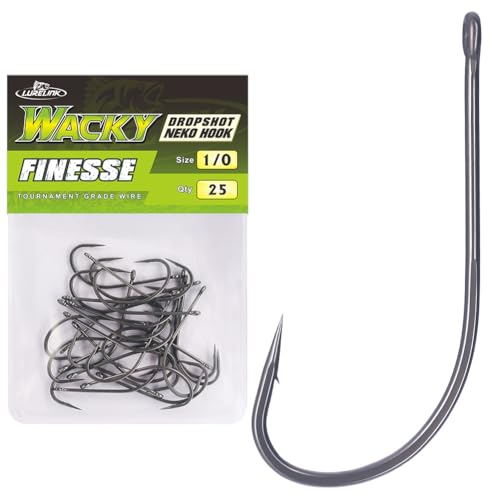

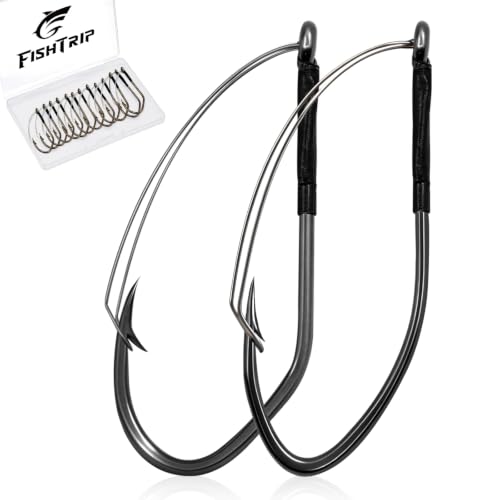
As an Amazon Associate we earn from qualifying purchases at no extra cost to you. Ratings are shown as listed on Amazon.
For an all-purpose wacky rig, a No. 1 weedless wacky hook is the safest starting point. It provides enough gap for common bass worms without overpowering the bait. Choose a weedless model when fishing grass, brush, or laydowns; use an exposed hook in open water for the best penetration.
Hook numbering can be confusing: as numbered hooks get smaller, the number gets larger. A No. 4 is smaller than a No. 1, while 1/0 is larger than No. 1. The measurements below are practical estimates because hook dimensions vary by brand, wire diameter, bend, and weed-guard design.
Standard Sizes
| Hook size | Approx. overall length | Approx. gap | Recommended worm length | Best use |
|---|---|---|---|---|
| No. 4 | 0.50 in (1.3 cm) | 0.22 in (0.6 cm) | 3–4 in (7.6–10.2 cm) | Small finesse worms and pressured bass |
| No. 2 | 0.62 in (1.6 cm) | 0.28 in (0.7 cm) | 4–4.5 in (10.2–11.4 cm) | Light-to-medium wacky rigs |
| No. 1 | 0.70 in (1.8 cm) | 0.33 in (0.8 cm) | 4–5 in (10.2–12.7 cm) | Best general-purpose bass size |
| 1/0 | 0.80 in (2.0 cm) | 0.38 in (1.0 cm) | 5–6 in (12.7–15.2 cm) | Thick worms and heavier cover |
| 2/0 | 0.95 in (2.4 cm) | 0.44 in (1.1 cm) | 6–7 in (15.2–17.8 cm) | Large worms and aggressive hooksets |
These dimensions refer to the approximate metal profile of a wacky-style hook, not a guaranteed measurement for every package. A straight-shank worm hook, drop-shot hook, and purpose-built wacky hook can share the same size number while having noticeably different gaps and lengths.
Purpose-built wacky hooks generally have a short shank, a wide gap, and an eye positioned to keep the point aligned with the worm. Weedless versions add a wire or fiber guard across the point. That guard improves snag resistance but can require slightly more pressure during the hookset.
How to Measure Your Space
With wacky rigs, “space” means the available hook gap around the worm and the amount of hook point that can contact a fish’s mouth. Use these steps before choosing a size:
- Measure the worm length. Lay the bait straight and measure from nose to tail. A No. 4 generally suits 3- to 4-inch baits, while a No. 1 suits many 4- to 5-inch worms.
- Measure the worm thickness. Use a ruler or caliper at the thickest point. A thin 5-inch worm may fish better on a No. 2 than a thick 4-inch worm, which may need a No. 1 or 1/0.
- Compare the hook gap. The gap should extend around the worm without being completely filled by it. As a working rule, leave roughly 1/8 inch (0.3 cm) of visible space between the plastic and the hook point when the bait is rigged.
- Check hook-point exposure. After inserting the hook through the middle of the worm, the point should sit close to the surface rather than being buried deeply in the plastic. Too little exposure reduces hookups.
- Test the bait’s action. A hook that is too large can make a finesse worm sink faster and glide less naturally. If the worm falls stiffly or rolls, step down one size.
- Account for cover. Around weeds, use a weedless hook and consider one size larger if the guard and thicker wire make the package feel crowded.
By Room or Use Case
Open-water finesse fishing
For clear lakes, suspended bass, docks, and lightly pressured water, choose a No. 4 or No. 2 hook with a thin wire. These sizes keep a small worm lively and allow it to flutter naturally on a light line. A 3- to 4-inch worm paired with a No. 4 is especially useful when bass are feeding on small forage.
Everyday 4- to 5-inch worms
A No. 1 is the most versatile choice for standard bass worms. It offers a useful balance of hook exposure, bait action, and holding strength. This is the size to buy first if you are building a basic wacky-rig assortment and do not yet know which worms you will fish most often.
Weeds, brush, and laydowns
Use a weedless No. 1 or 1/0 when the rig will pass through cover. Weedless wacky hooks from brands such as Harmony Fishing, Dovesun, and FishTrip are commonly sold in this range. A guarded hook can reduce snags, but it may not penetrate as easily as an exposed-point design, so maintain a firm, controlled hookset.
Large or thick-bodied worms
Choose 1/0 for a thick 5- to 6-inch worm and 2/0 for a large 6- to 7-inch bait. Do not select a 2/0 simply because the worm is long; thickness and gap are more important. An oversized hook can damage the bait, reduce its subtle fall, and make the rig look unnatural.
Budget and multipack buying
Wacky hooks commonly cost about $9 to $11 per pack, depending on the finish, weed guard, wire strength, and quantity. Example packs range from about 10 hooks to 30 hooks, with bulk drop-shot and wacky assortments often offering the lowest cost per hook. Check the actual quantity before comparing prices: a $9.99 10-pack costs substantially more per hook than a $10.99 25-pack.
Common Sizing Mistakes
- Choosing by number alone: A No. 1 from one manufacturer may not match the gap of another brand’s No. 1. Compare dimensions and product photos when available.
- Using a hook that is too small: If the point is buried or the gap is filled by plastic, hookups can suffer.
- Using a hook that is too large: Oversized hooks add weight, restrict the worm’s movement, and can cause the bait to sink unnaturally fast.
- Ignoring wire thickness: Heavy-wire hooks are stronger but may require a larger size to provide the same usable gap.
- Forgetting the weed guard: A guard takes up some of the working space near the point. If the rig feels crowded, move up one size rather than trimming the guard immediately.
- Hooking the exact center every time: Center rigging is a reliable starting point, but a slightly off-center position can change the fall and may better suit a tapered worm.
FAQ
What is the best hook size for a 5-inch wacky worm?
Start with a No. 1 hook. Move to 1/0 if the worm is thick, heavily salted, or used around cover. Choose No. 2 if the worm is unusually thin and you want a slower, more delicate fall.
Is a No. 1 hook bigger than a No. 2?
Yes. In standard numbered sizing, No. 1 is larger than No. 2. The order from smaller to larger generally runs No. 4, No. 2, No. 1, 1/0, and 2/0.
Should wacky-rig hooks be weedless?
Use weedless hooks around vegetation, brush, and wood. In open water, an exposed hook usually penetrates more easily and can improve hookup performance. Keep both styles available if you fish a variety of cover.
Can I use a regular worm hook for a wacky rig?
You can, but a traditional offset worm hook is not always ideal. Its longer shank and different bend may limit the worm’s action. A dedicated wacky, drop-shot, or finesse hook with a suitable gap usually presents the bait more naturally.




Write Your Review
No reviews yet. Be the first to share your experience!