
Key takeaways
- Repeatable lure placement: You can return a bait to the same distance after a strike, snag, or line reset. This is the primary reason to buy one.
- Better trolling control: Different line lengths let you spread lures across multiple depths and distances. That can reduce tangles and make it easier to identify where fish are active.
- Useful for multiple anglers: A counter gives everyone a simple instruction, such as “let out 50 feet,” instead of relying on vague descriptions like “a little farther back.”
- Helpful in low-visibility conditions: At dawn, dusk, or in murky water, the number on the counter is easier to repeat than judging line angle alone.
- Affordable entry point: Basic models often cost about $50 to $80, so the feature does not require a premium offshore reel.
- Levelwind convenience: Many trolling models guide line back and forth across the spool, making them easier to operate for anglers who do not want to manually thumb the line into place.
- Good for predictable presentations: Crankbaits, planer boards, downriggers, and trolling spoons all benefit when you can repeat a known amount of line.
The Short Answer
Yes—a line counter reel is worth it if you regularly need to place a lure or bait at a repeatable depth or distance. That is the one condition that matters: if knowing whether your presentation is 20, 40, or 80 feet down will improve your fishing, the counter can quickly justify its added cost.
If you mostly cast from shore, pitch jigs around cover, or fish water where depth changes constantly, a line counter is less useful. It adds money, weight, and one more component that can be damaged or misread. For those anglers, a standard spinning or baitcasting reel is usually the better buy.
Our top picks


As an Amazon Associate we earn from qualifying purchases at no extra cost to you. Ratings are shown as listed on Amazon.
In 2026, useful line counter reels generally cost about $50 to $150, with heavier, more refined models reaching $200 or more. The best value depends less on the display itself than on the reel’s drag, line capacity, retrieve speed, and resistance to corrosion.
What You Actually Get
A line counter reel measures how much line leaves the spool. Most counters display feet, although the reading is an estimate rather than a precision depth gauge. If you let out 60 feet of line, the reel may show approximately 60 feet, but the actual lure depth also depends on trolling speed, lure design, line diameter, current, and the amount of line angle.
The feature is especially useful for trolling. Suppose a fish hits when your lure is roughly 45 feet behind the boat. With a line counter, you can repeat that distance instead of guessing. It also helps you stagger several rods at different lengths, such as 25, 40, and 60 feet, to cover more of the water column.
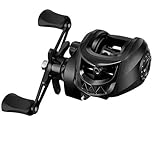
A typical counter reel includes a levelwind that distributes line across the spool, a mechanical or digital distance display, a drag system, and a gear train designed for steady retrieves. Some are conventional round reels built for trolling. Others are low-profile designs that feel more familiar to bass and inshore anglers.
The Okuma Magda Pro Line Counter Levelwind Trolling Reel MA-20DXT illustrates the inexpensive conventional approach. At about $54.99, it is aimed at anglers who want a dedicated trolling setup without spending much. The Okuma Convector low-profile reel, listed around $93.25, offers a more compact format and a 5.4:1 gear ratio, which may appeal to anglers who prefer a baitcasting-style profile.
Neither reel turns the counter into a fish finder. The display tells you how much line is out, not exactly how deep the lure is. That distinction is important. Line count is most valuable as a repeatability tool: it helps you reproduce a productive presentation after you have already found it.
Pros
- Repeatable lure placement: You can return a bait to the same distance after a strike, snag, or line reset. This is the primary reason to buy one.
- Better trolling control: Different line lengths let you spread lures across multiple depths and distances. That can reduce tangles and make it easier to identify where fish are active.
- Useful for multiple anglers: A counter gives everyone a simple instruction, such as “let out 50 feet,” instead of relying on vague descriptions like “a little farther back.”
- Helpful in low-visibility conditions: At dawn, dusk, or in murky water, the number on the counter is easier to repeat than judging line angle alone.
- Affordable entry point: Basic models often cost about $50 to $80, so the feature does not require a premium offshore reel.
- Levelwind convenience: Many trolling models guide line back and forth across the spool, making them easier to operate for anglers who do not want to manually thumb the line into place.
- Good for predictable presentations: Crankbaits, planer boards, downriggers, and trolling spoons all benefit when you can repeat a known amount of line.
Cons
- The reading is not lure depth: A display showing 50 feet does not mean the lure is 50 feet deep. Trolling speed, line type, current, and lure resistance can change the result significantly.
- Added bulk and weight: Conventional line counter reels can feel noticeably larger than comparable casting reels. That matters when you are casting all day rather than holding a rod in a holder.
- More things can go wrong: Counters, levelwinds, and small internal gears add complexity. Saltwater, sand, impact, and poor storage can shorten their useful life.
- Less useful for casting: The counter measures line leaving the spool, not casting accuracy or lure depth. It does not replace spool control or a good distance judgment.
- Counter accuracy varies: Line diameter, spool fill, and how tightly line is packed affect the number shown. A reel spooled differently from its original calibration may not read perfectly.
- Display visibility can be limited: Small mechanical counters may be difficult to read in glare or at night. Digital displays may be easier to see but can require batteries and careful maintenance.
- Potential line-management frustration: A levelwind helps, but it does not eliminate backlashes, crossed line, loose wraps, or poorly filled spools.
Who Should Buy It
Buy a line counter reel if you troll frequently and make decisions based on line distance. It is a particularly good fit for anglers targeting walleye, salmon, trout, striped bass, lake trout, and other species where lure depth and distance matter. It also makes sense for charter guests, families, and newer anglers who need a straightforward way to reproduce a productive setup.
It is worth considering when you fish from a boat with two or more lines. For example, a counter lets you place one lure at 30 feet, another at 50 feet, and a third at 70 feet without relying on memory. If one rod produces a bite, you have a useful starting point for resetting the other rods.
A budget reel around $50 to $80 can be enough for occasional freshwater trolling. Spending about $90 to $150 becomes more reasonable if you fish often, need smoother drag performance, want a lower-profile body, or expect the reel to handle larger fish and heavier line. Choose capacity based on the line you use and the amount of backing or lead-core line required—not just on the counter feature.
Who Should Skip It
Skip it if you mainly cast artificial lures, fish from shore, or move constantly between shallow cover and structure. A standard spinning reel or casting reel will usually be lighter and more versatile. You can estimate distance by counting pulls of line, marking the line, or using a consistent casting motion when exact trolling placement is not part of your strategy.
It is also a poor choice if you expect the counter to provide exact lure depth. Anglers who need true depth information may be better served by a downrigger, depth-adjusted presentation, sonar, or a combination of line-counter data and a known lure-diving curve.
Cheaper Alternatives
| Option | Cost | Trade-off |
|---|---|---|
| Standard spinning reel | $25–$70 | Lower cost and lighter handling, but no direct line-distance reading and less convenient for repeatable trolling. |
| Standard baitcasting reel | $50–$120 | Good casting control and compact size, but you must estimate or manually mark how much line is out. |
| Line marker or colored backing | $5–$20 | Inexpensive way to mark repeatable distances, though marks can fade and are harder to use in poor light. |
| Manual line-counting method | $0–$10 | Count pulls, rod lengths, or arm lengths to approximate distance; slow and inconsistent, especially with several rods. |
| Okuma Magda Pro MA-20DXT | About $54.99 | Affordable dedicated counter reel, but its conventional trolling format may feel bulky for all-day casting. |
| Okuma Convector low-profile reel | About $93.25 | More compact baitcasting-style design with a 5.4:1 gear ratio, but it costs more than basic counter reels. |
FAQ
Are line counter reels accurate?
They are accurate enough for repeatable line deployment when spooled and used consistently, but they are not laboratory measuring devices. The reading can change with line diameter, spool fill, line tension, and wear. Treat the number as a reliable reference for repeating a setup, not as an exact measurement of lure depth.
Can you use a line counter reel for casting?
Yes, but it may not be the ideal tool. A low-profile model can cast reasonably well, while a large conventional trolling reel may feel heavy and awkward. The counter can show how far line leaves the spool, but it does not improve casting distance, prevent backlash, or tell you where the lure is in the water column.
Do you need a line counter for trolling?
No. You can troll successfully by estimating line angle, using marked line, counting line pulls, or fishing with a downrigger. However, a counter saves time and makes productive distances easier to duplicate. The more often you troll multiple rods or target a specific depth zone, the more valuable it becomes.
What should you check before buying one?
Check line capacity, drag range, gear ratio, retrieve rate, corrosion resistance, counter readability, and replacement-parts support. Confirm that the reel holds your preferred line with enough reserve for a long run. For occasional freshwater use, a basic model may be sufficient. For frequent or saltwater use, prioritize sealed or corrosion-resistant components, a dependable drag, and easy cleaning over the lowest price.



Write Your Review
No reviews yet. Be the first to share your experience!