
Key takeaways
- Faster slack-line pickup: High-speed reels can recover several feet of loose line quickly, which helps after long casts or when a lure changes direction.
- More efficient lure presentations: Anglers fishing jerkbaits, buzzbaits, topwaters, and certain soft plastics can maintain a brisk retrieve without spinning the handle excessively.
- Quicker follow-up casts: A fast retrieve gets the lure back to the boat or bank sooner, allowing more casts during a short fishing window.
- Better control around cover: Once a fish is hooked near grass, docks, or timber, rapid line pickup can help move it toward open water—provided you still use the rod and drag correctly.
- Useful for moving fish: When a fish runs toward you, speed helps prevent the line from going slack.
- Versatility for experienced anglers: It is usually easier to slow down a fast reel with your hands and lure choice than to make a slow reel retrieve line faster.
- Good value at moderate prices: A capable fast baitcaster can cost roughly $60 to $120, while many suitable spinning reels fall between $80 and $160.
The Short Answer
Yes—high gear ratio reels are worth it if you regularly need to pick up slack line quickly, make repeated casts, or work fast-moving lures. The condition is that your fishing style must benefit from speed more than maximum cranking power.
A high gear ratio is not automatically an upgrade. It changes how the reel feels and performs. You turn the handle fewer times to retrieve the same amount of line, but each turn generally requires more effort under load. For many anglers, a mid-range ratio is the better all-around choice; for specific techniques, a fast reel can save time and improve lure control.
Our top picks


As an Amazon Associate we earn from qualifying purchases at no extra cost to you. Ratings are shown as listed on Amazon.
What You Actually Get
A reel’s gear ratio describes how many times the spool or rotor turns for each full turn of the handle. A 6.4:1 baitcasting reel, for example, turns the spool 6.4 times per handle rotation. A 7.1:1 or faster reel retrieves line more quickly, assuming the spool diameter and line level are similar.
Gear ratio is only part of the equation. Inches per turn (IPT) is often more useful because it tells you how much line the reel retrieves with one handle rotation. A larger spool can collect more line per turn than a smaller spool with the same ratio. IPT also drops as line leaves the spool, so the stated maximum is not constant throughout a cast.
In practical terms, a fast reel helps you remove slack after a long cast, keep a lure moving quickly, and reposition for the next cast. It can also help when a fish swims toward you. The trade-off appears when a fish, lure, or snag creates heavy resistance. The handle may feel less powerful, and a fast reel can tempt you to retrieve too aggressively.
For perspective, a reel in the 6.2:1 to 7.5:1 range is commonly considered fast for baitcasting. Spinning reels are often discussed by retrieve rate rather than ratio, because their rotor and spool design make direct comparisons less useful. A 5000-size spinning reel, such as the Piscifun NautiX with a listed 33-pound maximum drag, is built around line capacity and power as much as speed. Its listed price is $104.99, so it belongs in the midpriced category rather than the bargain tier.
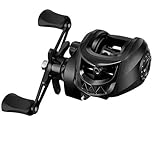
The KastKing Megatron 200 baitcaster is listed with a 6.4:1 ratio and a $67.99 price. That ratio is a practical middle-to-fast setting: quick enough for many soft plastics, topwaters, and reaction baits without being an extreme-speed specialist. Actual performance still depends on spool size, bearings, drag condition, line diameter, and how much line is loaded.
Pros
- Faster slack-line pickup: High-speed reels can recover several feet of loose line quickly, which helps after long casts or when a lure changes direction.
- More efficient lure presentations: Anglers fishing jerkbaits, buzzbaits, topwaters, and certain soft plastics can maintain a brisk retrieve without spinning the handle excessively.
- Quicker follow-up casts: A fast retrieve gets the lure back to the boat or bank sooner, allowing more casts during a short fishing window.
- Better control around cover: Once a fish is hooked near grass, docks, or timber, rapid line pickup can help move it toward open water—provided you still use the rod and drag correctly.
- Useful for moving fish: When a fish runs toward you, speed helps prevent the line from going slack.
- Versatility for experienced anglers: It is usually easier to slow down a fast reel with your hands and lure choice than to make a slow reel retrieve line faster.
- Good value at moderate prices: A capable fast baitcaster can cost roughly $60 to $120, while many suitable spinning reels fall between $80 and $160.
Cons
- Less mechanical advantage: A high ratio behaves somewhat like a bicycle in a high gear. It is fast, but it can feel harder to turn when pulling a deep-diving crankbait, heavy spinnerbait, or large fish.
- More angler fatigue in power applications: Repeatedly cranking against heavy resistance can tire your wrist and forearm faster than using a lower-ratio reel.
- Greater risk of overworking the lure: Beginners often retrieve too quickly simply because the reel allows it. Some presentations need a slow, steady pace.
- Not a substitute for drag quality: A fast gear set does not make a reel’s drag smoother or stronger. Drag performance, frame rigidity, spool control, and handle design remain important.
- Potentially higher maintenance demands: High-speed gears can be less forgiving when contaminated by grit, salt, or inadequate lubrication. Rinse and maintain saltwater gear according to the manufacturer’s instructions.
- Gear ratio can be misleading: Two reels with identical ratios may have different IPT figures. Comparing the ratio alone can result in the wrong purchase.
- More expensive versions are not automatically better: Spending $150 to $300 may buy improved materials, sealing, bearings, or ergonomics, but it will not make every fishing technique faster or more effective.
Who Should Buy It
Buy a high gear ratio reel if your regular techniques depend on quick line management. It is particularly useful for anglers who fish topwaters, frogs, buzzbaits, lipless crankbaits, jerkbaits, swim jigs, or soft-plastic rigs that require frequent slack pickup. It also makes sense if you often cast from shore and need to retrieve a lure across shallow water without wasting time.
A fast baitcaster is a good choice for an experienced angler who already controls retrieve speed with the rod and handle. A 6.4:1 model is a sensible compromise for someone who wants noticeably quicker pickup without selecting an extreme 8:1-or-faster reel.
Choose a high-speed spinning reel when you need capacity, smooth line flow, and quick recovery from long casts. A 4000- or 5000-size reel can suit larger lures and heavier line, but size, weight, and balance matter. A reel that weighs roughly 10 to 13 ounces may feel tiring on a light rod during a full day of casting, even if its retrieve rate is attractive.
Who Should Skip It
Skip a high gear ratio if you mainly fish deep-diving crankbaits, large swimbaits, umbrella rigs, heavy spinnerbaits, or other high-resistance lures. A lower ratio, often around 5.1:1 to 6.3:1 for baitcasters, gives you more cranking leverage and can make a demanding retrieve smoother.
It may also be the wrong choice for a first and only reel if your fishing is varied and you do not yet know which techniques you prefer. A moderate ratio around 6.2:1 to 6.6:1 is typically easier to adapt to than a specialized very-fast model. Anglers with wrist, hand, or shoulder discomfort should prioritize low weight, a comfortable handle, and smooth resistance over headline speed.
Cheaper Alternatives
| Option | Cost | Trade-off |
|---|---|---|
| Moderate-ratio baitcaster, roughly 6.2:1 to 6.6:1 | $45–$80 | Slower slack pickup, but better all-around balance and often more cranking comfort. |
| Entry-level spinning reel, 2500–4000 size | $25–$60 | Lower upfront cost and easy casting, but usually less line capacity, drag refinement, and durability than a midpriced model. |
| KastKing Megatron 200, 6.4:1 baitcaster | $67.99 | Affordable speed and a versatile ratio, but it may lack the refinement or long-term sealing of more expensive reels. |
| Standard-speed reel already in your tackle box | $0 additional cost | You save money, but must compensate with faster handle work when a presentation requires rapid line pickup. |
| Piscifun NautiX 5000 spinning reel | $104.99 | More capacity and a listed 33-pound maximum drag, but a 5000-size reel can be unnecessarily large for light freshwater presentations. |
The least expensive alternative is often not a new reel. If your current reel is smooth, holds appropriate line, and has a reliable drag, changing line diameter or adjusting your retrieve technique may solve the problem. Thinner line generally comes off the spool more easily and can increase practical distance, although it must still match the cover, target species, and line rating.
FAQ
Is a 6.4:1 gear ratio considered high?
It is generally a moderate-to-fast baitcasting ratio. It provides useful line pickup for many common techniques without being as specialized as a reel above roughly 7.5:1. Whether it feels fast depends on spool diameter and line level, so check the manufacturer’s IPT specification when available.
Are high gear ratio reels harder to use?
Not necessarily. They can be easy to use for casting and slack management, but they require more discipline when a lure needs a slow presentation. They may also feel harder to crank under heavy resistance. Beginners can use one successfully if they practice controlling speed with the handle rather than automatically turning as fast as possible.
Do high gear ratio reels cast farther?
Gear ratio alone does not determine casting distance. Spool design, brake settings, bearing condition, line diameter, lure weight, rod action, and casting technique matter more. A fast reel may help you retrieve the lure and make another cast sooner, but it will not automatically add distance to each cast.
What gear ratio should an all-purpose angler choose?
For a baitcaster, a ratio around 6.2:1 to 6.6:1 is a practical starting point. It is fast enough for many moving baits and soft plastics while retaining reasonable cranking leverage. Pair that with a comfortable rod and a reel that balances well; those factors usually matter more than choosing the fastest available gear set.



Write Your Review
No reviews yet. Be the first to share your experience!