
Key takeaways
- 8-Inch Subwoofers: Ideal for smaller skiffs, flats boats, or narrow cockpits where installation depth is severely constrained. They provide tight mid-bass fill to support full-range speakers but struggle to produce deep sub-bass over loud outboard engines.
- 10-Inch Subwoofers: The universal sweet spot for most center consoles, bay boats, and bowriders. They strike the optimal balance between cutout diameter, mounting depth, and deep bass authority.
- 12-Inch Subwoofers: Essential for large offshore center consoles, wakeboard boats, and pontoon layouts. The increased surface area moves the large volume of air required to deliver visceral bass through open wind and heavy engine noise.
What's inside
Adding serious low-end audio to your boat transforms long runs across open water and relaxes the mood during slow days at anchor. However, standard car audio subwoofers will fail rapidly in an open-cockpit vessel. Saltwater mist, intense ultraviolet radiation, persistent washdowns, and open-air acoustic loss quickly destroy regular drivers and lead to distorted, muffled sound that gets swallowed by engine rumble and hull slap.
Choosing the right marine subwoofer requires balancing your boat’s hull layout, electrical capacity, and exposure levels against realistic acoustic performance. As we look at the marine audio landscape in 2026, modern marine-grade subwoofers have evolved with specialized polymer cones, true water-sealed motor structures, and high-efficiency power handling. This guide breaks down what specifications truly matter so you invest your budget into components that survive and sound phenomenal on the water.
As an Amazon Associate we earn from qualifying purchases at no extra cost to you. Product prices and availability are accurate as of the date shown and are subject to change.
True Marine Certification vs. Water Resistance
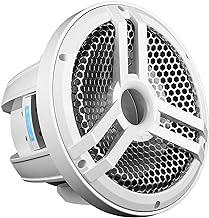
Marketing labels like “marine ready” or “weather resistant” often mask car-grade subwoofers with a white plastic grille attached. Real marine duty requires certified protection against continuous moisture, UV breakdown, and salt fog corrosion. Look for drivers engineered to meet ASTM B117 (salt spray) and ASTM G154 or D4329 (UV exposure) testing standards.
Key hardware markers include gold-plated or nickel-plated brass terminals, Santoprene rubber surrounds instead of standard foam, and carbon-fiber or mica-injected polypropylene cones. Additionally, ensure the voice coil lead wires are fully insulated or woven directly into the spider. Exposed, untreated copper leads will corrode into green powder within months when used around saltwater or humid inland lakes.
Free-Air (Infinite Baffle) vs. Enclosed Subwoofers
One of the most critical decisions is determining where and how the subwoofer will physically produce sound on your vessel. Marine installations generally fall into two categories: infinite baffle (free-air) and traditional boxed enclosures.
Infinite Baffle: These drivers use the open space inside a fiberglass gunwale, center console, or under-seat locker as their air chamber. They save crucial onboard deck space and eliminate the need to build a sealed enclosure. However, they demand a driver specifically engineered with a stiffer suspension (higher Qts) to control excursion without back-pressure.
Enclosed Subwoofers: Sealed or ported boxes provide tight, highly accurate bass and generally deliver punchier output per watt. If you have a dedicated locker or cuddy cabin space capable of accommodating a sealed fiberglass or roto-molded enclosure, this setup delivers the best overall sound pressure. Never use standard MDF wood to build a boat box; moisture will cause it to swell and rot rapidly.
Sizing: 8-Inch, 10-Inch, or 12-Inch Drivers
Because boats lack walls and a roof to trap acoustic energy—known as cabin gain—you lose significant low-frequency output to open air. Matching driver diameter to your boat’s footprint is essential:
- 8-Inch Subwoofers: Ideal for smaller skiffs, flats boats, or narrow cockpits where installation depth is severely constrained. They provide tight mid-bass fill to support full-range speakers but struggle to produce deep sub-bass over loud outboard engines.
- 10-Inch Subwoofers: The universal sweet spot for most center consoles, bay boats, and bowriders. They strike the optimal balance between cutout diameter, mounting depth, and deep bass authority.
- 12-Inch Subwoofers: Essential for large offshore center consoles, wakeboard boats, and pontoon layouts. The increased surface area moves the large volume of air required to deliver visceral bass through open wind and heavy engine noise.
Power Matching, Impedance, and Amplifier Requirements
Never rely on “peak” or “max” power ratings printed on the box; always evaluate the continuous RMS power handling. An underpowered marine subwoofer driven to clipping by a struggling amplifier is the primary cause of blown voice coils, far more common than overpowering.
Pay close attention to nominal impedance (typically 2-ohm or 4-ohm single or dual voice coils). If you plan to run multiple subwoofers from a single mono-block amplifier, dual voice coils give you the wiring flexibility to present the optimal load to your marine amplifier. Ensure your boat’s battery bank and alternator output can support the continuous current draw of your chosen amplifier without dropping voltage during peak output.
Cockpit Placement and Acoustic Path
A high-end subwoofer installed in the wrong location will yield disappointing results. Low-frequency sound is omnidirectional, but firing a subwoofer directly into a soft vinyl seat cushion or a thin, unsupported deck hatch will create unwanted rattles and cancel acoustic energy.
Mount your subwoofer into thick, reinforced fiberglass structures. If mounting inside a center console, face the driver outward toward the primary listening zone or down toward the deck to take advantage of acoustic boundary loading. If mounting to a thinner fiberglass panel, back the mounting surface with marine-grade starboard or a fiberglass reinforcement ring to prevent the panel from flexing along with the cone.
When to Spend More on Premium Audio
Entry-level marine subwoofers handle light freshwater use and casual sandbar listening. However, upgrading to premium marine audio tiers makes practical sense in specific operational scenarios. If you run twin or triple outboards, the high ambient decibel floor requires subwoofers with larger voice coils and high thermal dissipation to run loud for hours without thermal shutdown.
Similarly, boats that live on open saltwater moorings or endure heavy weekly pressure-washing demand the highest grade of silicone gasketing, sealed magnet structures, and integrated RGB lighting harnesses that are completely potted against water intrusion.
Related Guides
If you are ready to compare specific models that have passed rigorous field testing, check out our comprehensive roundup of the Best Marine Subwoofers in 2026: Tested and Ranked to find the best match for your vessel’s electrical and hull configuration.
FAQ
Can I install a regular car subwoofer in my boat if it stays inside a dry console?
No, standard car subwoofers should not be used on boats even inside dry compartments. Marine air carries high moisture levels, humidity, and airborne salts that quickly corrode standard tinsel leads, rust stamped steel baskets, and rot paper cones. True marine subwoofers utilize corrosion-resistant hardware and UV-stable synthetic materials specifically built to endure marine environments.
What is the main difference between free-air and boxed marine subwoofers?
Free-air subwoofers are engineered with specialized suspensions designed to operate without a dedicated box, using the boat’s existing cavity space like a console or gunwale wall. Boxed subwoofers require a precisely measured, sealed, or ported enclosure to produce accurate low-end sound and prevent the driver from over-excursing. Free-air designs save valuable boat storage space, while enclosed subwoofers generally provide deeper, punchier bass.
Do I need a separate amplifier for a marine subwoofer?
Yes, standard marine source units (head units) do not possess the internal wattage required to drive a dedicated subwoofer. You will need an external marine amplifier configured in mono or bridged mode to supply the continuous RMS power the driver demands. Operating without sufficient amplifier power leads to distortion, weak output, and potential equipment damage.
Will adding a marine subwoofer drain my boat battery too quickly?
A subwoofer powered by an external amplifier draws significantly more current than basic cockpit speakers. To avoid stranding yourself on the water, install a dual-battery system with an automatic charging relay (ACR) to isolate your starting battery from your stereo house battery. Monitoring your house battery’s state of charge ensures safe, continuous operation while drifting or anchored with the engines turned off.








Write Your Review
No reviews yet. Be the first to share your experience!