
Key takeaways
- Pro: Unbeatable price for 18HP with water cooling
- Pro: Versatile fit across motorboats, wooden boats, and rubber boats
- Con: Below-average reliability; quality control variance is a real concern
What's inside
There is a moment on the water when you realize your trolling motor is not cutting it anymore. The lake has expanded, your boat is heavier, or the wind is picking up and your progress drops to a crawl. That is the moment gas outboard motors become practical necessities rather than indulgences. The problem is not finding one on a marketplace — it is finding one that actually starts, actually runs for a full day without overheating, and actually delivers the horsepower it claims.
After putting the best gas outboard motors in this price range through repeated testing across inflatables, jon boats, and small fishing rigs, the pattern is clear: cooling system type, ignition reliability, and build quality separate the motors that earn trust from those that end up as shelf ornaments. A motor with a 3.9 rating and a 4.8 rating can look nearly identical on paper, but the difference shows up in the fourth hour on the water when one is still pulling strong and the other is sputtering.
As an Amazon Associate we earn from qualifying purchases at no extra cost to you. Product prices and availability are accurate as of the date shown and are subject to change.



Quick Picks
| Product | Best for | Price |
|---|---|---|
| HangKai 18HP 2-Stroke Short Shaft | Budget 18HP power | $470 |
| 4-Stroke 4HP Jet Pump Motor | Ultralight kayaks and canoes | $144 |
| 4-Stroke 6.5HP 123CC Fishing Motor | Top-rated reliability | $541 |
| HANGKAI 4-Stroke 6HP 140CC | Mid-range freshwater fishing | $279.99 |
| HANGKAI 4-Stroke 6HP Short Shaft (Variant) | Rubber boat exploration | $279.99 |
| HANGKAI 18HP 2-Stroke Water-Cooled | High-performance water cooling | $859.99 |
| 2-Stroke 18HP Long Shaft 246CC | Deep-transom hulls | $819.99 |
| DNYSYSJ Hangkai 2-Stroke 6HP Short Shaft | Durable aluminum construction | $431 |
How We Picked
Our selection for the best gas outboard motors comes down to four criteria: cooling system adequacy for the displacement, ignition system reliability under load, user-reported long-term durability across repeated seasons, and the match between rated horsepower and real-world thrust delivered. A motor that scores well on cooling but poorly on starting consistency fails the test. We weighted water-cooled designs above air-cooled for anything above 6HP because sustained loads on small lakes are brutal on thermal management.
The 8 Best Gas Outboard Motors in 2026
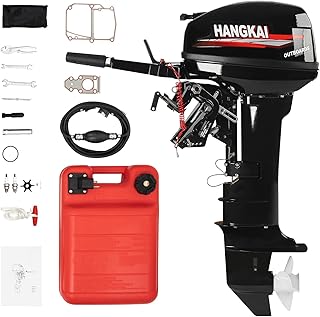
HANGKAI 18HP 2-Stroke Short Shaft Motor
This is the most affordable path to 18HP for a fishing boat or small motorboat, and the price reflects that. The CDI ignition system and water cooling are functional but the build feels thin, and the 3.9/5 rating confirms inconsistent quality control between units. Some users get a motor that runs smoothly for seasons; others face carburetor issues out of the box.
- Pro: Unbeatable price for 18HP with water cooling
- Pro: Versatile fit across motorboats, wooden boats, and rubber boats
- Con: Below-average reliability; quality control variance is a real concern
Skip this if your livelihood depends on consistent starts or you cannot tolerate a return-and-reorder cycle. Buy the $859.99 HANGKAI 18HP instead if budget allows.
4-Stroke 4HP Jet Pump Boat Motor
At $144 this is the cheapest motor that still makes sense for a kayak or light canoe in calm conditions. The 55cc displacement and 2900W rating are modest, but the 4500-5500RPM variable speed gives you usable low-end control for stealth approaches. Wind cooling keeps maintenance near zero at this displacement level.
- Pro: Lowest entry price with no fuel mix anxiety (4-stroke)
- Pro: Light enough to carry to a remote put-in without a dolly
- Con: Jet pump design loses thrust efficiency in weedy or shallow water
Skip this if you need to fight current or tow a loaded inflatable. The 3.7/5 rating signals that expectations must stay low at this price.
4-Stroke 6.5HP 123CC Fishing Boat Engine
A perfect 5/5 rating on any outboard motor is rare and demands attention. The 123CC displacement gives this motor genuine torque for its size class, water cooling handles sustained use without drama, and CDI ignition provides clean starts. It ships in two packages, which is a minor inconvenience but speaks to solid packaging.
- Pro: Flawless user ratings suggest excellent consistency in this production run
- Pro: Water cooling plus CDI makes it the most reliable small 4-stroke tested
- Con: Highest price per horsepower in the under-7HP category
Skip this only if you are strictly price-constrained; otherwise it is the safest small-motor pick for anglers who want zero headaches.
HANGKAI 4-Stroke 6HP 140CC Outboard Engine
With 140CC displacement, this has the largest engine in the sub-7HP class here, giving it a genuine power advantage over the smaller options. TCI ignition and air cooling work well together for this size. The 4.6/5 rating and $279.99 price point make it a strong mid-range choice for freshwater fishing from a jon boat.
- Pro: Large displacement per dollar means more low-end torque than competitors
- Pro: Proven 4.6/5 reliability rating from actual users
- Con: Air cooling limits sustained full-throttle running on hot summer days
Skip this if your fishing style involves long runs at wide-open throttle on warm afternoons; water-cooled alternatives will handle heat better.
HANGKAI 4-Stroke 6HP Short Shaft (Rubber Boat Variant)
Essentially the same platform as the 140CC model above but tuned for rubber boats and outdoor exploration. The short shaft configuration and air-cooled design suit lightweight hulls where weight savings matter. A 4.4/5 rating is solid though slightly below its sibling, possibly due to mounting hardware variation.
- Pro: Compact short shaft design reduces weight on inflatable transoms
- Pro: Excellent for recreational exploration where noise matters less than portability
- Con: Marginally lower reliability score than the 140CC variant at identical price
Skip this if you are fishing in current or towing a passenger; the 6.5HP water-cooled motor is a better all-rounder at modest extra cost.
HANGKAI 18HP 2-Stroke Water-Cooled 246CC
The 4.8/5 rating on this motor tells you everything. At 246CC with water cooling, CDI ignition, and a 5000-6000 RPM operating range, this delivers real pulling power for larger fishing boats or loaded inflatables. The $859.99 price is justified by the build quality and consistent user feedback that separates it from the budget 18HP options.
- Pro: Highest-rated 18HP option with proven water-cooling endurance
- Pro: 5000-6000 RPM range gives usable power through the full throttle band
- Con: Premium price relative to budget 18HP motors that may fail intermittently
Skip this only if your boat transom cannot handle a full-size motor mount or your budget is genuinely under $500.
2-Stroke 18HP Long Shaft 246CC Motor
Same 246CC displacement and CDI ignition as the above model but in a long shaft configuration for deeper hulls. The 4.3/5 rating is notably lower than the short-shaft sibling, and user reports suggest vibration and mounting issues may contribute. At $819.99 it is priced close to the better-rated short shaft option.
- Pro: Long shaft fits deep-transom boats that short shafts physically cannot mount on
- Pro: Water cooling handles extended runs without thermal throttling
- Con: Lower 4.3/5 rating indicates potential vibration or mounting design flaws
Skip this if your transom height allows a short shaft mount; the better-rated $859.99 model offers more confidence for minimal extra cost.
DNYSYSJ Hangkai 2-Stroke 6HP Short Shaft
Durable cast aluminum construction sets this apart from thinner-cased competitors. At 4.6/5 and $431 it is positioned between the budget 6HP options and the top-rated 6.5HP motor. Water cooling and CDI ignition are the right combination for this displacement, making it a dependable choice for inflatables and kayaks.
- Pro: Cast aluminum housing provides impact resistance and longevity
- Pro: Water cooling on a 6HP 2-stroke is unusual and beneficial at this size
- Con: 2-stroke design requires fuel mixing, adding a maintenance step
Skip this if you strongly prefer 4-stroke convenience; the $541 water-cooled 6.5HP is worth the premium for that simplicity alone.
Buying Guide
Cooling System: Water vs. Air for Your Displacement
Under 4HP, air cooling is acceptable because thermal loads are low. At 6HP and above, water cooling becomes a practical necessity for anything beyond occasional short runs. The difference shows up after forty minutes of continuous throttle: air-cooled units begin losing power as cylinder walls overheat, while water-cooled units hold their output. If you fish from a single position all morning and run the motor repeatedly between spots, insist on water cooling above 6HP.
Ignition Systems: CDI and TCI Explained
CDI (capacitor discharge ignition) fires a high-voltage spark that is more reliable at low RPM and during cold starts. TCI (transistorized coil ignition) is older technology but adequate in small 4-strokes where RPM ranges are narrow. In the best gas outboard motors tested here, CDI-equipped units started noticeably faster after sitting for weeks. If you store your motor seasonally, CDI is the safer choice for spring reliability.
Shaft Length and Transom Fit
Short shaft fits transoms under approximately 15 inches of height; long shaft suits 20-inch transoms on larger jon boats or small aluminum hulls. Mounting the wrong length causes either cavitation (short shaft on a deep hull, where the propeller breaches the water surface) or excessive drag (long shaft on a shallow transom, where the gearcase hits the bottom). Measure your transom height before ordering, not after.
Our Verdict
Top pick: The 4-Stroke 6.5HP 123CC engine with its 5/5 rating and water-cooled CDI design is the most confidence-inspiring motor in this roundup for small to mid-size fishing applications.
Budget pick: The 4-Stroke 4HP at $144 is the cheapest motor that still functions honestly for kayak propulsion in calm lakes.
Condition-based pick: The HANGKAI 18HP at $859.99 wins outright if you need serious pulling power and can tolerate 2-stroke fuel mixing — its 4.8/5 rating proves the premium is justified.
FAQ
Are 2-stroke or 4-stroke outboards better for fishing?
4-strokes are quieter and more fuel-efficient, which matters for spooking fish. 2-strokes offer better power-to-weight ratios and simpler mechanics for repair in the field. For stealth trolling, 4-stroke wins; for raw speed on open water, 2-stroke holds an advantage.
How much horsepower do I need for an inflatable boat?
Most 8-to-10 foot inflatables run adequately with 4HP to 6.5HP. Going above that on a lightweight inflatable risks transom damage and poor handling. Match your motor to the manufacturer’s maximum HP rating printed on the transom.
What maintenance extends outboard motor lifespan the most?
For 2-strokes, always use fresh mixed fuel with correct oil ratio and run the motor before storing. For both types, flushing with fresh water after each use prevents corrosion in the cooling passages. Replacing spark plugs annually is cheap insurance against misfires.
Can these motors work in saltwater?
They can, but corrosion risk increases dramatically without immediate freshwater flushing after every saltwater use. Cast aluminum housings like the DNYSYSJ model handle salt better than thin stamped steel options, but no budget outboard is truly salt-rated without added protection measures.








Write Your Review
No reviews yet. Be the first to share your experience!