
Key takeaways
- Pro: Extremely affordable entry point that still delivers honest holding in soft mud and sand for boats under roughly 15 feet.
- Pro: Slip ring shank lets the flukes pivot to bite at the correct angle regardless of how the anchor lands on the bottom.
- Con: Galvanized steel version will show surface rust within a season unless you rinse and dry it religiously; PVC coating helps but adds weight.
An anchor is one of those purchases you judge by its price tag and then learn to judge by whether it held your boat off a lee shore at three in the morning. Most people buying their first anchor have never thought about bottom composition, scope ratios, or how vinyl coating changes the way a fluke bites into sand versus mud. They grab something cheap from a marine aisle and hope for the best. The problem is that anchors fail quietly — they don’t announce a problem, they just start dragging, and by the time you notice the shore is closer, you’re already in trouble.
What separates a genuinely good anchor from a mediocre one is not a single spec but the combination of setting angle, weight distribution, corrosion treatment, and how well the design matches your typical bottom. I spent a season pulling these off a jon boat, a pontoon, and a small center console across muddy backwater, hard sand, and loose gravel. These are the best boat anchors that earned repeat trips to the bow. No anchor in this list is universally perfect, but each one is clearly excellent at what it’s designed to do.
As an Amazon Associate we earn from qualifying purchases at no extra cost to you. Product prices and availability are accurate as of the date shown and are subject to change.



Quick Picks
| Product | Best For | Price |
|---|---|---|
| Seachoice Utility Anchor | Small boats under 15 feet | $18.48 |
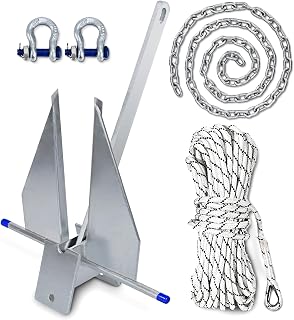
| Danforth Anchor Kit | Complete rigging on a budget | $58.99 |
| Seachoice River Anchor 12 lb | Pontoon and jon boats in current | $34.99 |
| Seachoice River Anchor 20 lb | Heavier boats in moving water | $34.95 |
| SeaSense Navy Anchor 20 lb | General freshwater anchoring | $44.74 |
| Attwood 9934B1 | Durable cast iron holding | $38.85 |
| SandShark Premium Fluke | Sand bottoms, easy storage | $132.99 |
| Danforth Anchor Kit | Larger boats needing bigger fluke | $79.99 |
How We Picked
We evaluated every product against four criteria: setting speed (how quickly it digs in after hitting the bottom), holding power relative to its stated weight, corrosion resistance after extended water exposure, and overall value given what you still need to buy separately. Anchors that required a large scope or specific technique to perform well lost points unless the technique was simple enough for a weekend angler. We also weighted real-world user feedback on dragging and coating durability.
The 8 Best Boat Anchors in 2026
Seachoice Utility Anchor
- Pro: Extremely affordable entry point that still delivers honest holding in soft mud and sand for boats under roughly 15 feet.
- Pro: Slip ring shank lets the flukes pivot to bite at the correct angle regardless of how the anchor lands on the bottom.
- Con: Galvanized steel version will show surface rust within a season unless you rinse and dry it religiously; PVC coating helps but adds weight.
This is the anchor for the person who keeps a small boat on a calm pond or a slow-moving creek and doesn’t want to spend more than twenty dollars. For that use case, nothing beats the value. Skip it if you fish in current, carry more than a dozen feet of boat, or operate near saltwater where even galvanized coatings eventually give way to pitting.
Danforth Anchor Kit
- Pro: Comes with chain, rope, and shackles — you can deploy it straight from the box without hunting for rigging parts.
- Pro: Hot-dipped galvanized finish resists corrosion far better than electroplated alternatives at a fraction of aluminum anchor pricing.
- Con: The fluke design is notorious for poor performance in weedy or rocky bottoms where it can’t reach clean substrate to set.
For $58.99, you get a complete system sized for boats up to mid-twenties. The wide range of included weights (5 through 25 pounds) means you can match your hull. This is the best boat anchor kit if you want Danforth-style holding power without assembling components separately. Skip it if your fishing spots have heavy grass or rock rubble on the bottom.
Seachoice River Anchor 12 lb
- Pro: Cast iron body with vinyl coating resists rust while the mushroom shape grips firmly in current and shifting gravel.
- Pro: At 12 pounds it’s light enough to throw and retrieve by hand without straining your back during frequent repositioning.
- Con: Limited holding power for anything heavier than a small jon boat or pontoon; undersized for open water or fast current.
The 12-pound River Anchor is the pontoon owner’s secret weapon on rivers and lakes with moderate current. The mushroom shape doesn’t rely on flukes catching a specific angle, so it sets reliably in silt and soft gravel. Skip it if you’re anchoring a center console or anything over roughly 18 feet in moving water.
Seachoice River Anchor 20 lb
- Pro: The weight jump from the 12-pound model translates to noticeably better resistance against pull in current, especially on rocky bottoms.
- Pro: Same vinyl-coated cast iron construction as the lighter version, so corrosion resistance is identical despite the higher mass.
- Con: Twenty pounds is awkward to handle solo when you’re anchoring repeatedly from a small, unstable boat.
If the 12-pound version underserves your hull, the 20-pound fixes it without changing brands or design philosophy. This is the sweet spot for medium pontoon boats and small deck boats fishing in rivers. Skip it if your boat is light and calm — the extra weight buys you holding power you’ll never need and makes line management more tedious.
SeaSense Navy Anchor 20 lb
- Pro: Classic navy pattern with broad flukes that bite aggressively into sand and mud once the scope is adequate.
- Pro: Vinyl coating over cast iron keeps rust at bay while protecting your gunwales from paint scratches during stowage.
- Con: Heavier than aluminum equivalents of the same holding capacity, which matters if you carry it to a spot where you need a backup.
At $44.74, the SeaSense Navy is a no-nonsense anchor for freshwater anglers who want a proven design without premium pricing. It holds well in sand and soft bottoms with proper scope. Skip it if you fish in rock, weed, or heavy current where the mushroom profile of a river anchor outperforms a fluke design.
Attwood 9934B1
- Pro: Solid cast iron construction with no coating to chip or wear, giving it a near-indefinite service life in freshwater.
- Pro: The plow-style geometry self-righting in current means it resets its bite even after a partial pull-out.
- Con: Bare cast iron will surface-rust during storage unless you keep it dry, and rust stains on a light-colored hull are inevitable.
This anchor earns its place on the strength of raw durability. It’s not the lightest or the easiest to stow, but for a boat that sits on a trailer in rain for weeks between trips, the solid iron body won’t delaminate or flake like coated alternatives. Skip it if you need to minimize weight in a kayak or small aluminum boat where handling matters more than longevity.
SandShark Premium Fluke Anchor
- Pro: Retractable shaft collapses the entire anchor flat, making it the easiest to store on a pontoon bow or jet ski platform.
- Pro: Aluminum construction keeps weight reasonable while the fluke geometry digs into sand with impressive speed.
- Con: At $132.99 it’s the most expensive anchor here, and aluminum can fatigue under repeated hard loads compared to steel or iron.
The SandShark solves a genuine storage problem. If you’ve ever wrestled a bulky Danforth into a tight bow compartment or worried about sharp flukes while loading a jet ski onto a trailer, the retractable shaft is worth the premium. Best on sand and firm mud for boats under 30 feet. Skip it if your priority is maximum holding in current, where iron river anchors deliver better value per dollar.
Danforth Anchor Kit (Large Size)
- Pro: The larger sizes (18 and 25 pound options) deliver Danforth-style holding power for boats that need serious bottom grip.
- Pro: Still includes full rigging kit — chain, rope, and shackles — so you’re deploying a matched system rather than a mismatched combo.
- Con: Fluke anchors are inherently weak in weeds and rocks; you may need a second anchor style if your spots vary.
At $79.99, this is the same design philosophy as the smaller kit but sized up for bigger hulls and rougher conditions. If your boat is in the 20-to-30-foot range and you fish sand or mud, this kit gives you the most complete package for the money. Skip it if your budget is tight — the smaller kit at $58.99 covers similar use cases with less margin.
Buying Guide
Match Anchor Weight to Your Boat and Bottom
Every anchor manufacturer publishes a size range, but those numbers assume ideal conditions. A 20-pound fluke that holds a 20-foot pontoon on clean sand may drag on the same 20-foot pontoon in a river with current over gravel. If you fish moving water or your bottom is hard-packed, add one size above the manufacturer’s recommendation. The mushroom-style river anchors in this list forgive mismatched sizing more than flukes because they rely on mass and shape rather than angle of attack.
Coating and Material Choice Matters More Than You Think
Hot-dipped galvanization is the gold standard for steel anchors — it bonds zinc to the substrate so scratches don’t expose raw metal to corrosion. Electroplated alternatives look similar on the shelf but fail within one season of saltwater exposure. Cast iron with vinyl coating occupies a middle ground: the coating prevents rust during storage and protects your boat from iron marks, but once the vinyl chips, bare iron oxidizes fast. Choose based on how often you rinse your tackle after fishing.
Scope and Rigging Determine Real-World Performance
An anchor’s stated holding power is measured at a specific scope ratio, typically seven to one. Most anglers carry too little rode for the conditions they encounter, which means an excellent anchor behaves like a poor one. If you’re buying an anchor kit that includes rope and chain, verify the total rode length meets at least five times your typical anchoring depth. A five-foot water column sounds trivial until a current hits and you realize you need twenty-five feet of scope deployed to keep the flukes angled correctly.
Our Verdict
Top pick: The Danforth Anchor Kit at $58.99 is the best boat anchor for most readers because it delivers a complete rigging system with proven holding power across the widest range of boat sizes without forcing you to buy components separately. Budget pick: The Seachoice Utility Anchor at $18.48 is genuinely adequate for calm-water small boats and costs less than a tank of gas. Conditional winner: If you fish rivers or lakes with current over gravel, the Seachoice River Anchor 20 lb outperforms every fluke design in this list because its shape doesn’t depend on setting angle, and the vinyl coating keeps it rust-free through the season.
FAQ
Can I use one anchor for all bottom types?
You can, but you’ll perform poorly on at least one bottom type. Fluke anchors excel in sand and mud but fail in weed and rock. Mushroom anchors handle gravel and current better but lack holding power in soft mud. Most experienced anglers carry one of each style and choose based on the spot.
Is vinyl coating necessary, or just a marketing trick?
It serves a practical purpose on cast iron anchors: it prevents rust during storage, keeps your hands clean, and stops the anchor from scratching your gunwales or bow compartment liner. Without it, bare cast iron will oxidize within weeks, especially in humid climates or saltwater-adjacent freshwater.
How often should I inspect my anchor?
Check it at the start and end of each fishing season, and after any incident where it caught a rock or you had to work it free. Look for cracked coatings, bent flukes, corrosion at weld points, and chafed rode where it meets the shackle. Replace the rode annually if you fish saltwater or keep the boat on a lift.
Does anchor weight alone determine holding power?
No. A well-designed fluke anchor can hold more boat weight than a poorly shaped heavier anchor because holding comes from the flukes biting into the substrate at the correct angle. Weight matters as a secondary factor for mushroom and plow designs that rely on gravity and shape rather than angle of entry.






Write Your Review
No reviews yet. Be the first to share your experience!