
Key takeaways
- Budget polyethylene set: General market range $80-$140 per 6-pack ($160-$280 per dozen). Expect touch-up paint after season 1 and replacement of 2-3 decoys by season 3 due to cracks or waterlogging. Over 3 seasons (60 hunts), effective cost is roughly $3.50-$6.00 per hunt before rigging, plus $15-$25 in paint and replacement keels.
- Premium rotomolded foam-filled set: General market range $160-$250 per 6-pack ($320-$500 per dozen). With proper storage, repaint is often not needed until season 4-5 and hulls rarely need replacement. Over 5 seasons (100 hunts), effective cost drops to roughly $3.20-$5.00 per hunt, with lower maintenance time.
The best duck decoys for realistic, reliable spreads are Avian-X Topflight, GHG Pro-Grade, Dakota Decoys X-Treme, and Higdon Battleship for most situations, with Dive Bomb Industries and Flambeau offering the best packability for mobile hunters and Mojo Outdoors for motion where legal.
Choosing the right spread is less about buying the most expensive decoy and more about matching float stability, paint durability, species accuracy, and rigging to where and how you hunt. A big-water diver hunter needs a completely different decoy than a walk-in timber hunter targeting mallards and wood ducks.
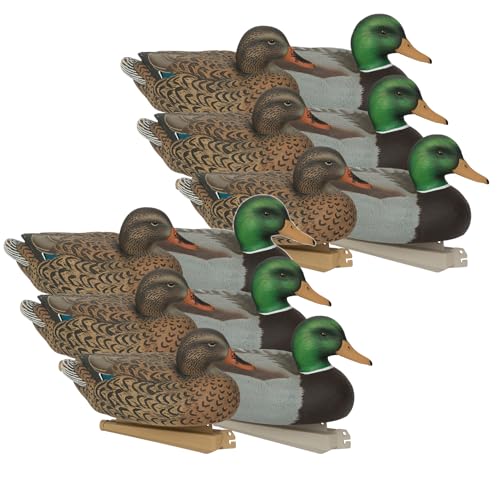
Avery GHG Essential Mallard Duck Decpus - 12 Pack
Included for 'Best Duck Decoys for Realistic, Reliable Spreads' because the listing specifies 12 Pack, details this guide uses to compare options.
View on Amazon
Avian X Top Flight Wood Duck & Mallard Hunting Floater Decoys, Green (6 Pack)
Included for 'Best Duck Decoys for Realistic, Reliable Spreads' because the listing specifies Green (6 Pack), details this guide uses to compare options.
View on AmazonHow to Choose the Best Duck Decoys: 5 Decision Criteria
Use these five factors to narrow your options before you look at brands:
1. Species Accuracy and Paint Detail
Realism matters most on pressured birds and in calm, clear conditions. Look for anatomically correct head shape, accurate speculum color, and feather texturing rather than just bright paint. Flocked heads reduce glare on sunny days, which helps for mallards and pintails, but flocking wears faster if decoys are bagged without slots. For puddle ducks, carving detail around the bill and tail brings more realism than high-gloss paint.
2. Float Stability and Keel Design
A decoy’s performance on water determines how natural your spread looks. Water-keel decoys ride the most realistically with chop and current but are heavier to pack. Weighted keels self-right faster and handle wind better than water-keels, while no-keel or foam-filled decoys are lightest for run-and-gun hunts. Deep V-keels cut through wind and stay upright in rivers; flat-bottom keels are more stable in calm marshes but roll easier in waves.
3. Paint Durability and Materials
Most modern decoys are blow-molded EVA, polyethylene, or rotomolded plastic. Polyethylene is lighter and more affordable but can chip on ice. Rotomolded decoys like Higdon Battleship and Dakota Decoys are heavier and far more resistant to shot, ice, and crushing in transit. Paint adhesion technology matters: double-molded or ultra-UV paint holds up longer than surface spray, especially on high-contact points like keels, bills, and tails.
4. Packability and Weight
If you walk in, haul decoys in a kayak, or hunt public land, weight and stackability are critical. Standard mallard floaters range from 20 to 34 ounces each. A dozen standard floaters can weigh 18 to 25 pounds before rigging. Lightweight EVA or collapsible silicone decoys cut that by 40-60% and pack flat, but they sit lower in the water and can be harder to see at distance.
5. Rigging System
Rigging affects setup speed and tangles. Texas rigs with tangle-free monofilament and sliding weights are fastest for shallow marshes under 4 feet. Long-line systems with clips work best for diver spreads of 2-4 dozen on open water. J-hook or gang rigs save time when you run large numbers. Consider line weight: 4 oz is adequate for calm water, 6-8 oz holds in current or wind over 15 mph.
Best Duck Decoys Compared: Specs and Features
This comparison focuses on core floater models widely available in 2026. Weights are per decoy without rigging, and dimensions are for standard mallard drakes unless noted.
| Model / Type | Material | Length | Weight (per decoy) | Keel Type | Key Durability Feature |
|---|---|---|---|---|---|
| Avian-X Topflight Mallards | Lightweight blow-molded plastic | 16.5 in | 24 oz | Weighted keel | Carved feather detail, no-chip paint with UV reflection control |
| GHG Pro-Grade XD Series | EVA / polyethylene blend | 17 in | 26 oz | Weighted keel | Double-molded paint, flocked drake heads |
| Dakota Decoys X-Treme Mallards | Rotomolded polyethylene | 17.5 in | 32 oz | Water / weighted keel option | Foam-filled, ultra-rugged hull |
| Higdon Battleship Mallards | Rotomolded polyethylene | 18 in | 34 oz | Deep V-weighted keel | Foam-filled, crush-proof |
| Dive Bomb F1 Mallards (EVA) | Lightweight EVA foam | 15.5 in | 14 oz | Water keel | Flexible body, packable, chip-resistant |
| Flambeau Master Series Classic | UV-painted polyethylene | 16 in | 20 oz | Water keel | UV-Tek paint, budget-friendly replacement heads |
| Mojo Outdoors Spinning Wing (Mallard) | ABS plastic / metal wings | 19 in body | 48 oz with pole/battery | Stake / pole mount | Rechargeable 12V lithium, ~10 hr runtime |
For visibility, larger decoys like Higdon Battleship and Dakota X-Treme show up farther on big water, while smaller, lighter decoys like Dive Bomb F1 excel when you need to carry two dozen in a backpack for a mile.
Picks by Hunting Situation
Best for Big Water and Divers: Dakota Decoys X-Treme and Higdon Battleship
When hunting lakes, rivers, or coastal bays for scaup, canvasback, redheads, and goldeneyes, prioritize stability and durability over packability. Foam-filled rotomolded decoys will not take on water if shot, and their extra weight keeps them from drifting or tipping in 15+ mph wind. Run long-lines with 36-inch droppers and 8 oz weights rather than individual Texas rigs to set and pick up 3-4 dozen quickly. These models typically run in the upper-mid to premium price range per half-dozen.
Best for Realism on Pressured Puddle Ducks: Avian-X Topflight and GHG Pro-Grade
For field and marsh hunts where mallards, pintails, wigeon, and gadwall circle multiple times, anatomical accuracy counts. Avian-X Topflight offers aggressive carving and low-sheen paint that photographs well at close range. GHG Pro-Grade adds flocked heads that kill glare on bluebird days. Both ride naturally on weighted keels without excessive bobbing. These are mid-range to premium in price and stack reasonably well in slotted bags to protect flocking.
Best for Walk-In and Public Land: Dive Bomb Industries and Tanglefree Migration Series
If you hike, bike, or kayak to your spot, every pound matters. EVA foam or lightweight polyethylene decoys that weigh 14-20 oz each let you carry 18-24 decoys for under 20 pounds. Dive Bomb F1 and Tanglefree pack flat or nest tightly and bounce back from being stepped on or compressed. The tradeoff is a slightly lower profile on the water, so add 2-4 full-size decoys or a jerk rig for motion if legal to increase visibility.
Best Budget Floater That Still Looks Good: Flambeau Master Series and Higdon Standard
For new hunters building a first dozen or hunters who need to replace ice-damaged decoys regularly, Flambeau Master Series delivers acceptable detail and UV-correct paint at an entry-level price range. The plastic is thinner and paint will show wear on the keel and bill after one to two hard seasons, but replacement cost is low. Keep them in mesh bags and avoid dragging them across frozen ground to extend life.
Best for Adding Motion: Mojo Outdoors Spinning Wing Decoys
Where spinning wing decoys are legal, one or two units add far more drawing power than a dozen static decoys. Mojo models with lithium batteries run 8-12 hours per charge and have remote control for on/off during final approach, which helps avoid flaring late-season birds. Check 2026 state regulations, as several flyways restrict motorized decoys during part of the season or on public land.
Decision Matrix: Match Your Hunt to the Decoy
| Your Situation | Recommended Type | Why It Works |
|---|---|---|
| Walk-in under 1 mile, 1-2 dozen needed | Lightweight EVA (Dive Bomb, Tanglefree) | Under 15 lbs per dozen, packs into backpack |
| Boat hunt, big water or river current | Foam-filled rotomolded (Dakota, Higdon Battleship) | Won’t sink when shot, holds in wind and waves |
| Hunting pressured fields or calm marshes | High-detail weighted keel (Avian-X, GHG Pro-Grade) | Maximum realism and glare control at close range |
| Building first spread on a budget | Standard polyethylene (Flambeau, Higdon Standard) | Lowest cost per decoy, easy to replace |
| Need to run 4+ dozen divers | Long-line rigged standard floaters + 1-2 Mojo for motion | Fastest setup/pickup, high visibility |
| Hunt ice and late season frequently | Foam-filled rotomolded | Resists cracking and ice abrasion, no waterlogging |
Cost Per Use: A Worked Calculation
Purchase price is only part of ownership cost. Paint durability and hull type determine how long decoys stay hunt-ready.
Example for a 12-decoy mallard rig hunted 20 days per season:
- Budget polyethylene set: General market range $80-$140 per 6-pack ($160-$280 per dozen). Expect touch-up paint after season 1 and replacement of 2-3 decoys by season 3 due to cracks or waterlogging. Over 3 seasons (60 hunts), effective cost is roughly $3.50-$6.00 per hunt before rigging, plus $15-$25 in paint and replacement keels.
- Premium rotomolded foam-filled set: General market range $160-$250 per 6-pack ($320-$500 per dozen). With proper storage, repaint is often not needed until season 4-5 and hulls rarely need replacement. Over 5 seasons (100 hunts), effective cost drops to roughly $3.20-$5.00 per hunt, with lower maintenance time.
If you hunt fewer than 10 days per year, budget models cost less overall. If you hunt 20+ days, especially in ice or rocky shallows, foam-filled decoys cost less per hunt and save repair time.
Durability and Ownership Realities
What actually fails first is rarely the body. Here is what to watch for and how to prevent it:
- Flocked heads: Wears off from rubbing in bags. Use slotted or individual mesh bags, let heads dry completely before storing, and avoid stacking flocked heads face-down.
- Paint on bills and tails: Chips from ice and gravel. Touch up with flat acrylic formulated for decoys and seal with a matte clear coat. Glossy touch-ups create glare.
- Keel water intrusion: Water-keel decoys can crack at the seam if water freezes inside. Drain keels after every hunt in freezing conditions and store upside down.
- Rigging tangles: Monofilament Texas rigs kink in cold weather. Coil rigs in 4-inch loops and store weights separately if using nylon cord. Replace any line with nicks, as it will break when a dog retrieves through the spread.
- Mojo wings and batteries: Wings bend in transit and batteries lose capacity if left discharged. Remove batteries after hunts, store at 40-60% charge, and carry spare wing lock pins.
Common mistakes include leaving decoys in a trailer bed in summer heat, which warps keels and softens paint, and pressure-washing decoys, which strips UV coating. Rinse with cold water, mild soap, and a soft brush only.
How to Rig for Different Conditions
Shallow Marsh Under 4 Feet
Use 4-foot Texas rigs with 4-6 oz weights and 400 lb monofilament or coated cable. Clip the line through the keel eye so the weight slides. This prevents tangles and lets you pick up a dozen by wrapping the main line around the keel in seconds. Add 6-8 feet of spacing between decoys for a natural look.
River Current or Tidal Water
Switch to 6-8 oz mushroom or grapple weights and 6-foot lines. Space decoys tighter on the upwind side and leave a landing pocket downwind. Long-lines with 6-12 decoys per line and 5-foot droppers keep the spread from drifting.
Field Hunting
Use full-body field decoys or lightweight floaters on field stakes. Silhouette decoys pack the flattest for large field spreads of 5-10 dozen. Mix 70% mallards with 15% pintails/wigeon and 15% teal for contrast, even if targeting primarily mallards.
Frequently Asked Questions
How many duck decoys do I need?
For small potholes and timber, 12-18 floaters with a jerk string is often more effective than 30 static decoys. For open water or fields, 2-4 dozen plus motion creates better visibility. Match numbers to water size, not tradition.
Are flocked heads worth it?
Yes for sunny, calm conditions where glare is visible to circling birds, especially on mallard and pintail drakes. No if you hunt mainly overcast days or abuse gear in transit, as flocking adds cost and maintenance.
Foam-filled vs. standard decoys: which is better?
Foam-filled decoys never sink and handle ice, shot, and rough handling, but they cost 40-70% more and weigh 6-10 oz more per decoy. Standard decoys are lighter and cheaper but can take on water if punctured. Choose foam-filled for hard use, standard for mobility.
Do I need different decoys for early vs. late season?
You do not need a separate set, but late-season spreads benefit from more drakes, cleaner paint, and larger decoys for visibility. Adding a few fully plumed mallard or pintail decoys and removing faded early-season teal helps.




Write Your Review
No reviews yet. Be the first to share your experience!