
Key takeaways
- Faster slack-line pickup: High-speed reels excel with jigs, worms, frogs, punch rigs, and other presentations where fast hooksets matter.
- More casts in limited time: If your lure is out of the strike zone after a short retrieve, a 30-plus-inch-per-turn reel gets it back quickly.
- Better control around cover: A fast retrieve helps keep fish from gaining line near grass, docks, timber, and other snag-prone structure.
- Useful for fish that swim toward you: Quick line pickup can help maintain pressure when a fish changes direction or surges toward the boat.
- Excellent for certain reaction baits: Buzzbaits, some spinnerbaits, lipless crankbaits, and topwater walking baits often benefit from higher retrieve speed.
- Less wasted motion: You can retrieve, reposition, and make the next cast without repeatedly cranking a slower reel.
The Short Answer
It depends: a high gear ratio reel is worth it if your fishing style benefits from picking up slack line quickly.
For anglers who work jigs, frogs, Texas rigs, spinnerbaits, buzzbaits, or other moving presentations, faster retrieval can make a meaningful difference. A reel in the 7.1:1 to 8.1:1 range lets you get a lure back efficiently, catch up to a fish charging toward the boat, and make more casts during a short outing.
Our top picks


As an Amazon Associate we earn from qualifying purchases at no extra cost to you. Ratings are shown as listed on Amazon.
But a high-speed reel is not automatically “better.” If you mostly throw deep crankbaits, large swimbaits, umbrella rigs, or other resistance-heavy lures, a moderate gear ratio around 5.4:1 to 6.4:1 is usually easier to turn and offers more usable torque. The right choice comes down to lure resistance and technique—not simply buying the fastest reel available.
What You Actually Get
Gear ratio describes how many times the spool turns for each full turn of the reel handle. A 6.4:1 reel spins its spool 6.4 times per handle turn; an 8.1:1 reel spins it 8.1 times. In practical terms, the faster reel retrieves more line per turn.
On a typical low-profile baitcasting reel, a 6.4:1 model may retrieve roughly 25 to 28 inches of line per handle turn, while a 7.5:1 model often falls around 29 to 32 inches. An 8.1:1 reel can reach approximately 32 to 36 inches, depending on spool diameter and how full the spool is. Bigger spools generally retrieve more line than smaller spools even at the same listed ratio.
That extra pickup matters most when the lure is not moving constantly. With a jig or soft plastic, for example, you may create slack as you hop the bait, shake it in place, or let it fall. A fast reel helps remove that slack before setting the hook. It also helps when a bass runs toward you after striking near the surface.
High gear ratio does not necessarily mean more drag. Drag strength is a separate specification based on the reel’s drag system. Nor does it mean every retrieve will feel effortless. Faster gears trade some mechanical advantage for speed, so high-resistance lures can feel heavier to crank—especially after several hours of fishing.
In 2026, many anglers build a small rotation rather than seeking one all-purpose speed. A 6.2:1 to 6.4:1 reel covers a wide middle ground, while a 7.1:1 or faster reel is a useful specialized tool for slack-line and fast-moving techniques.
Pros
- Faster slack-line pickup: High-speed reels excel with jigs, worms, frogs, punch rigs, and other presentations where fast hooksets matter.
- More casts in limited time: If your lure is out of the strike zone after a short retrieve, a 30-plus-inch-per-turn reel gets it back quickly.
- Better control around cover: A fast retrieve helps keep fish from gaining line near grass, docks, timber, and other snag-prone structure.
- Useful for fish that swim toward you: Quick line pickup can help maintain pressure when a fish changes direction or surges toward the boat.
- Excellent for certain reaction baits: Buzzbaits, some spinnerbaits, lipless crankbaits, and topwater walking baits often benefit from higher retrieve speed.
- Less wasted motion: You can retrieve, reposition, and make the next cast without repeatedly cranking a slower reel.
Cons
- Less mechanical advantage: High ratios can feel harder to turn when pulling large, deep-diving, or high-drag lures through the water.
- Easier to fish too fast: Beginners often unintentionally overwork slow presentations, especially worms, jigs, and cold-water baits.
- Not ideal for deep crankbaits: A 5.4:1 to 6.4:1 reel is generally more comfortable for lures that pull hard for an entire retrieve.
- Can cost more: Within the same reel family, high-speed versions may carry a modest premium, though pricing varies widely.
- Does not replace good technique: Fast pickup helps, but it cannot compensate for poor line management, a loose drag, or an inappropriate rod and line setup.
- May be unnecessary for casual use: If you fish a few times a year with versatile lures, a moderate-speed reel is simpler and more broadly useful.
Who Should Buy It
A high gear ratio reel makes sense for anglers who regularly fish close-range cover or use techniques that create slack. Bass anglers throwing 3/8- to 1-ounce jigs, Texas rigs, creature baits, frogs, and flipping rigs are prime candidates. These methods often require a quick, firm hookset and immediate control of the fish.
It is also a smart option for anglers who fish fast presentations. A 7.1:1 to 8.1:1 baitcaster works well for a buzzbait that needs to stay on top, a spinnerbait burned over shallow grass, or a lipless crankbait ripped through vegetation. The fast retrieve does not force you to fish quickly—you can turn the handle slowly—but it gives you a higher top speed when needed.
Choose a high-speed model if you already own a general-purpose reel and want to add a technique-specific setup. For example, pair a fast baitcaster with a 7-foot to 7-foot 4-inch heavy or medium-heavy rod for frogs, jigs, and close-cover work. A high-speed reel is particularly useful on a dedicated rod where its strengths are clear.
For spinning setups, focus less on the advertised ratio alone and more on inches per turn. A larger 4000 or 5000 size spinning reel may collect substantial line with every turn because of its wider spool. That is useful for inshore fishing, larger freshwater species, or situations where line recovery matters after a long cast.
Who Should Skip It
Skip the high gear ratio if this will be your only baitcasting reel and you want the most flexible choice. A 6.2:1 to 6.4:1 model is the safer all-around starting point. It can still retrieve quickly enough for many spinnerbaits, soft plastics, and topwaters, while remaining easier to crank with moderate-resistance lures.
Anglers who spend most of their time deep cranking should also lean slower. Deep-diving crankbaits, large Colorado-blade spinnerbaits, oversized swimbaits, and umbrella rigs pull hard against the line. A lower ratio gives you more leverage and can reduce wrist and forearm fatigue during a full day on the water.
It may also be the wrong purchase if your main issue is casting distance or backlash control. Gear ratio has little to do with either. For easier casting, prioritize a properly adjusted spool tension knob and brake system, a spool matched to your line size, and a lure weight that suits the rod.
Finally, avoid paying extra for speed if you fish mostly from shore with live bait or simple steady retrieves. A moderate reel is easier to live with and leaves more of your budget for quality line, terminal tackle, and a rod that matches your preferred lures.
Cheaper Alternatives
| Option | Cost | Trade-off |
|---|---|---|
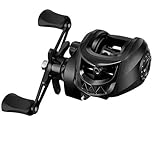
| KastKing Megatron 200 baitcasting reel, 6.4:1, right-hand retrieve | $67.99 | A versatile moderate-speed option rather than a true high-speed choice; better suited to general use and resistance-heavy lures. |
| Entry-level 6.2:1 to 6.4:1 baitcasting reel | About $45 to $80 | Usually has fewer premium materials, bearings, and adjustment refinements, but provides the broadest technique range for the money. |
| Midrange 7.1:1 baitcasting reel | About $80 to $130 | Offers faster pickup without moving into premium pricing; may feel less powerful with deep-diving or large-bladed lures. |
| Piscifun NautiX 5000 spinning reel | $104.99 | An aluminum-body spinning reel with up to 33 pounds of max drag, but spinning-reel sizing and use differ from a compact baitcasting setup. |
FAQ
What gear ratio counts as high speed on a fishing reel?
For baitcasting reels, 7.1:1 and above is commonly considered high speed. Ratios around 6.2:1 to 6.4:1 are versatile middle-ground choices, while 5.4:1 to 5.8:1 models are generally better for high-resistance lures.
Is a 7.1:1 reel good for beginners?
Yes, but it is not the easiest all-purpose choice. A beginner focused on jigs, worms, frogs, or topwater can use a 7.1:1 reel effectively. For one reel that will handle a broader mix of techniques, a 6.4:1 model is usually more forgiving.
Does a higher gear ratio make a reel stronger?
No. Higher gear ratios increase line pickup speed, not drag strength or pulling power. In fact, slower ratios provide more mechanical advantage when retrieving hard-pulling lures.
Can I use a high-speed reel for crankbaits?
You can, especially with shallow or lipless crankbaits. For deep-diving crankbaits that pull hard, however, a lower ratio is normally more comfortable and helps keep your retrieve controlled over long periods.



Write Your Review
No reviews yet. Be the first to share your experience!