
Key takeaways
- Repeatable lure placement: You can return a lure to 50, 100, or 180 feet behind the boat instead of estimating each reset.
- Faster adjustments after a bite: When a fish hits at a certain setback, you can quickly reproduce the same presentation on another rod.
- Better multi-rod organization: Counters help keep staggered lines separated—for example, one lure at 40 feet, another at 70 feet, and another at 110 feet.
- Useful with trolling charts: Many crankbait depth charts use line-out numbers. A counter lets you apply those charts with much more confidence.
- Helpful for divers and weighted rigs: When using planer boards, diving devices, inline weights, lead-core, or other depth-control systems, consistent line lengths make your setup easier to repeat.
- Less guesswork for beginners: New trolling anglers can follow a simple instruction such as “set that rod 90 feet back” without learning to judge line distance by sight.
- Improved record keeping: Notes such as “silver crankbait, 2.2 mph, 75 feet back” are much more useful than vague notes about a lure being “pretty far behind the boat.”
The Short Answer
It depends: you need a line counter reel for trolling if consistent lure depth is important to your fishing. If you are trolling for species that respond to a specific depth band—such as walleye, salmon, trout, striped bass, or lake trout—a line counter makes repeatable presentations much easier. It tells you approximately how much line is out, so you can send the same lure back to the same distance after a strike, snag, turn, or rod reset.
If you mostly troll shallow water, pull baits close behind the boat, fish casually a few times a year, or are comfortable estimating line by feel and rod markers, you can absolutely catch fish without one. A line counter reel is a convenience and consistency tool, not a requirement for trolling.
Our top picks


As an Amazon Associate we earn from qualifying purchases at no extra cost to you. Ratings are shown as listed on Amazon.
The honest answer is that it becomes more valuable as your trolling setup becomes more technical. The more rods, divers, planer boards, lead-core line, directional changes, and depth-sensitive fish you deal with, the more a counter reel earns its place on the boat.
What You Actually Get
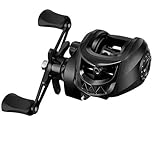
A line counter reel is usually a conventional, levelwind trolling reel with a mechanical display that measures line paid out. Most counters display line in feet, typically up to 999 feet before rolling over. You press a reset button at the boat, let out your lure, and the display tracks the amount of line leaving the spool.
What it does not do is tell you your exact lure depth. That distinction matters. A counter measures line distance, not depth below the surface. Actual running depth depends on line diameter, lure style, trolling speed, current, rod angle, waves, turns, added weight, diving devices, and whether the reel is properly spooled. A crankbait that runs 15 feet deep with 100 feet of 10-pound monofilament may run considerably differently with 20-pound braid or at a faster boat speed.
Still, knowing that a productive lure was 82 feet behind the boat is extremely useful. You can reset at 82 feet rather than guessing at “somewhere around three pulls.” This is especially helpful after catching a fish. If one rod takes several bites at 65 feet back, you can duplicate that setback on another rod and build a more deliberate spread.
Most entry-level line counter reels cost roughly $45 to $80. For example, an Okuma Magda Pro MA-20DXT is commonly listed around $54.99. Midrange and heavier-duty reels generally fall in the $100 to $200 range; the Okuma Cold Water CW-453D is commonly around $149.99. Higher-end trolling reels can cost more, particularly in larger sizes designed for wire line, big divers, downrigger fishing, or saltwater use.
Reel size matters as much as the counter itself. Smaller models are often appropriate for inland walleye, trout, and light trolling with 10- to 20-pound line. Larger reels hold more line and suit heavy braid, copper, lead-core, wire divers, large plugs, and stronger fish. Do not buy the largest reel automatically: an oversized reel adds weight to the rod, can feel clumsy for everyday use, and may be unnecessary for a modest freshwater setup.
Pros
- Repeatable lure placement: You can return a lure to 50, 100, or 180 feet behind the boat instead of estimating each reset.
- Faster adjustments after a bite: When a fish hits at a certain setback, you can quickly reproduce the same presentation on another rod.
- Better multi-rod organization: Counters help keep staggered lines separated—for example, one lure at 40 feet, another at 70 feet, and another at 110 feet.
- Useful with trolling charts: Many crankbait depth charts use line-out numbers. A counter lets you apply those charts with much more confidence.
- Helpful for divers and weighted rigs: When using planer boards, diving devices, inline weights, lead-core, or other depth-control systems, consistent line lengths make your setup easier to repeat.
- Less guesswork for beginners: New trolling anglers can follow a simple instruction such as “set that rod 90 feet back” without learning to judge line distance by sight.
- Improved record keeping: Notes such as “silver crankbait, 2.2 mph, 75 feet back” are much more useful than vague notes about a lure being “pretty far behind the boat.”
Cons
- It does not provide exact depth: A line counter is not a fish finder, depth sensor, or automatic depth-control system.
- Counter accuracy depends on proper spooling: Different line diameters and spool fill levels can change the reading. A reel filled well below its intended capacity may not read the same as a full spool.
- More moving parts: Mechanical counters, reset buttons, levelwinds, and gears add complexity compared with a basic trolling reel.
- Higher upfront cost: A basic conventional reel may cost less than a line counter model, especially if you need several matching reels.
- Added size and weight: Many line counter reels are bulkier than spinning reels, which can matter when holding rods for long periods or fishing from a compact boat.
- Not essential for simple trolling: If you make short passes with one or two rods in shallow water, the benefit may be small.
- It can encourage false precision: Seeing “100 feet” on the display does not mean every lure is running at the same depth. Speed, line, and lure selection still matter.
Who Should Buy It
Buy a line counter reel if you troll regularly and want to become more systematic. It is particularly worthwhile for anglers who fish deep lakes, target suspended fish, run more than two trolling rods, use planer boards, or rely on crankbait depth charts. Walleye anglers often find them useful because small changes in line-out can change a lure’s running depth enough to affect bites.
They also make sense for salmon, trout, and striped bass anglers who need to repeat a successful presentation over long trolling passes. If you are using divers, lead-core, copper, or weighted setups, counters can simplify a rig that otherwise becomes difficult to duplicate.
For a first setup, you do not necessarily need premium equipment. A roughly $55 entry-level reel can be a sensible way to learn whether the feature fits your fishing. Spend more—often $120 to $180—when you need stronger drags, greater line capacity, more durable gears, or a reel that will see frequent hard use.
Who Should Skip It
Skip a line counter reel if you primarily troll shallow shoreline water with lures 20 to 40 feet behind the boat, especially if you fish only one rod. In that situation, a simple spinning or conventional reel is easier to use, lighter in hand, and usually less expensive.
You can also skip it if you prefer casting, drifting, jigging, or live-bait fishing and only troll occasionally to move between spots. A counter reel should solve a real repeatability problem; it should not be purchased simply because it looks more specialized.
Anglers with a very tight budget may be better off putting money toward quality line, a dependable rod, a basic depth finder, a selection of proven lures, and a reliable boat-speed method first. Those items can affect trolling success more than a line counter alone.
Cheaper Alternatives
| Option | Cost | Trade-off |
|---|---|---|
| Line markers on monofilament or braid | $5–$15 | Markers can indicate 25-, 50-, or 100-foot intervals, but they are less precise and can fade or move over time. |
| Count line pulls by arm span | $0 | Free and workable for casual fishing, but results vary between anglers and are harder to repeat in wind or waves. |
| Metered trolling line | $15–$40 per spool | Color changes or markings help estimate distance, but the line itself may not suit every technique or preferred line strength. |
| Basic conventional trolling reel | $30–$70 | Reliable and simple, but you lose the quick line-out reference that makes resetting rods easier. |
| Use a clip-on depth or line-out reference system | $10–$30 | Can help organize a setup, but it is another accessory to manage and usually does not match the convenience of an integrated counter. |
FAQ
Are line counter reels accurate?
They are accurate enough for repeatable trolling, provided the spool is filled consistently with the intended line diameter. Treat the number as a dependable line-out reference rather than an exact scientific measurement. If a lure catches fish at 90 feet back, the key benefit is being able to return it to the same 90-foot setting.
Does a line counter reel tell me how deep my lure is?
No. It tells you how much line has been released. To estimate depth, combine the line-out reading with a lure-depth chart, your trolling speed, line type, and any weights or diving devices in use. Turns and current can also change a lure’s actual depth.
What size line counter reel should I buy for walleye trolling?
For many walleye setups, a small or medium line counter reel is sufficient when using 10- to 20-pound monofilament, fluorocarbon, or braid. Choose a larger reel only if you need substantial capacity for heavy line, long lead-core sections, large diving devices, or unusually long trolling leads.
Can I use braid on a line counter reel?
Yes, but pay attention to spool fill and line diameter. Thin braid can change how a mechanical counter reads compared with thicker monofilament. Use backing if needed so the reel is properly filled, and keep the same line type and approximate fill level once you have found settings that work.



Write Your Review
No reviews yet. Be the first to share your experience!