
Key takeaways
- Leaning rods directly against a wall: A rod can slide, fall, or develop a permanent bend.
- Supporting only the tip or handle: Use at least two appropriate support points for long rods whenever the rack design allows it.
- Overloading the rack: Follow the manufacturer’s capacity and count reels, tackle, and hooks as part of the load.
- Using random nails or undersized anchors: Fasteners should match the wall material and expected weight.
- Storing wet gear: Dry rods, reels, and tackle before placing them in the garage.
- Keeping rods beside chemicals: Gasoline, solvents, fertilizers, and cleaners can damage finishes and fishing line if spilled.
- Placing the rack behind a parked car: A bumper or door can crush rods before you notice the problem.
- Leaving hooks exposed: Store lures in closed boxes and remove them from rods before putting equipment away.
Fishing rods are easy to damage when they are leaned in a corner, stacked under a workbench, or left on the garage floor. Tips can snap, guides can bend, reels can collect dust, and fishing line may develop unwanted kinks. A poorly planned rack can also become a safety hazard if it blocks a walkway or pulls out of the wall under the weight of several rods.
The best garage storage system keeps rods off the floor, supports them at more than one point, and leaves enough room to remove one without disturbing the others. Before you start, decide whether you need a compact wall-mounted solution, a freestanding rack, or a combination of rod storage and tackle organization. This guide explains how to store fishing rods in garage spaces safely and efficiently in 2026.
Our top picks

As an Amazon Associate we earn from qualifying purchases at no extra cost to you. Ratings are shown as listed on Amazon.
What You Need
| Item | Why | Optional? |
|---|---|---|
| Fishing rod rack or holders | Supports rods vertically or horizontally and keeps them off the floor. Choose a rack sized for your collection, such as a 6- to 12-rod system. | No |
| Stud finder | Locates solid framing for wall-mounted racks. A loaded rack should be fastened to studs or properly rated anchors. | No for wall mounting |
| Tape measure and pencil | Helps maintain spacing from the floor, ceiling, vehicles, doors, and other garage equipment. | No |
| Level | Keeps horizontal holders straight so rods do not gradually slide or rest at an angle. | Recommended |
| Drill, bits, and hardware | Installs the rack. Use fasteners appropriate for wood studs, masonry, or drywall rather than relying on the screws included with every product. | No for permanent installation |
| Soft rod sleeves or cloth | Separates rods and protects blanks, guides, and finishes from rubbing. | Yes |
| Plastic bins or tackle organizer | Stores lures, line, tools, and loose accessories so they do not hang from or weigh down the rods. | Yes |
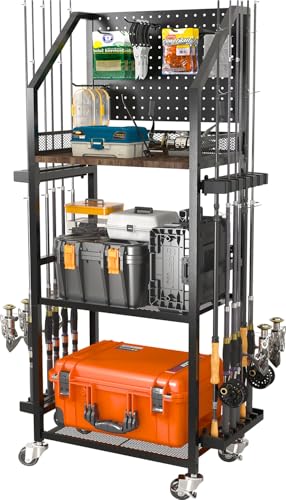
| SOYEEZE Fishing Rod Holders for Garage | A rolling fishing cart with pegboard, hooks, and space for up to 12 rods; the listed price is $65.99. It can suit renters or anglers who want movable tackle storage. | Yes |
| Ghosthorn Rotating Fishing Rod Holder for Garage | A freestanding wood-floor pole rack priced at $36.99. Its rotating design can provide access when wall space is limited. | Yes |
Step-by-Step
1. Inventory and clean every rod (20 to 30 minutes)
Lay the rods on a clean surface and group them by length, type, and frequency of use. Separate spinning, baitcasting, fly, ice-fishing, and two-piece rods if you own several styles. Remove lures, hooks, bobbers, and other terminal tackle before storage. A sharp hook left on a rod can snag clothing, damage another rod, or cause an injury.
Wipe down the blanks with a dry or slightly damp microfiber cloth. Clean reels according to their manufacturer’s instructions, and let any wet equipment dry fully before it goes into the garage. Do not store damp rods in sealed plastic sleeves, where trapped moisture can encourage corrosion or mildew.
2. Choose a safe location (10 to 15 minutes)
Select a wall or floor area away from garage doors, car doors, lawn equipment, and frequent traffic. Keep rod tips clear of light fixtures, shelving, and the path of an opening garage door. As a practical starting point, leave at least 24 inches of clear walkway in front of the storage area and enough room to lift the longest rod without striking the ceiling or a vehicle.
Avoid locations that regularly become wet or experience extreme temperature swings, such as directly beside an unsealed garage door. If wall space is unavailable, a stable freestanding rack can work, but it should sit on a level floor and remain outside the path of carts and vehicles.
3. Measure the rods and plan the layout (15 to 20 minutes)
Measure the longest rod in its stored configuration. For two-piece rods, decide whether you will store them assembled or separated. Horizontal storage generally requires a support near the handle and another near the upper section. Place supports far enough apart to prevent sagging, but not so far apart that the rod flexes under its own weight.
For vertical storage, check the full ceiling-to-floor clearance and leave several inches above the rod tip. Put heavier rods and reels in lower positions when possible. Keep commonly used rods between waist and shoulder height so you do not need to reach over a car or climb a ladder.
4. Install a wall rack or position a floor stand (30 to 60 minutes)
For a wall-mounted holder, mark the mounting points with a level and locate the studs. Fasten the rack into studs whenever possible. If the rack must go into drywall, use anchors rated for the total expected load, including rods, reels, and any tackle hanging from the system. Do not assume a small plastic anchor can safely hold a fully loaded rack.
For a freestanding unit such as the Ghosthorn Rotating Fishing Rod Holder, assemble it on a level surface and tighten every connection before adding equipment. Rotate it slowly to confirm that it does not wobble or contact nearby objects. Keep a freestanding rack several inches away from walls so rods and reel handles do not scrape.
5. Add rods with the heaviest equipment lowest (10 to 15 minutes)
Place each rod into its holder without forcing the blank or guide through a tight opening. Store reels so they do not collide with one another. If a holder is designed for bare rods, avoid overloading it with bulky reels that change the balance of the rack.
Leave a little breathing room between neighboring rods. A useful target is approximately 1 to 2 inches of separation where reel handles, guides, or line can touch. Arrange rods with the tips facing the same direction and keep handles accessible. If you have more rods than available slots, add another rack rather than cramming them together.
6. Organize tackle separately (15 to 25 minutes)
Use hooks, pegboard accessories, or bins for pliers, line, soft plastics, tools, and tackle boxes. Keep sharp hooks capped or inside closed containers. Do not hang heavy tackle bags from a rod rack unless the rack is specifically designed and rated for that load.
The SOYEEZE system, listed at $65.99, combines rod storage with a pegboard, six hooks, wheels, and room for tackle organization. A movable cart can be useful when you need to roll gear toward the garage door, but lock or block the wheels before loading it. Typical dedicated rod storage costs roughly $35 to $70 for a basic freestanding or rolling system and more for larger, wall-mounted setups.
7. Test the finished setup (10 minutes)
Gently pull one rod from each position and return it. Check that the rack does not shift, tilt, or pull away from the wall. Inspect the tips for contact with the ceiling and confirm that no reel is pressing against a neighboring rod. Open and close the garage door and nearby vehicle doors to verify that nothing can strike the storage system.
After the first day, check the screws and brackets again. Seasonal temperature changes and repeated movement can loosen hardware, especially on a rolling cart or a rack mounted to a surface that is not solid wood.
Mistakes to Avoid
- Leaning rods directly against a wall: A rod can slide, fall, or develop a permanent bend.
- Supporting only the tip or handle: Use at least two appropriate support points for long rods whenever the rack design allows it.
- Overloading the rack: Follow the manufacturer’s capacity and count reels, tackle, and hooks as part of the load.
- Using random nails or undersized anchors: Fasteners should match the wall material and expected weight.
- Storing wet gear: Dry rods, reels, and tackle before placing them in the garage.
- Keeping rods beside chemicals: Gasoline, solvents, fertilizers, and cleaners can damage finishes and fishing line if spilled.
- Placing the rack behind a parked car: A bumper or door can crush rods before you notice the problem.
- Leaving hooks exposed: Store lures in closed boxes and remove them from rods before putting equipment away.
How Often
Do a quick inspection every time you put rods away after a trip. Wipe off dirt, salt, and moisture immediately, particularly after saltwater fishing. Once a month, check rack screws, wall brackets, wheels, and rotating parts. Confirm that rods remain separated and that no holder has developed a sharp edge.
At the beginning and end of each fishing season, remove every rod for a more thorough inspection. Look for cracked blanks, loose guides, corroded reel seats, frayed line, and mildew. Reorganize the rack so the rods used most often are easiest to reach.
When to Call a Pro or Replace
Call a qualified handyman if you are unsure whether a garage wall contains usable studs, if you need to mount into masonry, or if the rack will carry a large, expensive collection. Professional help is also sensible when installation requires working high above a vehicle or when the wall shows cracking, water damage, or loose sheathing.
Replace a rack if it bends, rocks, develops cracked welds or wood, or pulls away from its mounting surface. Replace a rod with a visibly cracked blank, crushed section, badly bent guide, or damaged reel seat. Do not rely on tape to reinforce a structural crack. A damaged rod can fail under load and may be unsafe to fish with.
FAQ
Is it better to store fishing rods vertically or horizontally?
Either orientation can work when the rod is supported properly. Vertical storage saves wall space and makes individual rods easy to remove, while horizontal storage can keep long rods out of the way. Use two or more support points and avoid placing pressure on delicate tips.
How much space should be between stored fishing rods?
Allow about 1 to 2 inches where rods, guides, or reel handles are closest. You may need more space for large conventional reels or bulky rod socks. Adequate separation prevents rubbing and makes it possible to remove one rod without pulling out several others.
Can fishing rods stay in an unheated garage?
Usually, yes, if they are clean, dry, and protected from direct sunlight and moisture. Temperature alone is less concerning than condensation, leaks, and repeated dampness. Avoid sealed bags around wet equipment, and keep reels away from corrosive chemicals and standing water.
Should I store rods assembled or broken down?
Store frequently used rods assembled if your rack has enough clearance and support. Break down two-piece rods when space is tight or when doing so protects the tips from traffic. In either case, remove lures and secure loose line before storage.




Write Your Review
No reviews yet. Be the first to share your experience!