
Key takeaways
- Better handling: Low-memory line can come off a spinning spool with fewer coils and loops, reducing tangles and wasted casts.
- More dependable strength: A consistent line is less likely to contain weak sections caused by uneven manufacturing, although knots and abrasion still remain common failure points.
- Improved abrasion resistance: Quality line can last longer around rocks, pilings, weeds, shells, and submerged timber when used within its limits.
- Longer service life: A spool that resists UV exposure, flattening, and surface damage may not need replacement as often.
- More efficient casting: A smoother, thinner braid or well-behaved mono can improve distance and lure control with the right rod and reel.
- Better specialized performance: Premium fluorocarbon can help with leader visibility and sensitivity, while braid can provide direct contact with lures and fish at long range.
- Fewer lost tackle costs: If better line prevents even a few lost lures or rigs, the price difference may be easier to justify.
The Short Answer
Expensive fishing line is worth it only when its specific advantages solve a problem in your setup. If you fish around heavy cover, sharp structure, deep water, or frequently cast long distances, paying more for better abrasion resistance, lower memory, thinner diameter, or improved handling can save lost lures and frustrating re-spools. If you fish casually in open water and replace line regularly, a budget line will usually catch just as many fish.
Price alone does not determine performance. A well-matched $10 monofilament line can outperform an expensive braid that is the wrong diameter or strength for your rod and reel. The best purchase is the line that fits your target species, lure weight, water conditions, and fishing style.
Our top picks

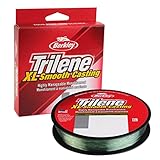
 Berkley Trilene Big Game Braided Fishing Line
- Material: Blend
- Fishing Line Type: Braided
- Line Weight: 30
As an Amazon Associate we earn from qualifying purchases at no extra cost to you. Ratings are shown as listed on Amazon.
What You Actually Get
Higher-priced fishing line generally buys consistency rather than magic. Premium monofilament may have a more uniform diameter, lower memory, smoother casting behavior, and better resistance to nicks. Premium braid may offer tighter construction, a rounder profile, less fraying, and more predictable breaking strength. Those improvements are useful, but they do not make a line immune to damage or bad knots.
Line type matters more than the word “premium.” Monofilament is inexpensive, floats, stretches under load, and is usually easy to tie. That stretch can protect light hooks and reduce sudden breakoffs, but it also makes bite detection less immediate. Fluorocarbon is relatively stiff, sinks, and is less visible underwater, but it costs more and can be difficult to manage on spinning reels. Braided line has very little stretch, packs substantial strength into a small diameter, and casts well, though it can dig into the spool and may need a leader.
Diameter is often a better comparison than the pound-test number printed on the package. Two lines labeled 30 pounds may have noticeably different diameters, casting behavior, and knot performance. A thinner line can increase casting distance and reduce water resistance, while a thicker line may provide more abrasion resistance and better control around rocks, docks, or vegetation.
For example, Reaction Tackle Monofilament is listed at $10.98 for 260 yards of 60-pound clear nylon line. That is not necessarily “expensive” in fishing-line terms, especially if you need heavy mono for leaders, catfish, saltwater, or structure fishing. Berkley Trilene Big Game Braided Line is listed at $19.74 for 330 yards of 30-pound braid. Its higher price reflects the braid construction and longer spool, but whether it is a better value depends on whether your reel and fishing technique benefit from braid.
Pros
- Better handling: Low-memory line can come off a spinning spool with fewer coils and loops, reducing tangles and wasted casts.
- More dependable strength: A consistent line is less likely to contain weak sections caused by uneven manufacturing, although knots and abrasion still remain common failure points.
- Improved abrasion resistance: Quality line can last longer around rocks, pilings, weeds, shells, and submerged timber when used within its limits.
- Longer service life: A spool that resists UV exposure, flattening, and surface damage may not need replacement as often.
- More efficient casting: A smoother, thinner braid or well-behaved mono can improve distance and lure control with the right rod and reel.
- Better specialized performance: Premium fluorocarbon can help with leader visibility and sensitivity, while braid can provide direct contact with lures and fish at long range.
- Fewer lost tackle costs: If better line prevents even a few lost lures or rigs, the price difference may be easier to justify.
Cons
- Higher upfront cost: A premium spool may cost $15 to $40 or more, compared with roughly $5 to $12 for basic mono in common sizes.
- Marketing can obscure value: Claims such as “super strong” or “professional grade” do not tell you how the line performs on your particular reel.
- Knots still matter: The wrong knot, insufficient lubrication, or a poorly trimmed tag end can weaken premium line just as easily as inexpensive line.
- Some lines are harder to manage: Braid can wind around rod guides, dig into the spool, and form wind knots. Fluorocarbon can develop coils and spring off a spinning reel.
- Strength is not the whole story: A high-pound-test line may be too thick for your lure, reel capacity, or target species, reducing casting distance and presentation quality.
- Damage is not always visible: Even costly line should be inspected after contact with rocks, docks, fish teeth, or heavy vegetation. Premium construction does not eliminate the need to retie.
- Overbuying is easy: A casual angler may pay for low stretch or extreme abrasion resistance that never provides a noticeable benefit.
Who Should Buy It
Buy higher-priced line if you fish often enough to notice handling problems or regularly lose line to conditions. It is particularly worthwhile for anglers who:
- Fish around rocks, oyster beds, bridge pilings, docks, or thick cover.
- Need long casts from shore or want better sensitivity in deep water.
- Use finesse lures where diameter and line management affect presentation.
- Target strong fish that make long runs or apply sudden pressure.
- Fish saltwater, where corrosion, UV exposure, and abrasive structure can shorten line life.
- Prefer to spend more once rather than repeatedly replacing tangled or damaged line.
It can also make sense for beginners who are struggling with a specific problem, such as excessive spinning-reel loops. However, changing to premium line will not fix an overfilled spool, an incorrectly sized reel, or poor casting technique. Fill a spinning reel to about 1/8 inch below the spool lip, use a suitable knot, and match the line to the rod’s recommended range before blaming the line.
Who Should Skip It
Skip the upgrade if you fish only a few times each season, use basic spinning gear in open ponds, or are still learning how to tie knots and set a drag. In those situations, inexpensive monofilament in the appropriate pound test is often the smartest choice. It is easy to handle, widely available, and inexpensive enough to replace at the beginning of each season.
You should also skip premium line when the product’s key feature does not match your needs. Low-stretch braid is not automatically better for a topwater lure where some stretch can help prevent pulled hooks. Heavy 60-pound line may be unnecessary for small bass lures. Conversely, ultralight line is a poor bargain if you routinely fish around sharp cover.
Cheaper Alternatives
| Option | Cost | Trade-off |
|---|---|---|
| Basic monofilament, 8–12 pounds, 300–600 yards | $5–$10 | Affordable and easy to tie, but usually has more memory and stretch than premium line. |
| Standard monofilament, 15–30 pounds, 200–300 yards | $7–$14 | Good general-purpose strength, though it may be thicker and less smooth for long casts. |
| Reaction Tackle 60-pound mono, 260 yards | $10.98 | Low-cost heavy mono with abrasion resistance, but 60 pounds is excessive for many light freshwater setups. |
| Entry-level braided line, 20–30 pounds, 150–300 yards | $12–$20 | Offers low stretch and small diameter, but may be rougher, noisier, or less consistent than premium braid. |
| Berkley Trilene Big Game 30-pound braid, 330 yards | $19.74 | More capacity and braid performance than basic mono, but it may require a leader and careful spool management. |
The best value is often a two-line system: inexpensive braid as backing or main line paired with a reasonably priced mono or fluorocarbon leader. You can replace the leader frequently without discarding the entire spool. Another money-saving option is to purchase a larger spool only if you fish enough to use it before age, heat, and sunlight degrade the line.
FAQ
Is expensive fishing line more likely to catch fish?
Not by itself. Fish respond to lure action, location, presentation, and timing far more than the price of the line. Premium line can indirectly improve results by casting farther, transmitting bites better, or reducing breakoffs, but it cannot compensate for fishing in the wrong location or using an unsuitable lure.
How often should I replace fishing line?
Inspect it before every trip and replace it when it shows nicks, flat spots, severe coils, discoloration, or repeated tangles. Frequent anglers may replace monofilament every few months, while occasional anglers may get a season or longer from it if the line is stored cool and away from direct sunlight. Braid can last longer, but its coating and outer fibers still need inspection.
Is braid better than monofilament?
Neither is universally better. Braid is a strong choice for long casts, heavy vegetation, deep-water sensitivity, and situations where low stretch matters. Mono is easier to handle, generally cheaper, and more forgiving around treble hooks and sudden runs. Many anglers use braid as the main line and mono or fluorocarbon as a leader.
What should I prioritize when buying line?
Start with the line type, diameter, pound test, and compatibility with your rod and reel. Then consider abrasion resistance, memory, stretch, visibility, and spool length. If your current line casts smoothly, holds knots, and survives your conditions, paying more may provide little benefit. If it tangles, breaks at the first rough surface, or limits your presentation, upgrading is likely worth the money.






Write Your Review
No reviews yet. Be the first to share your experience!