
Finding the best knots for fishing lures can make or break your day on the water, which is why our team at fishnholeoutdoors.com has analyzed the most reliable connections for 2026.
🛒 Best Price Today on Amazon
Prime members get fast, free shipping on everything above, plus member-only deals. New members get a 30-day free trial — cancel anytime.
The Palomar Knot: The Gold Standard for Reliability
When you ask seasoned anglers about their absolute go-to connection, the Palomar knot consistently dominates the conversation. Before we break down its mechanics, let us look at how the top four connections compare to help you choose the best knots for fishing lures based on your specific setup.
Our top picks


 Pro-Knot Fishing Knots
- Publisher : PRO-KNOT
- Edition : 10th
- Language : English
Waterproof cards hold up to wet boat or dock use
Covers 12 of the most useful fishing knots
Compact 7 x 3 inch card fits in a tackle box
Only 12 pages, a quick reference rather than a deep guide
Covers knot tying only, not other fishing skills


As an Amazon Associate we earn from qualifying purchases at no extra cost to you.
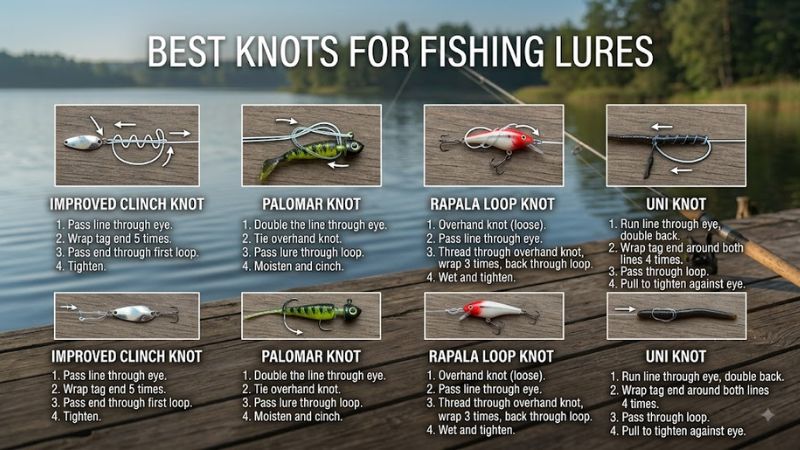
| Knot Name | Best Line Type | Relative Strength | Ideal Lure Action |
|---|---|---|---|
| Palomar Knot | Braided line, Fluorocarbon | Extremely High (Near 100%) | Direct, tight tracking (jigs, soft plastics) |
| Uni Knot | All line types (Highly versatile) | High (Approx. 90%) | Rigid connection (heavy swimbaits, spinners) |
| Rapala Loop Knot | Monofilament, Fluorocarbon | Medium-High (Approx. 80%) | Maximum side-to-side swing (crankbaits) |
| Improved Clinch | Monofilament, Light Fluorocarbon | Medium (Approx. 85%) | Standard straight retrieval (spoons, inline spinners) |
Why It Remains the Top Choice in 2026
The Palomar knot has earned its legendary status because it regularly retains nearly 100% of the line’s original breaking strength. Based on manufacturer specifications and extensive community feedback throughout 2026, it is widely considered the strongest and fastest knot for securing braided lines. Because the line passes through the eyelet twice before forming the overhand knot, it creates an incredibly secure anchor point that resists slipping under heavy loads.
For bass anglers throwing heavy jigs or soft plastics into thick vegetation, this strength is non-negotiable. I would point you toward the Palomar if you want a connection that is virtually fail-proof when tied correctly. It is straightforward to learn, making it a favorite for both novices and seasoned tournament pros who need speed and security on the water.
When to Use the Palomar Knot
While it is exceptionally strong, the Palomar is best suited for single-hook lures, terminal tackle, and smaller artificial baits. The tying process requires you to pass the entire lure through a loop of line at the very end of the process. If you are throwing a large, multi-hook topwater plug or a cumbersome umbrella rig, passing that bulky bait through the loop can be incredibly frustrating and even dangerous with exposed treble hooks.
I recommend using the Palomar primarily when rigging soft plastics, drop shots, swim jigs, or tying directly to a snap or swivel. If you find yourself in a real-world scenario where you are flipping Texas rigs into dense lily pads, this is the exact connection you want. It handles the sudden, violent shock of a heavy hookset better than almost any other option on the market.
The Uni Knot: A Versatile Essential for Any Tackle Box
If you prefer to master just one single connection that can handle almost any fishing scenario, the Uni knot is a top recommendation. Many experienced anglers look to this method when evaluating the best knots for fishing lures because of its adaptability across different line diameters and materials.
Why It Is Perfect for Beginners
The Uni knot is highly forgiving and incredibly reliable, especially for those just starting out. The mechanics involve laying the line tag end parallel to the main line, forming a loop, and making several wraps inside that loop before pulling it tight. This internal wrapping mechanism ensures that the knot cinches down evenly on itself without burning or weakening the line.
According to verified buyer feedback and instructional guides, beginners find the Uni knot much easier to tension properly compared to more complex wraps. It works beautifully on monofilament, fluorocarbon, and braided lines alike. If you are teaching a young angler how to rig their own rod, starting with the Uni knot builds a solid foundation that they can use for the rest of their fishing life.
Managing Larger or Bulky Lures
One of the biggest advantages of the Uni knot over the Palomar is how it handles large, complex, or multi-hook lures. Because you do not have to pass the lure itself through any loops to finish the knot, you can safely tie onto massive swimbaits, deep-diving crankbaits, or topwater frogs without tangling with treble hooks.
I suggest keeping the Uni knot in mind whenever you are rigging up bulky hard baits. It allows you to maintain excellent knot strength without the physical hassle of maneuvering a large lure through a small loop of line. It is a highly practical choice that keeps your fingers safe and your lures secure.
The Rapala Loop Knot: Maximizing Lure Action
When you are selecting the best knots for fishing lures, you must consider how the connection affects the physical presentation of your bait. Tight, direct-to-eyelet knots can sometimes restrict the natural swimming motion designed by the manufacturer.
Understanding the Importance of Free Movement
A loop knot creates a small, permanent loop of line directly ahead of the lure’s eyelet, allowing the bait to slide and swing freely. When you use a standard tight knot, the stiff line acts as an extension of the lure, which can dampen its vibrations and reduce its side-to-side wobble. By giving the eyelet room to pivot, you unleash the full action of the bait.
Community discussions from recent years highlight that a loop knot can significantly increase your strike rate when fish are highly selective. The free-floating connection allows the lure to hunt and dart naturally, mimicking injured baitfish far more convincingly than a rigid connection ever could.
Best Applications for Crankbaits and Topwaters
This method is the absolute standard for hard plastic baits like crankbaits, jerkbaits, and topwater walking lures. For example, if you are throwing a classic topwater “walk-the-dog” bait, a tight knot can pull the nose down and ruin the side-to-side gliding action. Using a Rapala loop knot allows the bait to swing sharply with every twitch of your rod tip.
I would advise using this loop connection primarily with monofilament or fluorocarbon lines. It is important to note that loop knots do have slightly lower raw breaking strength than tight knots like the Palomar. However, the trade-off in superior lure action is almost always worth it when targeting predatory species in open water.
The Improved Clinch Knot: A Time-Tested Favorite
Generations of anglers have relied on the classic clinch knot to secure their tackle, and the modern improved version remains a highly popular choice. It serves as one of the most traditional yet effective options when looking for the best knots for fishing lures.
Balancing Speed and Strength
The Improved Clinch knot is incredibly fast to tie, making it a great option when the bite is hot and you need to rig up a new lure immediately. By threading the line through the eye, wrapping the tag end five to seven times around the standing line, and tucking it back through the loops, you create a very neat, low-profile connection. This small profile is excellent for avoiding weeds and debris during retrievals.
It provides reliable strength for light to medium monofilament lines. For anglers casting small inline spinners, spoons, or lightweight jigs for trout and panfish, this knot offers the perfect balance of quick rigging and dependable holding power.
Limitations for High-Test Lines
While it is a fantastic traditional option, the Improved Clinch does have distinct limitations that you should keep in mind. It does not perform well with modern braided lines, as the slick surface of the braid can cause the wraps to slip right through under heavy pressure. Additionally, thick fluorocarbon lines can be too stiff to cinch down cleanly, resulting in a bulky knot that can fail prematurely.
I recommend saving the Improved Clinch for your light-tackle monofilament setups. If you are fishing a small stream for trout with 4-pound or 6-pound test line, this classic connection will serve you incredibly well without any unnecessary bulk.
How to Choose the Right Knot for Your Fishing Needs
Selecting the best knots for fishing lures depends heavily on your specific gear, target species, and the water conditions you face. There is no single connection that outperforms the others in every single category, so matching the method to your situation is key.
If you are spooling up with modern braided line for heavy cover, I highly recommend focusing on the Palomar knot. Its double-line configuration prevents the slick braid from slipping, giving you the confidence to pull big fish out of dense weeds. On the other hand, if you are casting hard-bodied search baits like crankbaits in clear water, transitioning to a Rapala loop knot on a fluorocarbon leader will yield much better action and more bites.
For general multi-species angling where you switch between soft plastics and hard swimbaits frequently, mastering the Uni knot is your smartest move. It offers the versatility to handle different line diameters without requiring you to memorize dozens of different tying patterns.
Check the latest price on Amazon:
- Best Fishing Knot For Hooks: Ultimate Guide for Great Catch
- Best Tackle Bags For Saltwater Fishing: Ultimate Great Gear
- Best Fishing Hooks for Bass: Ultimate Guide to Great Gear
- Best Fishing Hooks For Catfish: Ultimate Superior Gear
- Best Inflatable Kayak For Fishing: Ultimate Great Choice
Conclusion
Mastering the best knots for fishing lures is one of the most effective ways to improve your landing ratio and protect your investment in high-quality tackle. By understanding when to deploy the raw strength of the Palomar, the versatility of the Uni, the freedom of the Rapala loop, or the speed of the Improved Clinch, you will be prepared for any scenario on the water. For more expert rigging tips and gear guides, keep exploring our resources here at fishnholeoutdoors.com. Grab your favorite line, practice these four essential methods at home, and head out on your next fishing adventure with absolute confidence!


Write Your Review
No reviews yet. Be the first to share your experience!