
Our Top Picks
 Muck Arctic Pro Tall Rubber Insulated Extreme Conditions1213 x 11 x 6 inches2.25 poundsCheck on Amazon
 Baffin Men's TUNDRA Insulated Waterproof Lightweight Extreme-Weather Outdoor1019 x 7 x 18 Inches2 PoundsCheck on Amazon
For most anglers who sit still on hard water in truly brutal weather, the Baffin Eiger is the strongest all-around pick on this page: it is a tall, Polar Rated pac-style boot with a removable multi-layer liner, built for long, low-movement hours in deep cold. If you want a pull-on rubber boot that sheds slush, the Muck Arctic Pro or Korkers Neo Arctic fit better, and the Norfin Klondike 2 adds retractable cleats for slick ice. “Extreme cold” here means sustained air temperatures well below zero Fahrenheit, where insulation, a dry foot and a locked-down fit matter more than weight.
Below you will find a quick list, a decision table, six detailed write-ups in listing order, a specs table and practical buying advice.
Muck Arctic Pro Tall Rubber Insulated Extreme Conditions Men's Hunting Boots
Picked as a relevant option in this category.
View on Amazon
Baffin Eiger Men's Winter Boots, Polar Rated, -60 to -76 degrees Fahrenheit, Tall Height, Bk1 - Black, Size 11
Chosen because it specifies Polar Rated and 60 to -76 degrees Fahrenheit.
View on Amazon
Korkers Men's Neo Arctic Rubber Boots - Inuslated and Waterproof for the Extreme Cold - Includes Interchangeable All Terrain Sole - Size 9/Black
Chosen because it specifies Inuslated and Waterproof for the Extreme Cold and Includes Interchangeable All Terrain Sole.
View on AmazonBaffin Men's TUNDRA Insulated Waterproof Lightweight Extreme-Weather Outdoor Snow Winter Boots for Snowshoeing & Ice Fishing, Black, 10
Chosen because it specifies Black.
View on Amazon
Norfin Klondike 2 - Winter Boots for Fishing, Hunting and Hiking - Anti Slip - Retractable ice Cleats for Added Safety and Protection - Made of EVA Material - Removable Insole, Grey, 12
Chosen because it specifies Winter Boots for Fishing and Hunting and Hiking.
View on Amazon
Baffin Men's Control Max Snow Boot,Worn Brown,7 M US
Chosen because it specifies Worn Brown and 7 M US.
View on AmazonQuick List
- Muck Arctic Pro Tall – best for pull-on waterproof warmth around slush, standing water and wet shorelines
- Baffin Eiger – best for sitting on the ice in the deepest cold with a removable liner
- Korkers Neo Arctic – best for anglers who want a neoprene rubber boot with swappable soles
- Baffin Tundra – best for lighter, mobile days of walking, drilling and snowshoeing between spots
- Norfin Klondike 2 – best for slick, glare-ice days thanks to built-in retractable cleats
- Baffin Control Max – best for a leather-upper snow boot with a removable liner when you value dry-liner swaps
Which One Is Right for You?
| If you… | Choose |
|---|---|
| Sit in an open-air setup for hours at extreme-cold temperatures | Baffin Eiger |
| Walk through slush, overflow and shoreline water to reach your spot | Muck Arctic Pro Tall |
| Want a rubber, neoprene-insulated boot with a replaceable sole system | Korkers Neo Arctic |
| Fish a lot of spots and want a lighter boot for hole hopping | Baffin Tundra |
| Fear a fall on bare, glassy ice | Norfin Klondike 2 |
| Prefer a leather upper and a liner you can pull out to dry overnight | Baffin Control Max |
| Also hunt or do farm chores in the same boot | Muck Arctic Pro Tall or Korkers Neo Arctic |
Think about activity first. A boot that feels perfect while you are dragging a sled can leave your toes numb after two hours of sitting, so match the insulation to how much you actually move. Then think about footing and water: rubber shells win in slush, while liner boots win when you want to dry the insulation separately each night.
All 6 Picks in Detail
1. Muck Arctic Pro Tall – Best for Pull-On Waterproof Warmth
As an Amazon Associate we earn from qualifying purchases at no extra cost to you.

The Muck Arctic Pro is listed as a tall rubber, insulated boot for extreme conditions and is marketed toward hunters, but its fully waterproof neoprene construction makes it a natural fit for ice anglers who deal with wet snow, slush and shoreline puddles. It slips on without laces, which is a real advantage when you are wearing gloves at a frozen access point. The manufacturer describes a comfort range stated down to about minus 60 degrees Fahrenheit, though temperature numbers like these are not standardized across the boot industry, so treat them as a rough upper limit for active use rather than a promise for sedentary hours.
- Tall rubber and neoprene shaft with a stretch-fit topline (shaft height varies by retailer, so confirm on the listing)
- Roughly 8 mm of neoprene foam in the body with additional thermal foam under the footbed, per manufacturer information
- Fleece-style lining for next-to-foot comfort
- Molded outsole designed to shed mud and snow; no built-in ice cleats
- Waterproof, slip-on design
Pros:
- Easy on and off and truly waterproof
- Good fit for wet approaches and slushy lakes
Cons:
- No removable liner to dry overnight
- Smooth rubber can slide on polished ice without traction aids
Compared with the Korkers Neo Arctic, it offers a similar rubber-and-neoprene concept but without the swappable sole system.
2. Baffin Eiger – Best for Sitting in Deep Cold

The Baffin Eiger is the heavyweight of the group. The listing calls it Polar Rated at roughly minus 60 to minus 76 degrees Fahrenheit and tall in height, and the design backs that up: a thick, removable multi-layer liner sits inside an Arctic Rubber shell with an insulated nylon and leather upper. Manufacturer information describes a snow collar with an extendable gaiter and double hook-and-loop straps, which help keep snow out during long sessions. It is not a lightweight boot; expect a heavy pair, and note that some retailers report it fits snug, so consider sizing room for thick socks. Baffin states its cold-comfort ratings assume activity, so a long, static day on the ice calls for good socks and movement breaks.
- Polar Rated for the deepest cold, as stated in the listing
- Removable multi-layer liner with reflective and moisture-managing layers
- Rubber shell with a molded outsole and EVA midsole
- Snow collar with a built-in extendable gaiter
- Listed in men’s size 11; other sizes vary, so confirm on the page
Pros:
- Highest stated cold rating on the page
- Liner pulls out to dry between trips
Cons:
- Heavy and bulky for walking long distances
- Overkill for mild early-season outings
Next to the Baffin Control Max, it trades a lighter leather build for a taller, more insulated profile.
3. Korkers Neo Arctic – Best for Swappable Soles
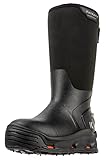
Korkers built its reputation on interchangeable soles, and the Neo Arctic brings that idea to a neoprene rubber winter boot. The listing states it is insulated, waterproof and meant for extreme cold, and includes an interchangeable all-terrain sole. Manufacturer details describe a roughly 16-inch waterproof rubber shaft with about 8 mm of neoprene and a comfort rating stated near minus 60 degrees Fahrenheit. The appeal for ice anglers is that the sole system lets you change traction when conditions change, although specialty sole options are sold separately, so confirm what comes in the box. It is a slip-on with a reinforced heel and an adjustable top gusset to keep drafts out.
- Waterproof vulcanized rubber lower with neoprene insulation
- Interchangeable sole system; all-terrain sole included per the listing
- Adjustable top gusset to snug the calf
- Listed in size 9; men’s sizes vary, so confirm on the page
- Comfort rating stated by the manufacturer near minus 60 degrees Fahrenheit
Pros:
- Worn-out or mismatched soles can be swapped instead of replacing the boot
- Easy slip-on design
Cons:
- No removable liner for drying
- Extra sole options add cost and one more thing to carry
It is the closest relative of the Muck Arctic Pro, with the sole system as its main differentiator.
4. Baffin Tundra – Best for Mobile, Walk-Heavy Days

The Baffin Tundra is described in its listing as an insulated, waterproof, lightweight extreme-weather boot for snowshoeing and ice fishing. It sits below the Eiger in warmth and weight, which makes it better for anglers who haul a sled, drill several holes and keep moving. Retailers commonly cite a minus 40 rating, while Baffin’s own page uses a more conservative activity-based range, so read it as a moving-day boot rather than a pure sit-and-wait boot. The liner is removable and multi-layer, and the upper is a durable nylon with a locking snow collar and reflective piping.
- Insulated, waterproof boot built for snowshoeing and ice fishing per the listing
- Removable multi-layer liner
- Nylon upper with a snow collar and ankle strap
- Rubber shell with EVA midsole
- Listed in men’s size 10; confirm other sizes on the page
Pros:
- Lighter than the Eiger, easier on the legs when walking
- Liner can be dried separately
Cons:
- Not the best choice for the very coldest static days
- Nylon upper is less abrasion-resistant than leather
Choose it over the Eiger when mobility matters more than maximum insulation.
5. Norfin Klondike 2 – Best for Slick Ice and Traction

The Norfin Klondike 2 is the only boot here with built-in retractable ice cleats, which the listing highlights as an anti-slip safety feature. It is made of lightweight EVA, includes a removable insole, and is positioned for fishing, hunting and hiking. Retailers state a comfort rating near minus 40 degrees Fahrenheit, a figure to treat as approximate. The cleat idea is practical: lock them out on glare ice, tuck them away on snow or when you step into a shelter. EVA boots should be kept away from direct heat, since concentrated heat can warp the material, so dry them at room temperature.
- Two retractable stainless-steel cleats in the sole, per manufacturer information
- Lightweight EVA construction
- Removable insole with insulating layers
- Waterproof, tall shaft
- Size varies; confirm on the listing
Pros:
- Built-in traction without strap-on cleats
- Light on the foot
Cons:
- Lower stated cold rating than the Eiger or Neo Arctic
- EVA is sensitive to heat; avoid drying near a heater
Pick it over the Muck Arctic Pro if footing worries you more than maximum warmth.
6. Baffin Control Max – Best for a Leather-Upper Snow Boot

The Baffin Control Max is listed as a snow boot in worn brown (the listing shows a men’s size 7 option). Manufacturer information describes a full-grain insulated leather upper with a seam-sealed waterproof build, a removable multi-layer liner and an Arctic Rubber shell. Baffin classifies it as Arctic Rated for moderate to high activity, while some retailers repeat much colder figures; those numbers vary, so confirm on the product page and plan on layered socks. It is a good choice for anglers who like the feel of a leather pac boot and want an insulating liner they can pull out and dry.
- Full-grain insulated leather upper
- Removable multi-layer liner
- Rubber shell with molded outsole
- Slip-resistant tread and snowshoe compatible per manufacturer information
- Size varies; confirm on the page
Pros:
- Durable leather upper
- Dryable liner for multi-day trips
Cons:
- Rating information is inconsistent between sources
- Laces and leather need more upkeep than a rubber boot
Next to the Eiger, it is shorter and more traditional, with a rating the maker frames more cautiously.
Specs Compared
| Boot | Construction | Closure | Stated cold rating | Removable liner | Traction feature |
|---|---|---|---|---|---|
| Muck Arctic Pro Tall | Rubber and neoprene | Pull-on | About -60 degrees F comfort (manufacturer) | No (confirm on listing) | Molded outsole |
| Baffin Eiger | Rubber shell, nylon and leather upper | Hook-and-loop straps | Polar Rated, -60 to -76 degrees F (listing) | Yes | Molded rubber outsole |
| Korkers Neo Arctic | Rubber and neoprene | Pull-on with gusset | About -60 degrees F comfort (manufacturer) | No (confirm on listing) | Interchangeable soles |
| Baffin Tundra | Rubber shell, nylon upper | Strap with snow collar | Confirm on listing; retailers cite about -40 | Yes | Molded rubber outsole |
| Norfin Klondike 2 | EVA | Pull-on | About -40 degrees F (retailer-stated) | Removable insole | Retractable stainless cleats |
| Baffin Control Max | Rubber shell, leather upper | Lace-up | Arctic Rated (confirm on listing) | Yes | Slip-resistant rubber outsole |
How We Chose These
We built this list from the current catalog set rather than from field trials, so nothing here rests on personal wear. We compared the stated cold ratings, upper materials, closure styles and traction features in each listing, then cross-checked them against manufacturer product pages and retailer specification fields. We favored boots that are waterproof, insulated well beyond everyday winter wear, and clearly designed for standing on snow or ice. Where sources disagreed on a rating, weight or shaft height, we said so and told you to confirm on the product page. Brand temperature ratings are not standardized, so we treated them as one input alongside construction, liner design and fit.
What to Look For
Understand What a Cold Rating Really Means
There is no universal standard for winter boot temperature ratings. A number like minus 60 usually means the maker believes an active adult with good socks can stay comfortable at that air temperature, not that your toes will stay warm while you sit motionless on a bucket. Brands also define activity level differently. As a rule of thumb, subtract 20 to 30 degrees from the number if you will be sedentary, and add a pair of high-quality wool or synthetic socks. Wind chill does not change air temperature, but it speeds heat loss from exposed skin, so a snow collar or gaiter matters on windy lakes.
Removable Liner or Sealed Rubber?
Liner boots such as the Baffin models let you pull the insulation out at the end of the day and dry it by a room-temperature source. That is a major advantage on multi-day trips, because sweat and snow melt can accumulate and chill your feet. Sealed neoprene boots, like the Muck and Korkers, stay waterproof to a higher shaft and are easier to hose off, but damp socks can only dry from the open top. If you fish from a heated shelter and take your boots off, a rubber boot is simple; if you stay in them all day, a dryable liner is worth the extra bulk.
Fit, Socks and Circulation
Cold feet are often tight feet. Leave about a thumb’s width of space in front of your toes and enough volume for one thick sock plus air around it. Boots that are too snug compress insulation and restrict blood flow, which makes the cold rating almost meaningless. Try on boots at the end of the day, with the sock you plan to wear. If a retailer notes that a model runs small, sizing up by a half or full size is reasonable.
Traction and Safety on Ice
Smooth rubber and EVA soles grip snow reasonably well but can be treacherous on clear, wet ice. Options include built-in cleats, interchangeable soles, or strap-on spikes that fit over almost any boot. Retractable cleats are convenient but add weight and may wear on concrete boat ramps. Whatever you choose, test the traction in a safe spot before you walk out far. Always check ice thickness before heading out; a common rule of thumb is at least four inches of clear, solid ice for walking, and more for groups or vehicles.
A boot is only one layer of a cold-weather foot system. Start with a thin, moisture-wicking liner sock, add a midweight merino or synthetic wool sock on top, and avoid cotton entirely because it holds moisture and strips heat away. Do not stack three or four pairs into a boot that was sized for two; the extra bulk squeezes the foot and cuts circulation, which makes you colder, not warmer. Aftermarket insoles with a foil or foam layer can add insulation from the ice below, which is the largest source of heat loss when you stand or sit in one place for hours. A square of closed-cell foam or an insulated mat under your feet does just as much good as a more expensive boot, and it costs almost nothing.
Bring a spare pair of dry socks in a zip-top bag in your jacket, not in the sled. If your feet get damp from sweat or a splash of water at the hole, changing socks inside a shelter takes two minutes and can save the rest of your day. Chemical toe warmers help in a pinch, but they need a little oxygen, so place them on top of the toes rather than under the foot, where compression will starve them of air.
Height, Gaiters and Weight
Shaft height decides how deep a drift you can wade through before snow spills over the top. Tall rubber boots reaching mid-calf or higher are comfortable in slush and light snow, while pac-style boots with a snow collar or gaiter seal out powder when you step off the packed trail. If you tuck insulated pants over the top of the boot, wind-driven snow tends to funnel inside, so wear the pant legs outside the boot and cinch them down. A boot that is too tall can also rub behind the knee if you walk long distances, so check how the top edge feels when you bend your leg.
A pair of heavy winter boots can easily weigh around five to seven pounds. Over a mile of walking with a sled and auger, that weight adds up, and tired legs generate less heat. If your fishing spot is a short walk from the parking area, a heavier, warmer boot is a fair trade. If you cover ground on foot all day, consider a lighter model and rely on movement, layers and breaks to stay warm.
Worked example. Suppose you plan three-hour sits at minus 10 degrees Fahrenheit with a light breeze. A boot with a stated rating of minus 40 might be borderline, because you will be sedentary. A boot rated near minus 60 or colder, paired with a thick sock and a wool liner, gives you a margin. If instead you will walk half a mile with a sled and then fish from a heated tent, a lighter rubber or liner boot at the minus 40 level is perfectly adequate, and the lighter weight is a bonus.
Questions
Are hunting boots good for ice fishing?
Often yes. Insulated, waterproof rubber hunting boots handle the same cold, wet conditions. Just check traction, because many hunting soles are designed for mud and leaves rather than glare ice.
How warm should my boots be for extreme cold?
For sustained sub-zero temperatures, look for a stated rating of minus 40 or colder if you will be moving, and colder still if you will be sitting. Remember that ratings are manufacturer estimates and your socks, fit and activity level change the result.
Do I need ice cleats if my boots have good tread?
Tread helps on snow but does little on clear, polished ice. Built-in cleats, interchangeable soles or strap-on spikes give you real bite. Many anglers keep strap-on spikes in the sled as a backup.
How do I keep my feet from sweating in insulated boots?
Wear moisture-wicking liner socks under merino or synthetic wool and avoid cotton. Adjust your pace to stay below the point where you sweat, and swap damp socks for dry ones during breaks.
How should I dry and store insulated boots?
Pull out removable liners and let them air-dry at room temperature. Keep EVA boots away from direct heat, since it can warp the material, and avoid storing any boot in a hot vehicle.
Can I use these boots inside a heated shelter?
Yes, but boots can overheat feet in a warm tent. Many anglers loosen laces or swap to insulated slippers inside to let their feet dry and recover.
Update History
- October 20, 2026 – Initial publication; product set drawn from current catalog listings.
- Check the product page for current specifications and availability before buying.
Sources
- Manufacturer product and specification pages for Muck Boot Company, Baffin, Korkers and Norfin
- Retailer listing titles and specification fields
- Outdoor retailer product descriptions for shaft height, weight and stated cold ratings
Write Your Review
No reviews yet. Be the first to share your experience!