
Our Top Picks
 Roland 4-Channel Stereo Mixing Keyboard Amplifier200-Watt25 x 26 x 21 inches63.9 poundsCheck on Amazon


A keyboard amplifier mixer system is a different purchase from a plain combo. You are buying the mixing desk as much as the speaker: per-channel EQ, effects sends, a monitor input, and a balanced output that exports the finished mix to the house. For stage piano work the decision is how much of the band’s small-format mixing you want this one cabinet to absorb before a separate mixer becomes unavoidable.
This guide suits stage piano players who run the keys corner of a band, worship and function musicians who blend several sources, and solo acts who mix voice, piano and tracks in one box. Products were selected from their Amazon titles and listing details, and every system here documents a balanced XLR line, main or DI output, because a mixer that cannot export its mix cleanly has missed the point.
Quick Picks
As an Amazon Associate we earn from qualifying purchases
| Product | Best for | Key spec from title |
|---|---|---|
| Behringer ULTRATONE KXD15 | The deepest onboard mixer with graphic EQ and FX sends | 600W, 4 stereo channels, 15-inch Turbosound, balanced XLR DI out |
| Roland KC-600 | A four-channel Roland mixer with sub out and stereo link | 4-channel stereo mixing, 200W, 15-inch woofer, XLR line outs |
| Laney AUDIOHUB AH300 | Five channels and a master graphic for mixed sources | 300W, 5 channels, 15-inch woofer, balanced XLR DI output |
| Peavey KB 5 | A stereo mixer with monitor input and effects loop | 150W, two 10-inch speakers, XLR balanced stereo line out |
How to Choose
Measure mixer depth per channel, not channel count alone
Two amps can both claim four channels and offer very different mixing. Look for what each channel actually carries: its own EQ, an FX send, and a level that is easy to reach mid-set. The Laney AH300 gives channels 1 to 4 level, two-band EQ and FX level each, while the Peavey KB 5 splits duties, with a stereo mixer section and a separate mic and line channel carrying 3-band EQ. Decide which layout matches your sources instead of chasing the largest channel number in the title.
Decide between built-in effects and an effects loop
Built-in processors, like the Klark Teknik unit in the Behringer KXD15 or the DSP presets in the AH300, keep the rig self-contained and recall the same sound each night. An effects send and return loop, as the KB 5 provides, lets a favourite external reverb or processor join instead, and works per the routing the amp allows. Players who already own outboard they love should favour the loop; players building a one-box rig should favour the onboard processor and its per-channel sends.
Use the master section as your room correction
The master EQ is where a mixer system adapts to a new room without disturbing the balance you set between sources. A graphic design, such as the KXD15’s 7-band EQ with feedback detection or the AH300’s 5-band master graphic, targets problem frequencies precisely, while the Roland KC-600’s master EQ with Shape switch works as a faster, broader tone control. Feedback detection earns its keep when a microphone shares the cabinet, because it flags the ringing band before it becomes a squeal.
Check how the mix leaves the box
A mixer system lives or dies by its outputs. You want the full mix available balanced, ideally with ground lift, plus a sensible monitor path. The KXD15 offers a balanced stereo XLR DI output with ground lift and a link output for a second cabinet, the KC-600 provides XLR and jack line outputs with a sub output, and the KB 5 adds a monitor input so the desk can talk back. Map your exact signal flow on paper before ordering, including who controls the final level.
The 4 Best Options
Behringer ULTRATONE KXD15
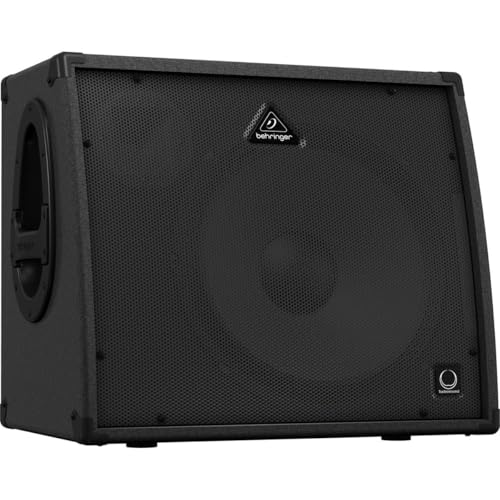
As a mixer system, the KXD15 is built around control: four independent stereo channels with individual volume and FX send controls, a Klark Teknik processor with 100 presets to send them to, and a 7-band graphic EQ with FBQ feedback detection watching the master. Channel 1 adds an XLR mic input, so a vocal or spoken mic joins the keys without extra hardware. The balanced stereo XLR DI output with ground lift then exports the whole production to the house desk, which is precisely the workflow this category exists for.
Specs
- 600-watt bi-amped PA system and keyboard amplifier
- 4 independent stereo channels with volume and FX send per channel
- Original 15-inch Turbosound speaker
- Klark Teknik multi-FX processor with 100 presets
- Balanced stereo XLR DI output with ground lift switch
- 7-band graphic EQ with FBQ feedback detection
- XLR mic input on channel 1
- Link output for coupling a second unit into a stereo system
- Integrated pole socket for stand mounting
Best for: Keys players who mix several stereo sources and effects in the amp and export one finished feed.
Watch out for: With this much onboard processing, confirm your preferred effects are reachable from the panel quickly; deep preset lists reward setup time at home, not mid-song searching.
Roland KC-600
Roland’s KC-600 approaches the mixer brief with a calmer hand: four stereo input channels, a stereo auxiliary input, and a master EQ with a Shape switch for fast overall voicing. Its output panel is a system builder’s set, with XLR and jack line outputs, a sub output for reinforcing piano low end, and Stereo Link for chaining a second KC-600 into a wider rig. For stage piano, that means the amp can start as a single mixer-amp and grow into a stereo pair without changing how you work.
Specs
- 4-channel stereo mixing keyboard amplifier
- 200 watts of power
- 15-inch woofer and horn tweeter in a two-way speaker system
- XLR and 1/4-inch line outputs, including balanced XLR line out pair
- Sub output for adding low-end reinforcement
- Stereo Link for chaining a second KC-600
- Master EQ with Shape switch
- Removable casters included
Best for: Stage piano players who want a four-channel mixer that can expand into a linked stereo system.
Watch out for: Effects are not the KC-600’s focus, so players wanting onboard reverb or chorus should plan on their keyboard’s own effects or an external unit.
Laney AUDIOHUB AH300
Laney’s AH300 is the widest mixer here, with five channels spanning balanced XLR, instrument, stereo line and RCA inputs, each of the first four with level, two-band EQ and an FX send into 16 onboard DSP presets. A master 5-band graphic EQ shapes the combined result, and the output set, including a balanced XLR DI output, a line out and a record out, lets different destinations take different versions of the mix. The kickback cabinet suits the common keys-corner job of monitoring a small band from the floor.
Specs
- 300-watt multi-input combo amplifier
- 5 channels with XLR, jack, RCA and mini-jack inputs
- 15-inch custom woofer plus HF horn
- Balanced XLR DI output for mixers and recording devices
- Master 5-band graphic EQ
- Onboard DSP with 16 effect presets
- Channels 1 to 4 with level, two-band EQ and FX send
- FX loop, line out, record out and headphone output with level control
- Dual-position kickback cabinet
Best for: Mixed bands and worship teams blending keys, e-drums, vocals and playback in one cabinet.
Watch out for: Five channels of flexibility means more panel to learn; label your channel assignments before the first gig so soundcheck stays quick.
Peavey KB 5
Peavey’s KB 5 mixes like a small PA because that is what it was designed to be. A stereo mixer with 2-band EQ and a main effects send and return handles the instruments, a separate mic and line channel brings 3-band EQ for a voice, and a monitor input with level control and assign lets the house desk return foldback into the same cabinet. The XLR balanced stereo line out exports the mix, ground lift handles noisy venues, and an external speaker can raise the output when the room grows.
Specs
- 150 watts, rising to 200 watts with an external speaker
- Two 10-inch speakers and a horn
- Stereo mixer with 2-band EQ and main effects send/return
- Mic/line channel with 3-band EQ and effects send/return
- XLR balanced stereo line out
- Ground lift and DDT speaker protection defeat switch
- Monitor input with level control and assign
- Headphone output with level control
- Built-in casters and handle
Best for: Singing pianists and small ensembles who need mixing, foldback and a balanced feed in one unit.
Watch out for: The effects path is a send and return loop rather than a built-in processor, so budget a place in the rig for an external effects unit if you rely on one.
Which One Fits Your Situation
A keys corner running two boards and tracks
The Behringer KXD15 gives each stereo source its own channel and FX send, the graphic EQ tames the room, and the ground-lifted DI output hands the desk a finished stereo mix. It is the closest thing here to a mixing desk that happens to contain a 15-inch speaker.
A solo stage piano act with voice and backing tracks
Choose the Peavey KB 5. The mic and line channel treats your voice separately with its own 3-band EQ, the stereo mixer takes piano and tracks, and the monitor input means a venue’s foldback can come back into the same cabinet you mixed in.
A worship or function rig with many source types
The Laney AH300 accepts the mixture without adapters: balanced XLR channels, stereo line channels and an RCA channel for playback, all under a master graphic EQ. Its DI output then gives the church or venue desk a clean, balanced copy of everything.
A piano rig that will grow into a stereo pair
Start with the Roland KC-600. Run it alone as a four-channel mixer-amp, feed the house from its XLR line outputs, and add the sub output or a second linked KC-600 later. The workflow stays identical as the rig expands, which protects the habits you build at soundcheck.
Common Mistakes
- Buying on channel count while ignoring per-channel EQ and FX sends, then finding the mixer cannot shape individual sources.
- Double-processing a signal with onboard effects and a looped external unit both active, and blaming the amp for the wash.
- Sending the desk a feed without agreeing who controls its level, the amp master or the house engineer.
- Putting a microphone through a keys channel with no feedback control in a system that offers graphic EQ or detection.
- Forgetting the monitor path: a mixer amp with no monitor input cannot accept the desk’s foldback return.
Frequently Asked Questions
What makes an amp a mixer system rather than a combo?
Depth of mixing. A mixer system gives individual channels their own EQ and effects sends, adds a considered master section, and provides routing such as monitor inputs, link outputs and a balanced feed of the whole mix. The KXD15, AH300, KC-600 and KB 5 each meet that description in different ways.
Do I still need a separate DI box with one of these?
Generally no for your keys rig. The balanced XLR line, main or DI outputs on these systems perform the DI role between amp and desk, carrying the full mix. A separate DI still helps if you want a feed taken before the amp’s mixer, for example a dry piano split for the engineer.
Built-in effects or an effects loop: which is better?
Built-in effects keep the rig compact and consistent, and per-channel sends decide how much each source gets. A loop suits players with a favourite external processor. The KXD15 and AH300 go the built-in route, while the KB 5 provides the send and return loop instead.
Can a mixer amp handle a whole small band?
It can handle a keys-led slice of one: several instruments, a microphone and playback, as the five-channel AH300 shows. Full drum kits and multiple guitars still belong on a proper desk. Treat the amp as the keyboard department’s mixer, exporting one balanced feed to whatever runs the whole show.
FAQ
What makes an amp a mixer system rather than a combo?
Do I still need a separate DI box with one of these?
Built-in effects or an effects loop: which is better?
Can a mixer amp handle a whole small band?
More from Amazon
Programs that pair well with the guide above. Offers and eligibility are set by Amazon and may change.
Free shipping on eligible items, Prime Video and more. Eligible new members can start with a free trial.
Start a Prime free trialA Prime membership for ages 18-24 with a trial period. Eligibility is set by Amazon.
See Prime for Young AdultsAudiobooks and podcasts to listen to on the go. Eligible new members can start with a free trial.
Try Audible freeAd-free music streaming. Eligible new subscribers can start with a free trial.
Try Music Unlimited freeAs an Amazon Associate we earn from qualifying purchases.



Write Your Review
No reviews yet. Be the first to share your experience!