
Our Top Picks
 Peavey KB 2 50-Watt 1x10 Keyboard Amp50 watts21.12 x 16.62 x 22.12 inches38.36 poundsCheck on Amazon
 Behringer Ultratone K900fx Ultra-Flexible 90-Watt15.5019.37 x 11.77 x 16.89 inches39.9 poundsCheck on Amazon
 Behringer ULTRATONE KXD12 600 Watt 4 Channel PA18.39 x 11.81 x 16.54 inches40.34 poundsCheck on Amazon
Portable and balanced output pull in opposite directions. The small amps that are easy to carry usually treat the house desk as somebody else’s problem, while the amps with proper XLR feeds tend to be the big ones. For a stage piano player, the real decision is finding the smallest cabinet that still hands front of house a balanced signal, so the amp can stay a monitor while the PA does the room.
This guide is for gigging pianists who carry their own amp to rehearsals, small venues, houses of worship and function gigs, and who plug into house systems of unknown quality. The picks come from Amazon product titles and listing details only, and each one had to show a balanced XLR line, main or DI output in its documented outputs before it earned a place here.
Quick Picks
As an Amazon Associate we earn from qualifying purchases
| Product | Best for | Key spec from title |
|---|---|---|
| Peavey KB 2 | The smallest carry that still feeds the desk balanced | 40/10W biamped, 10-inch coax speaker, balanced XLR main out |
| Behringer ULTRATONE K900FX | A stand-mountable 90-watt amp for small stages | 90W, 3 channels, 12-inch woofer, balanced XLR line out |
| Behringer ULTRATONE KXD12 | Four stereo channels in the 12-inch cabinet | 600W, 4 stereo channels, 12-inch Turbosound, balanced XLR DI out |
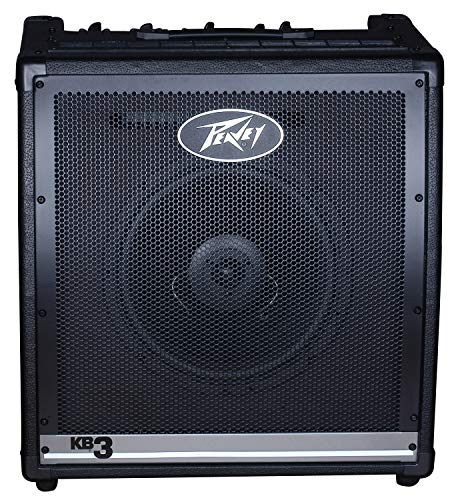
| Peavey KB 3 | A compact all-rounder with a monitor input channel | 60W, 12-inch speaker, 3 channels, balanced XLR main out |
How to Choose
Let the balanced output carry the room, not the speaker
Once an amp has a balanced XLR feed, its own speaker only has to serve you at the piano. That changes the portability maths completely: a 10-inch combo like the Peavey KB 2 can be the right gigging choice because the house system supplies the audience volume. Without that output, the same small amp would need to fill the room alone and would run out of headroom. So judge portable candidates first by their output panel, and only then by how their speaker will sound as your personal monitor.
Read portable as format, not just a weight figure
Listings do not always state weight, and a headline number hides shape, handles and how a cabinet loads into a car. A 12-inch combo with a pole socket, like the Behringer K900FX, can ride on a speaker stand at ear height and travel like PA gear, while a similar-sized floor combo cannot. The KXD12 keeps the 15-inch model’s channel count in a smaller 12-inch cabinet. Think about the carry you actually do: stairs, one trip from the car, or a trolley across a venue car park.
Keep enough channels for the travelling rig
Portable rigs grow quietly: the piano, then a small synth for pads, then a playback device for clicks or tracks. Three channels is a sensible floor for a working stage piano setup, and the KB 3 adds a monitor input channel on top of its three main channels. Check the mic provision too. A channel with an XLR input, as on the KB 2’s channel 3, lets a portable amp cover a spoken announcement or a single vocal without extra hardware in the bag.
Notice where small amps quietly cut corners
The savings on compact keyboard amps usually appear on the back panel: a line out that is unbalanced only, no ground lift, no effects loop, or a headphone socket that mutes more than expected. Every amp in this guide kept a balanced XLR output, which is the corner that matters for stage piano work. Also check the power source line in the listing. All four here are corded electric, so portable means easy to transport, not battery powered or busking-ready away from mains.
The 4 Best Options
Peavey KB 2
Peavey’s smallest KB with a balanced output is the natural travel amp in this group. The 10-inch coaxial speaker and 40/10-watt biamped layout keep the cabinet compact, while three channels plus a monitor input cover piano, a second source and a return feed. Channel 3 takes XLR and jack inputs, so a microphone can join without a mixer. The balanced XLR main out is the headline for stage piano use: plug into the house, keep the amp by your bench, and let the PA handle the audience.
Specs
- 40/10 watts of biamped power
- 10-inch coaxial speaker
- 3 separate channels, plus a channel 4 monitor input
- Channel 3 with XLR and 1/4-inch inputs
- 2-band EQ per channel
- Effects send/return
- Balanced XLR main out
- Headphone output
Best for: Pianists who carry their amp to every rehearsal and small gig and always feed a house desk.
Watch out for: Forty watts into a 10-inch speaker is a monitor, not a room-filler. On stages with no PA support, its bigger brothers in this guide are safer.
Behringer ULTRATONE K900FX
Behringer’s K900FX takes a PA-style approach to portability: a 90-watt, three-channel combo with a 12-inch woofer, an integrated pole socket for stand mounting, and a line output on XLR and jack connectors, with the XLR documented as balanced in its specifications. Raising a keyboard amp to ear level transforms it as a monitor in noisy rooms, and the stand mount means it packs and travels like the rest of a small PA. Onboard effects, a 5-band graphic EQ and a subwoofer output round out a flexible little system.
Specs
- 90-watt 3-channel PA system and keyboard amplifier
- 12-inch Bugera woofer and custom 1-inch driver
- Line output on XLR (balanced) and 1/4-inch connectors for a mixing console
- 24-bit digital effects processor with 100 presets
- 5-band graphic EQ with FBQ feedback detection
- Separate volume and FX send per channel, plus XLR mic input on channel 1
- CD input, subwoofer output and headphone output
- Integrated 35 mm pole socket for stand mounting
- Corded electric power source
Best for: Players who mount their amp on a stand and want effects and EQ built into a single carry.
Watch out for: The line output pair mixes one XLR and one jack, so confirm which connector your venue’s stage box expects before relying on a stereo feed.
Behringer ULTRATONE KXD12
The KXD12 is the portable answer for players who refuse to give up channels: it keeps the KXD15’s four independent stereo channels, Klark Teknik effects and balanced stereo XLR DI output with ground lift, but wraps them around a 12-inch Turbosound speaker instead of a 15. For stage piano that trade makes sense, because the DI feed, not the woofer, reaches the audience in most venues. A link output still lets a second unit form a stereo pair when a bigger stage demands it, and the pole socket helps placement.
Specs
- 600-watt bi-amped PA system and keyboard amplifier
- 4 independent stereo channels with volume and FX send per channel
- Original 12-inch Turbosound speaker
- Klark Teknik multi-FX processor with 100 presets
- Balanced stereo XLR DI output with ground lift switch
- 7-band graphic EQ with FBQ feedback detection
- XLR mic input on channel 1
- Link output for coupling a second unit into a stereo system
- Integrated pole socket for stand mounting
Best for: Keyboardists with multi-source rigs who need full mixer features in the smaller cabinet.
Watch out for: It is the smaller KXD, not a small amp in absolute terms. Check the listed dimensions against your car boot and any tight rehearsal-room doors.
Peavey KB 3
Peavey’s KB 3 sits in the middle of the portable range: 60 watts through a 12-inch speaker with a tweeter, three separate channels, and a channel 4 monitor input for a return feed from the desk. The balanced XLR main out sends your mix onward, and an effects send and return lets an external processor join the rig without repatching the piano. An extension cabinet can raise output to 80 watts, which gives a portable setup a growth path for larger rooms without replacing the amp itself.
Specs
- 60 watts of power, extending to 80 watts with an extension cabinet
- 12-inch speaker with tweeter
- 3 separate channels, with a mic input on channel 1
- 2-band EQ per channel
- Channel 4 monitor input
- Effects send/return
- Balanced XLR main out
- Headphone output
Best for: Gigging pianists who want one compact amp for rehearsals, small venues and desk-fed stages alike.
Watch out for: The mic input sits on channel 1 rather than a dedicated mic channel, so a singing pianist should check the shared EQ arrangement before buying.
Which One Fits Your Situation
Rehearsals and small rooms, car-boot sized
The Peavey KB 2 is the easiest carry here and still offers the balanced XLR main out that matters when a rehearsal space has a small desk. Its 10-inch speaker covers a circle of musicians comfortably, and channel 3’s XLR input handles a single microphone for announcements or a quiet vocal.
A function gig where the amp goes on a stand
Pick the Behringer K900FX. The pole socket puts the cabinet at ear height behind the piano, the balanced XLR line output feeds the function band’s desk, and the onboard effects and graphic EQ reduce the extra pedals and processors in your gig bag.
A travelling multi-keyboard rig
The Behringer KXD12 keeps four stereo channels and a ground-lifted DI output in the 12-inch format, so a piano, synth and playback rig travels without shrinking to a lesser mixer. Add a second unit through the link output only when a venue genuinely needs the stereo pair.
One amp for practice rooms and desk-fed stages
The Peavey KB 3 covers both lives. At rehearsal it is a self-contained three-channel combo; on stage its monitor input takes the desk’s return while the balanced main out sends your piano mix forward, so the same box works in both directions of the signal chain.
Common Mistakes
- Choosing the smallest amp by cabinet size alone, then finding its line out is unbalanced and noisy on long runs.
- Reading portable as battery powered when the listing states corded electric, and arriving at an outdoor gig with no mains plan.
- Filling every channel at home and leaving no spare input for the playback device or mic the gig actually requires.
- Judging a monitor amp by room-filling volume instead of clarity at the playing position once the PA is involved.
- Ignoring the pole socket and handle layout, which decide whether a nominally portable amp is genuinely a one-trip carry.
Frequently Asked Questions
Can a small keyboard amp really work for stage piano?
Yes, provided it has a balanced output and there is a house system to feed. The amp becomes your monitor, the desk handles the audience, and the balanced XLR feed keeps the run quiet. The KB 2 and KB 3 in this guide are built around exactly that division of labour.
Are any of these portable amps battery powered?
No. The Amazon listing details for the amps here show corded electric power, so portable describes their size and transport format. A battery amp would be a different product category, and in this guide it would also have needed a balanced output, which small battery models rarely document.
Why does a ground lift switch matter on the DI output?
When an amp and a house desk take power from different outlets, a ground loop can add hum to the balanced feed. A ground lift, fitted to the KXD12’s DI output, breaks that loop at the amp end. It is a small switch that can save a soundcheck, especially in older venues.
Should I mount a portable keyboard amp on a stand?
Raising the cabinet to ear height usually improves what you hear more than extra wattage would, because the sound stops firing at your knees. The K900FX and KXD12 both include pole sockets for that purpose. Keep the stand stable and the amp’s own volume modest once the house feed is set.
FAQ
Can a small keyboard amp really work for stage piano?
Are any of these portable amps battery powered?
Why does a ground lift switch matter on the DI output?
Should I mount a portable keyboard amp on a stand?
More from Amazon
Programs that pair well with the guide above. Offers and eligibility are set by Amazon and may change.
Free shipping on eligible items, Prime Video and more. Eligible new members can start with a free trial.
Start a Prime free trialA Prime membership for ages 18-24 with a trial period. Eligibility is set by Amazon.
See Prime for Young AdultsAudiobooks and podcasts to listen to on the go. Eligible new members can start with a free trial.
Try Audible freeAd-free music streaming. Eligible new subscribers can start with a free trial.
Try Music Unlimited freeAs an Amazon Associate we earn from qualifying purchases.


Write Your Review
No reviews yet. Be the first to share your experience!