
Key takeaways
- Best for occasional lake fishing and easy transport: Intex Mariner 4.
- Best compact solo fishing platform: Sea Eagle 285 Frameless Pontoon Boat.
- Best for two anglers with substantial gear: Sea Eagle 350FX Fishing Explorer.
- Best value for calm-water family fishing: Intex Excursion 5.
- Best for shallow, rocky rivers: a reinforced high-pressure-floor or inflatable-pontoon design with a self-bailing deck, rather than a basic recreational raft.
The best inflatable fishing boat for most lake anglers is a reinforced PVC model with an inflatable or slatted floor, two separate air chambers, and enough capacity for one person, tackle, battery, and motor without operating near its limit; river anglers should prioritize self-bailing construction, abrasion protection, and a rigid or high-pressure floor instead.
Best inflatable fishing boats by situation
- Best for occasional lake fishing and easy transport: Intex Mariner 4.
- Best compact solo fishing platform: Sea Eagle 285 Frameless Pontoon Boat.
- Best for two anglers with substantial gear: Sea Eagle 350FX Fishing Explorer.
- Best value for calm-water family fishing: Intex Excursion 5.
- Best for shallow, rocky rivers: a reinforced high-pressure-floor or inflatable-pontoon design with a self-bailing deck, rather than a basic recreational raft.
There is no single winner for every trip. A 12-foot boat may carry more gear, but it also needs more storage space, takes longer to dry, and is harder to load alone. A compact frameless pontoon can be excellent for one angler, but it has less room for a second person, a cooler, or a large battery.
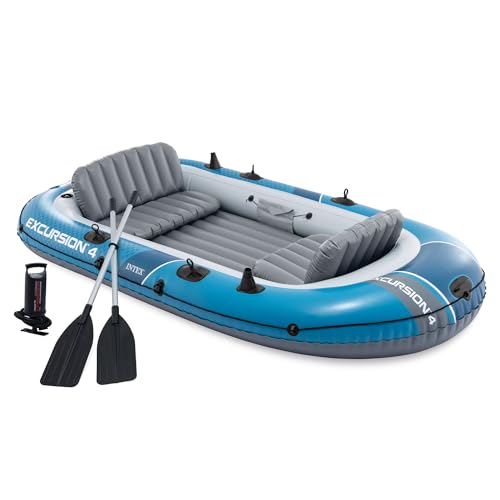
INTEX Excursion 5-Person Inflatable Fishing Boat River Raft Set with Oars
Included for 'Best Inflatable Fishing Boats for Lakes and Rivers' as a relevant option in this category; details come from the product listing.
View on Amazon
INTEX Excursion Pro K2 Inflatable Kayak 2-Person Set with Paddles & Pump
Included for 'Best Inflatable Fishing Boats for Lakes and Rivers' as a relevant option in this category; details come from the product listing.
View on Amazon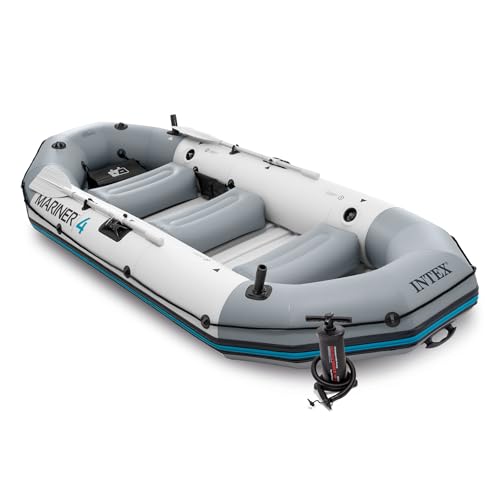
INTEX Mariner 4-Person Inflatable Fishing Boat Set with Oars and Pump
Included for 'Best Inflatable Fishing Boats for Lakes and Rivers' as a relevant option in this category; details come from the product listing.
View on AmazonHead-to-head comparison
| Model | Approx. inflated size | Rated capacity | Boat weight | Floor and construction | Motor compatibility | Typical inflation time | Packed-size reality |
|---|---|---|---|---|---|---|---|
| Intex Mariner 4 | 129 x 57 x 19 in | 880 lb | About 77 lb | Inflatable I-beam floor; heavy-duty PVC; aluminum bench seats | Transom-mounted motor up to about 3 hp, using a suitable motor mount | About 15–25 minutes with a 12-volt or electric pump | Large duffel-sized bundle; awkward for a small sedan trunk |
| Intex Excursion 5 | 144 x 66 x 17 in | 1,320 lb | About 57 lb | Inflatable I-beam floor; PVC hull; removable aluminum benches | Motor mount compatible with the optional Intex-style bracket | About 15–25 minutes | More manageable than its length suggests, but still needs a dry storage corner |
| Sea Eagle 285 Frameless Pontoon | About 9 ft 8 in long | 450 lb | About 42 lb, depending on package | Two pontoon tubes with a suspended fishing seat and open frame | Compatible with a small electric motor when fitted with the appropriate motor mount | About 10–15 minutes | One of the easiest options to carry in a car; frame parts add separate pieces |
| Sea Eagle 350FX Fishing Explorer | About 11 ft 7 in x 3 ft 3 in | 1,200 lb | About 57 lb for the boat package, before optional accessories | High-frequency welded PVC; inflatable drop-stitch floor | Designed for a compatible transom and small electric or gas motor, subject to the package rating | About 10–15 minutes with a suitable pump | Rolls into a manageable bag, but the floor and transom components increase bulk |
Dimensions, weights, capacities, and accessory compatibility can vary by package and production year. Check the current manual before adding a motor, and treat the listed capacity as a maximum—not a comfortable fishing load. A capacity figure usually includes people, motor, battery, fuel, cooler, and tackle.
What the numbers mean on the water
Length and width
Length improves tracking and gives two anglers more usable space. Width improves stability while casting, standing, or reaching for a net. The trade-off is maneuverability: a wide recreational raft can be stable on a lake but cumbersome in a narrow river with frequent turns.
For one angler, roughly 9 to 10 feet is usually enough for a seat, tackle box, and modest cooler. For two anglers, look closer to 11 to 12 feet and pay attention to the interior floor length, not just the outside dimensions. Thick side tubes can consume several inches of usable width on each side.
Weight capacity
Use a practical target of 60–70% of the published capacity for fishing. For example, two anglers weighing 180 and 160 pounds, a 55-pound battery, a 25-pound motor, and 80 pounds of equipment total 685 pounds. In a boat rated for 880 pounds, that leaves a 195-pound margin, but the interior may still feel crowded. In a 450-pound pontoon, that load is not appropriate at all.
Leave extra capacity for waves, rainwater, clothing, and an unexpectedly full cooler. Operating close to the limit reduces freeboard, which allows spray and wake water to enter more easily.
Floor construction
An inflatable I-beam floor is light, comfortable, and compact. It works well on calm lakes, but it can flex under a standing angler and should be protected from hooks, knives, and sharp rocks.
A drop-stitch floor uses thousands of internal threads to hold the top and bottom surfaces apart at high pressure. It feels firmer underfoot and packs smaller than a rigid floor, making it a strong compromise for anglers who want better casting stability without transporting a hard boat.
Slatted aluminum or wood floors provide a firm platform and can improve motor handling, but they add setup time and create a longer, heavier package. For rocky rivers, floor protection matters as much as firmness: use a reinforced underside, avoid dragging the boat, and carry it around gravel bars.
Motor and battery planning
A motor-ready boat is not automatically safe with any motor. Confirm four separate limits: the boat’s horsepower rating, the motor-mount rating, the transom or bracket design, and the total load after adding the battery or fuel.
For quiet lakes, a 30- to 55-pound-thrust electric motor is often a sensible range for a solo or lightly loaded inflatable. A 55-pound-thrust motor drawing roughly 45 amps from a 12-volt, 100 amp-hour battery has a theoretical runtime of:
100 amp-hours ÷ 45 amps = 2.2 hours.
Real runtime is lower because batteries should not always be fully discharged, wind and current increase consumption, and high throttle settings draw more power. Plan on approximately 1.5–2 hours of useful mixed-speed operation from that example, and secure the battery so it cannot shift or puncture the floor.
Most small inflatables are best suited to electric propulsion or very small outboards. Rivers with current require more control than calm-water trolling, but fitting a larger engine simply because the boat has a transom can overload the hull. Check local registration and equipment requirements before launching.
Decision matrix for transport and experience
| Your situation | Best fit | Why | What to avoid |
|---|---|---|---|
| Small car, solo angler, frequent short trips | Compact frameless pontoon | Low carry weight and fast setup | Long boats with multi-piece floors |
| Two anglers on calm lakes | 11–12 ft boat rated around 880–1,200 lb | More seating and gear capacity | Trying to fish two people from a 9 ft solo platform |
| Beginner with limited storage | Inflatable I-beam floor and removable benches | Simple setup and moderate packed size | Rigid floors that cannot be stored indoors |
| Shallow or rocky river | Reinforced PVC with a firm, protected floor | Better abrasion resistance and control | Dragging a thin recreational raft over rocks |
| Regular motorized fishing | Transom-equipped boat with a documented motor rating | Safer load planning and better tracking | Clamping a motor to an improvised rail or seat |
Setup and ownership details that matter
Before the first trip, inflate each chamber in the manufacturer’s sequence and use a pressure gauge when one is specified. Pressure changes with temperature: a boat inflated in cool morning air can become over-pressurized in direct afternoon sun. Do not use a high-pressure compressor unless the boat’s instructions explicitly allow it.
Keep hooks, pliers, scissors, and fish spines away from unprotected tubes. Store tackle in closed boxes, use a landing net, and place a foam pad or marine mat beneath batteries and hard coolers. The areas most likely to wear are the underside, valve bases, seat attachments, motor-mount contact points, and folded creases.
After each outing, rinse off sand, algae, and salt, then dry the boat fully before packing it. Trapped moisture encourages odor and mildew. Do not store it tightly compressed while wet, and avoid prolonged ultraviolet exposure. Carry a repair kit with compatible material, adhesive, valve tools, and spare valve caps; a slow leak is much easier to find at home than on the water.
A common mistake is judging portability by boat weight alone. A 57-pound boat may become a 90-pound transport problem after adding floor panels, seats, battery, motor, anchor, and tackle. Measure your vehicle’s trunk opening and storage closet, not just the available interior volume. If the packed bag cannot pass through the narrowest opening, its advertised packed size will not help.
Bottom line
Choose the Sea Eagle 285 Frameless Pontoon for efficient solo lake fishing and the Intex Mariner 4 when two people need a relatively simple, economical platform. Choose a drop-stitch-floor design such as the Sea Eagle 350FX when a firmer deck and higher load capacity justify a larger package. For rivers, prioritize reinforcement, floor protection, freeboard, and predictable motor handling over the lowest price or highest advertised capacity. The best inflatable fishing boats are the ones whose real packed weight, interior space, and safety margin match the way you actually travel and fish.


Write Your Review
No reviews yet. Be the first to share your experience!