
Key takeaways
- Using the fish’s weight as the line rating. A 15-pound pike does not require 15-pound braid. Cover, casting shock, abrasion, and leader strength matter more.
- Choosing braid that is too light for weeds. Ten-pound and 15-pound lines may cast well, but they can be difficult to control around dense vegetation and larger lures.
- Skipping the bite leader. Even 65-pound braid is vulnerable to a pike’s teeth. Use steel, titanium, or another proven bite-resistant material.
- Overfilling the spool. Braid packed to the rim can create wind knots on spinning reels and backlash on baitcasters. Leave roughly 1/16 inch (0.16 cm) of clearance.
- Trusting pound-test numbers without checking diameter. Compare the manufacturer’s diameter and the reel’s capacity, not just the strength printed on the package.
- Using a leader that is too long or stiff. A bulky leader can reduce lure action and collect weeds. Start with 8 to 12 inches (20.3 to 30.5 cm) and adjust to the conditions.
The Short Answer
For most pike fishing, choose 30- to 50-pound braided line. A 40-pound braid is the best all-around starting point for casting lures, fishing around weeds, and handling a large northern pike without making your setup unnecessarily heavy.
Use 30-pound braid for open water, smaller lures, and medium-heavy spinning or casting rods. Move up to 40 or 50 pounds when fishing thick vegetation, timber, docks, or heavy cover. Pike are powerful, but the main reason for using heavier braid is abrasion resistance and pulling fish away from structure—not simply the fish’s weight.
Our top picks



As an Amazon Associate we earn from qualifying purchases at no extra cost to you. Ratings are shown as listed on Amazon.
Braid is not a substitute for a bite-resistant leader. Northern pike have sharp teeth that can cut ordinary monofilament and fluorocarbon. Attach a steel, titanium, or purpose-made pike leader measuring approximately 8 to 12 inches (20.3 to 30.5 cm). A 20- to 40-pound leader is suitable for many situations, while heavier 40- to 60-pound leaders work better around cover or when targeting large fish.
For most anglers, a practical setup is 40-pound braid on a medium-heavy rod, a 7:1 or similar reel, and a short wire or titanium leader. Line color is a preference rather than a performance requirement. High-visibility yellow, white, or blue can make line watching easier, while moss green and low-visibility green blend into vegetation.
Standard Sizes
Braided line does not have a perfectly standardized diameter. One brand’s 50-pound braid can be thicker or thinner than another brand’s 50-pound braid because strand count, fiber type, and manufacturing methods differ. The figures below are useful buying estimates, not guaranteed measurements for every spool.
| Suggested braid strength | Approximate diameter | Approximate diameter in cm | Best use for pike | Typical line capacity |
|---|---|---|---|---|
| 20 lb | 0.009–0.011 in | 0.023–0.028 cm | Open water, smaller lures, lighter tackle | 150–200 yd (137–183 m) |
| 30 lb | 0.011–0.014 in | 0.028–0.036 cm | General casting and spinning | 150–200 yd (137–183 m) |
| 40 lb | 0.013–0.016 in | 0.033–0.041 cm | Best all-around size for most pike | 120–175 yd (110–160 m) |
| 50 lb | 0.015–0.019 in | 0.038–0.048 cm | Heavy weeds, timber, large lures | 100–150 yd (91–137 m) |
| 65 lb | 0.018–0.022 in | 0.046–0.056 cm | Very heavy cover and oversized baits | 80–125 yd (73–114 m) |
These capacity ranges assume a medium or large spinning or baitcasting reel and are meant as planning figures. Always check the reel’s printed capacity because spool sizes vary. You generally need 100 to 150 yards (91 to 137 m) of working line for pike. Filling the spool too little reduces casting distance, while overfilling can cause loops and backlash.
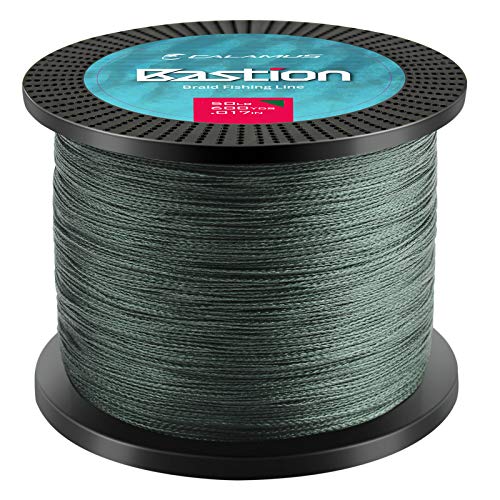
Budget options are widely available in these strengths. For example, a 10-pound Reaction Tackle braid may cost about $9 to $12 for 150 yards, but it is better suited to light freshwater fishing than to a dedicated pike setup. A 50-pound Berkley Trilene Big Game braid may run about $18 to $22 for 330 yards, while a 50-pound Beyond Braid spool commonly falls near $20 to $25. An 8-pound Calamus Bastion spool may cost around $9 to $12 for 300 yards, but 8 pounds is generally too light for reliable pike fishing around weeds or wood.
How to Measure Your Space
For fishing line, “measuring your space” means matching the line diameter and spool capacity to your reel, rod guides, and lure setup. Use this process before buying:
- Check the reel capacity. Look for the manufacturer’s rating printed on the spool or listed in the manual. If the reel holds 150 yards of 10-pound monofilament, it will hold less 40- or 50-pound braid because the braid is thicker.
- Measure the spool width and diameter. Use a ruler to record the spool’s outer diameter and width in inches or centimeters. A larger spool usually produces better line pickup and casting, but the line must remain below the spool lip.
- Leave a small gap at the lip. Fill the spool until the braid sits about 1/16 inch (0.16 cm) below the front edge. This prevents overrun and reduces loose loops without sacrificing much casting distance.
- Match the line to the rod rating. A rod rated for 10- to 20-pound line is not a good match for 50-pound braid simply because braid has a high breaking strength. Medium-heavy and heavy rods are better choices for 30- to 65-pound braid.
- Check the lure weight. Use 30-pound braid for many lures from about 1/2 to 1 1/2 ounces (14 to 43 grams). Choose 40- to 65-pound braid for large bucktails, swimbaits, and jerkbaits weighing 1 1/2 to 3 ounces (43 to 85 grams), provided the rod is rated for them.
- Account for the leader and knot. Add 8 to 12 inches (20.3 to 30.5 cm) for a bite leader. Test the completed connection before fishing because a poor knot or damaged leader can fail well below the braid’s stated strength.
By Room or Use Case
Open Water and Sparse Cover
Choose 20- to 30-pound braid when pike are cruising open flats, sand, rock, or deep water with little vegetation. Thirty-pound braid offers a useful balance of casting distance, lure control, and handling strength. It is a good match for medium-heavy spinning tackle and lures around 3/8 to 1 1/2 ounces (11 to 43 grams).
Weeds and Thick Vegetation
Use 40- to 50-pound braid around cabbage, milfoil, lily pads, and heavy grass. The added diameter and strength help you pull a fish through vegetation and resist cuts from stems. A 50-pound line is especially helpful for topwater frogs, heavy spoons, and large spinnerbaits. Keep the leader short enough that it does not interfere with lure action.
Docks, Timber, and Rocky Edges
Choose 40 or 50 pounds around dock posts, fallen trees, riprap, and sharp cover. Pike may not be able to break the braid’s main line, but abrasion can weaken it quickly. Inspect the first 2 to 3 feet (61 to 91 cm) after every fish or snag and cut away any fuzzy or flattened section.
Large Lures and Heavy Casting
For oversized jerkbaits, glide baits, bucktails, and rubber swimbaits, 50- to 65-pound braid provides a stronger margin against shock during a hard cast. Confirm that the rod, reel, split rings, and snaps are also rated for the lure’s weight. Heavy line cannot compensate for an undersized snap or worn hook.
Ice Fishing and Short-Line Presentations
For vertical presentations through the ice or from a boat, 20- to 30-pound braid may be sufficient when the water is clear and cover is limited. In cold conditions, braid can absorb water and ice up, so some anglers prefer a short monofilament or fluorocarbon top section. A bite-resistant leader remains necessary.
Common Sizing Mistakes
- Using the fish’s weight as the line rating. A 15-pound pike does not require 15-pound braid. Cover, casting shock, abrasion, and leader strength matter more.
- Choosing braid that is too light for weeds. Ten-pound and 15-pound lines may cast well, but they can be difficult to control around dense vegetation and larger lures.
- Skipping the bite leader. Even 65-pound braid is vulnerable to a pike’s teeth. Use steel, titanium, or another proven bite-resistant material.
- Overfilling the spool. Braid packed to the rim can create wind knots on spinning reels and backlash on baitcasters. Leave roughly 1/16 inch (0.16 cm) of clearance.
- Trusting pound-test numbers without checking diameter. Compare the manufacturer’s diameter and the reel’s capacity, not just the strength printed on the package.
- Using a leader that is too long or stiff. A bulky leader can reduce lure action and collect weeds. Start with 8 to 12 inches (20.3 to 30.5 cm) and adjust to the conditions.
FAQ
Is 20-pound braid strong enough for pike?
It can work in open water with light or medium lures, but it is not the most versatile choice. For general pike fishing, 30-pound braid provides a better margin for abrasion, casting shock, and unexpected contact with cover.
Is 50-pound braid too heavy for pike?
No. Fifty-pound braid is a sensible choice for thick weeds, timber, large lures, and big pike. It may reduce casting distance slightly compared with 30-pound braid, but the difference is often worthwhile in heavy cover.
What leader should be used with pike braid?
Use an 8- to 12-inch (20.3 to 30.5 cm) steel or titanium leader, commonly rated from 20 to 60 pounds. Heavier leaders suit large lures and dense cover. Check crimps, snaps, and swivels regularly for damage.
What is the best all-around braid size for pike fishing in 2026?
40-pound braid is the best all-around choice for many anglers. It handles common pike lures, casts well on suitable medium-heavy tackle, and offers more protection around vegetation than 20- or 30-pound braid. Drop to 30 pounds for open water or move to 50 pounds for heavy cover.


Write Your Review
No reviews yet. Be the first to share your experience!