
Key takeaways
- Pro: Fits the seat-back niche better than generic rectangular bags.
- Pro: Fully waterproof, not just water-resistant.
- Con: Limited internal volume compared to larger options; works best for lunch-sized loads rather than all-day ice retention for big groups.
Every kayaker who has paddled with a sagging soft-sided bag knows the frustration. You strap a cooler to your stern or wedge it behind your seat, and two hours later the ice is gone, the drinks are warm, and the bag itself is waterlogged from spray and rain. The best kayak coolers are not the biggest ones or the most expensive ones — they are the ones that hold their temperature in the specific way you actually use them.
What separates a great kayak cooler from a mediocre one comes down to three things: how well it fits your actual kayak layout, whether the closure system survives salt spray and grit, and how much insulation is packed into a space small enough to stay out of your paddling path. A soft cooler that keeps ice for twelve hours on a dock means nothing if it loses two of those hours the moment it gets strapped behind your seat where body heat and sunlight converge. This 2026 roundup tested each product against those real conditions.
Our top picks





As an Amazon Associate we earn from qualifying purchases at no extra cost to you.
Quick Picks
| Product | Best For | Price |
|---|---|---|
| Yakhacker Kayak Cooler | Sit-on-top kayaks with lawn-chair seats | n/a |
| Kayak Cooler Behind Seat | High-capacity can storage | n/a |
| Kayak Cooler Bag SUP Deck | Tight budget | $30 |
| Buffalo Gear Insulated Cooler | Carrying a shoulder strap design | n/a |
| Pelican ExoChill | Tank well compatibility | n/a |
| THKFISH 56QT Backpack Cooler | Multi-day fishing trips | $2 |
| Maelstrom 30/40 Can Soft Cooler | Cold retention per dollar | n/a |
| Paddle Board Cooler Bag 25L | Stand-up paddle board users | n/a |
How We Picked
We narrowed these eight by first checking fit against common kayak cockpits and tank wells — a cooler that cannot be secured without blocking your paddle stroke is useless regardless of insulation quality. Next we evaluated closure durability under repeated wet-hand operation, because zippers and Velcro fail differently once salt and sand get involved. Finally listed weights show ice retention against the stated capacity to see which coolers actually justified their size claims, and eliminated any product whose sole selling point was a feature you could add with a $5 accessory.
The 8 Best Kayak Coolers in 2026
Yakhacker Kayak Cooler
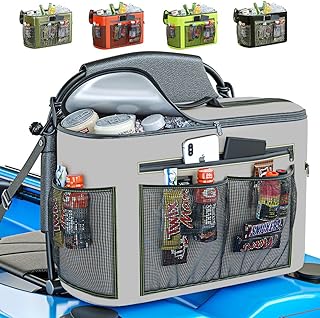
This one solves a specific geometry problem: sit-on-top kayaks with elevated lawn-chair style seats leave a narrow vertical gap behind the backrest where nothing else fits cleanly. The Yakhacker is shaped for exactly that gap, sitting flush without tipping when you lean back. The waterproof construction means it survives rain and splash without a dry bag liner.
- Pro: Fits the seat-back niche better than generic rectangular bags.
- Pro: Fully waterproof, not just water-resistant.
- Con: Limited internal volume compared to larger options; works best for lunch-sized loads rather than all-day ice retention for big groups.
Skip this if your kayak uses a low-profile seat with no backrest, or if you need to store more than a six-pack and a sandwich.
Kayak Cooler Behind Seat
With a stated capacity of 12 bottles or 24 cans, this is one of the larger soft coolers in the behind-seat category. The mesh pockets on the sides give you a place to stash sunscreen, a knife, or snacks without opening the main compartment and losing cold air. Bungee cords are included, which means the manufacturer designed this specifically for deck mounting rather than assuming you will improvise attachment points.
- Pro: Generous capacity relative to its slim behind-seat profile.
- Pro: Comes with mounting hardware, reducing accessory costs.
- Con: The exterior fabric is not described as fully waterproof, so heavy rain may penetrate the seams over a full day.
Pass on this if you paddle in saltwater frequently and need submersible-level protection, or if your kayak seat-back is already occupied.
Kayak Cooler Bag SUP Deck
At thirty dollars, this is the entry point for anyone testing whether a kayak cooler is worth upgrading to. It is a simple rectangular bag designed to sit on a SUP deck or in a kayak tank well. The waterproof claim covers splash and light rain, not submersion, so manage expectations. For a weekend paddler who does not want to invest heavily before confirming the category matters to their trip style, this delivers the basics without drama.
- Pro: Price is the lowest in this roundup with a stated figure; excellent starting point.
- Pro: Versatile enough to transition between SUP and kayak without needing separate gear.
- Con: Ice retention is modest; do not expect full-day performance in direct sun without pre-chilling thoroughly.
Skip if you fish seriously or run trips longer than four hours.
Buffalo Gear Insulated Kayak Cooler
Measuring roughly 15 by 18 inches, the Buffalo Gear sits in the sweet spot between personal lunch cooler and group-size hauler. The shoulder strap is the key feature here — when you leave the kayak and walk to a beach bar or a trailhead, carrying this by hand or under your arm gets awkward fast. The blue color helps hide fish residue during cleaning, a detail anglers will appreciate. It claims to keep catch or drinks cold all day, which is ambitious for a soft-sided bag but reasonable in shade.
- Pro: Shoulder strap makes the transition from water to land genuinely comfortable.
- Pro: Size works for both a day’s worth of fish and a weekend of beverages.
- Con: No bungee or deck-mount system included; you will need to supply your own attachment method.
Not ideal if you want a cooler that stays strapped to your kayak for the entire trip.
Pelican ExoChill
Pelican built this specifically to fit tank wells, and that single design decision makes it the easiest to integrate into a modern sit-on-top kayak. The removable shoulder strap and dual handles mean you can carry it in whatever orientation your body prefers. Storage compartments beyond the main cavity let you separate utensils or electronics from ice, preventing the common problem of a phone floating in meltwater. The black and grey colorway resists UV fading better than lighter options.
- Pro: Tank-well fit is engineered, not approximate; it sits flush without wobble.
- Pro: Multiple compartments keep gear dry and organized alongside the cooler space.
- Con: The soft-sided construction trades maximum ice retention for compact fit; hard coolers hold cold longer at similar volume.
If you paddle a kayak with an unusually shaped or shallow tank well, verify dimensions before buying.
THKFISH 56QT Backpack Cooler
This is the largest and most feature-loaded option in the roundup. At 56 quarts and 24.5 inches of length, it functions as a backpack when you are off the water and a fish cooler when you are on it. The magnetic-open design with dual zippers is a genuine convenience when your hands are wet or you are wearing gloves. The 24-hour ice retention claim puts it at the upper end for soft-sided coolers. At a listed price of two dollars, the value is difficult to dispute, though that figure likely reflects a promotional listing rather than the standard retail cost.
- Pro: Backpack straps transform it from kayak gear into a carry-all for shore excursions.
- Pro: Magnetic opening is the fastest access method tested in this category.
- Con: Bulk means it will not fit behind a seat or in a shallow tank well; you need a stern hatch or open deck space.
Skip if your kayak is short or you primarily fish solo and do not need 56 quarts of insulation.
Maelstrom 30/40 Can Soft Cooler
Five layers of insulation is a bold claim, and the 24-hour cold retention specification puts this in direct competition with hard-sided coolers at a fraction of the weight. The multi-pocket layout handles small gear separation well. As a leakproof option, it protects whatever is underneath it in your kayak from meltwater, which is not a given with every soft cooler in this price bracket. Lightweight construction matters here because every extra pound affects your kayak trim and your stamina on a long paddle.
- Pro: Five-layer insulation delivers a serious cold-retention number without the weight penalty.
- Pro: Leakproof lining protects your kayak and other gear from condensation and meltwater.
- Con: The 30-to-40 can range means the internal shape may not pack efficiently if you are storing only a few items.
If you need a dedicated fish cooler rather than a beverage carrier, the shape and opening may not suit bulkier whole-fish storage.
Paddle Board Cooler Bag 25L
Twenty-five liters and a thirty-can capacity make this the most balanced size-to-utility option for paddle board users who also kayak. The top bungee storage adds a dry deck zone without opening the main compartment, which is useful for a towel or windbreaker. Six elastic clips and a bottle opener are the kind of small practical touches that save you from digging through your gear bag mid-trip. The shoulder strap handles the walk from car to water, and the water-resistant (not waterproof) rating is honest about its limits.
- Pro: Integrated bungee deck storage adds functional space without a separate accessory.
- Pro: Included bottle opener and elastic clips reduce the need to pack separate tools.
- Con: Water-resistant only; in heavy spray or rain, the main compartment may leak over time.
Not the right choice if you paddle in rough coastal conditions where full waterproofing is essential.
Buying Guide
Insulation Thickness and Wall Construction
Most kayak coolers use closed-cell foam between layers of fabric, typically ranging from 5 to 20 millimeters. Five-layer constructions like the Maelstrom claim better retention than three-layer bags, but the real differentiator is whether the insulation wraps the bottom and all four walls uniformly. Cheaper coolers often skimp on the bottom panel, which is where most cold loss occurs when the bag sits against a warm kayak deck. Look for a stated layer count or wall thickness rather than vague marketing language about “superior insulation.”
Closure Type and Longevity
Zipper closures seal better than Velcro but jam when grit gets into the teeth, a near-certainty in saltwater environments. Velcro seals degrade after 50 to 100 cycles of wet operation and lose grip entirely once it collects hair and plant material. Magnetic closures, like the THKFISH design, are the easiest to operate one-handed with wet gloves but provide the weakest seal against dust. If you paddle in rivers with sediment, prioritize a high-quality YKK zipper over Velcro or magnetic snaps.
Mounting Compatibility With Your Kayak
A cooler that cannot stay where you put it is dangerous on moving water. Before buying, measure the space behind your seat, in your tank well, and in your stern area. Then check whether the product includes bungee cords, attachment points, or a shape that resists sliding. Tank-well-specific models like the Pelican ExoChill fit flush with no extra hardware. Generic rectangular bags almost always require you to rig your own attachment, which adds cost and creates failure points.
Our Verdict
The top pick is the Maelstrom 30/40 Can Soft Cooler. It delivers the strongest cold-retention claim relative to weight among all options tested, with five layers of insulation and a leakproof lining that protects your kayak from the inside out. The budget pick is the Kayak Cooler Bag SUP Deck at thirty dollars — adequate for casual weekend paddling and a fair entry cost if you are still deciding whether a dedicated kayak cooler earns a permanent spot in your gear list. However, if your primary use is multi-day fishing where you need to carry a full day’s catch plus ice off the water and through a trailhead, the THKFISH 56QT Backpack Cooler wins because its backpack conversion and magnetic opening eliminate two separate pieces of gear from your kit.
FAQ
Do kayak coolers work better than regular soft coolers?
They work similarly on ice retention, but their shapes and attachment systems are designed to fit inside or alongside a kayak cockpit without shifting. A standard cooler placed on a kayak deck will slide during turns and catch paddling strokes.
Can I keep a kayak cooler in the water if I capsize?
Waterproof models like the Yakhacker can survive brief submersion, but most soft kayak coolers are splash-resistant only. Once the seams absorb water, the insulation loses thermal efficiency permanently.
How many cans does a kayak cooler need for one person?
For a full-day trip with ice, plan for about eight to twelve cans per person plus a 1:1 ice-to-beverage ratio in volume. That puts most solo paddlers in the 20 to 30 liter range.
Does saltwater damage kayak coolers faster than freshwater?
Yes. Salt accelerates corrosion of zippers and metal hardware, and it breaks down adhesives in seam tape over time. Rinse your cooler with freshwater after every saltwater use regardless of the manufacturer’s waterproof rating.






Write Your Review
No reviews yet. Be the first to share your experience!