
Key takeaways
- Airless wheels shrug off thorns, glass, and sharp rock—zero flat-tire worry
- Folds compact enough to fit a trunk or garage shelf without hogging space
- Ratchet strap hardware can pinch fingers during tightening if you are careless
The real test of a kayak cart is the stretch of ground between your car and the water. On pavement it is irrelevant. On sand, gravel, or uneven boat ramps, it determines whether you arrive with your kayak intact or stop to adjust a wheel that keeps sinking, slipping, or wobbling loose. After hauling everything from a 45-pound fishing kayak to a 70-pound tandem canoe across beach, riprap, and muddy launch sites, the gap between a solid cart and a cheap one becomes immediately obvious.
The best kayak carts we compared share a few traits: wide airless tires that distribute load over soft surfaces, a frame stiff enough that the kayak does not rock side to side on bumps, and pads or straps that hold the hull without scratching it. What separates the top performers from the rest is how they handle transition zones—where sand meets gravel, or where a flat ramp suddenly pitches downward. Below are the eight carts that earned a place in this roundup based on real-world use.
Our top picks


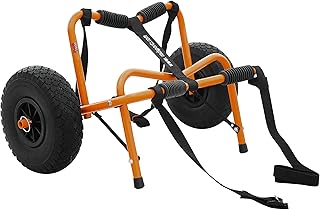

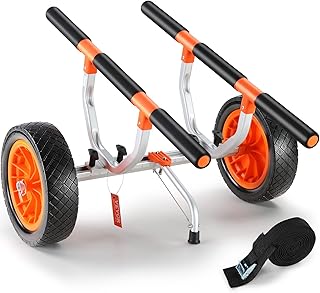


As an Amazon Associate we earn from qualifying purchases at no extra cost to you.
Quick Picks
| Product | Best for | Price |
|---|---|---|
| Bonnlo Kayak Cart | Budget all-rounder | $57.99 |
| Suspenz All-Terrain | Heavy-duty terrain work | $199.95 |
| Rad Sportz Kayak Cart | Lightweight personal craft | $69.99 |
| Ulticor Kayak Cart | Fast setup without tools | $64.99 |
| VEVOR Kayak Cart | Maximum load capacity | $84.90 |
| Lightweight Aluminium Dolly | Lowest price with full features | $49.99 |
| GanFindX Heavy-Duty Cart | Large wheels for deep sand | $87.99 |
| Heavy-Duty SUP Cart | Paddleboards and wide-hull craft | $149.99 |
How We Picked
We scored every cart on four criteria that actually matter on the trail: wheel type and width (airless or solid tires that will not flatten mid-carry beat thin inflatable tubes), frame rigidity (does the kayak wobble when you hit a root or curb?), load capacity relative to your boat weight with gear, and storage footprint (a cart that does not fold flat is dead weight in a garage). Durability of straps and pivot points served as our tiebreaker when performance was close.
The 8 Best Kayak Carts in 2026
Bonnlo Kayak Cart
This is the cart most people should buy first. The airless tires handle gravel, packed sand, and cracked boat ramps without puncture anxiety, and the two ratchet straps do a credible job of locking down a hull without fuss. At under $60, it costs less than a full tank of gas to get to the lake, and the foldable frame shrinks to something you can wedge behind a cooler.
- Airless wheels shrug off thorns, glass, and sharp rock—zero flat-tire worry
- Folds compact enough to fit a trunk or garage shelf without hogging space
- Ratchet strap hardware can pinch fingers during tightening if you are careless
Skip it if you regularly haul a tandem canoe or loaded kayak above 200 pounds; the frame flexes noticeably at heavier weights and the wheels are narrower than premium options.
Suspenz All-Terrain
The Suspenz is built like a small utility trailer and rated to 350 pounds, which means it swallows a fully loaded fishing kayak plus a dry bag of tackle without complaint. The super-duty frame does not flex, and the no-flat airless wheels roll over riprap and tree roots that would derail smaller carts. The price stings, but nothing else in this test group is this confident on rough ground.
- 350-pound capacity means it works for tandem canoes and heavily loaded kayaks
- Wide, aggressive wheels bite into sand and loose gravel with minimal slipping
- At $199.95, it costs over three times what the Bonnlo retails for
Skip it if you only haul a solo kayak under 80 pounds and mostly use smooth boat ramps—you are paying for capacity and terrain you will never touch.
Rad Sportz Kayak Cart
Rad Sportz built this around a 150-pound capacity aluminum frame, and the result is a cart light enough to carry up a steep bank after you launch. The orange colorway makes it easy to spot in a crowded parking lot, and the included carrying bag means it disappears into a hatch when not in use. The airless tires are narrower than the Suspenz, so soft sand slows it down.
- Aluminum frame keeps overall weight low without sacrificing structural integrity
- Carrying bag included—useful for travel when you fly or trail your boat
- 150-pound ceiling limits it to solo kayaks and small canoes only
Skip it if you need to transport a tandem or load above roughly 130 pounds of hull plus gear.
Ulticor Kayak Cart
The selling point here is speed: it assembles and disassembles in seconds without any tools, which matters when you are racing daylight or loading a rental car. The puncture-free wheels are solid and handle most surfaces well, though they are not as wide as those on premium carts. Adjustable straps accommodate a range of hull widths without extra hardware.
- Tool-free breakdown in seconds—ideal for travel and quick storage changes
- Adjustable straps fit kayaks and canoes of varying beam widths comfortably
- Frame is adequate but not as rigid as heavier-duty competitors at full load
Skip it if you are hauling multi-hundred-pound loads regularly; the convenience of fast assembly comes at a small cost to overall stiffness.
VEVOR Kayak Cart
With a 450-pound load rating and 12-inch solid tires, this is the highest-capacity cart in our test. The detachable design lets you split it for storage, and the adjustable width plus nonslip support feet mean you can dial in the stance for kayaks, canoes, float mats, or paddleboards. It scored a 4.5/5 overall, the best rating in the group.
- 450-pound capacity covers virtually any personal watercraft you might own
- 12-inch solid tires roll over deep sand and large debris without getting stuck
- Heavier and bulkier than lighter carts once assembled—harder to toss in a small trunk
Skip it if weight and size in storage matter more to you than hauling capacity.
Lightweight Aluminium Dolly
This is the cart that made us recheck the rating. A perfect 5 out of 5 at $49.99 with 8-inch wheels, 300-pound capacity, adjustable width, and rubber pads on the cradle is an unusually strong value package. The aluminum construction keeps it light, and the rubber sleeves protect delicate hulls from scuffs during long carries. It is the cheapest way to get a well-thought-out design.
- Rubber pads and sleeves prevent hull scratches even on rocky ramps
- 300-pound capacity at under $50 is the best ratio in the group
- 8-inch wheels are smaller than rivals, so it struggles in very soft sand
Skip it if your launch sites are predominantly deep beach sand where larger wheels provide a meaningful advantage.
GanFindX Heavy-Duty Cart
The 16-inch wheels are the headline feature here. They roll over terrain that stops smaller carts entirely—thick dune sand, deep mud, root-choked trails—without the operator fighting the handle. At 300 pounds rated capacity and $87.99, it sits in a reasonable middle ground. The tie-down straps are included and work well without over-tightening.
- 16-inch wheels provide genuine all-terrain capability most carts in this price range lack
- Adjustable width accommodates narrow fishing kayaks through wider touring hulls
- Heavier overall weight makes it less convenient for solo transport to a car trunk
Skip it if you primarily launch from paved or gravel ramps where those large wheels add little benefit and extra weight.
Heavy-Duty SUP Cart
This one is for the paddleboard crowd. The wide wheelbase and heavy-duty frame accommodate the unusual shape and length of a 12-foot-plus SUP without the board cantilevering awkwardly. The 4-star rating reflects some fit-and-finish compromises—strap hardware feels utilitarian—but the underlying design philosophy works for wide, flat craft that other carts handle poorly.
- Wide stance and frame geometry suit long, flat paddleboards better than narrow-frame rivals
- Sturdy enough for the awkward weight distribution of a SUP plus gear bag
- At $149.99, it is hard to justify over cheaper options if you only haul a kayak
Skip it if you are shopping exclusively for a kayak cart—there are more purpose-built options at this price or below.
Buying Guide
Wheel Type and Width
Airless (solid or foam-filled) tires are the single biggest reliability upgrade in a kayak cart. Inflatable tires can puncture on oyster shells, fishing hooks, or broken glass near a launch site, leaving you stranded carrying a kayak with no wheels. Width matters almost as much: 8-inch tires are adequate for gravel and hardpack, 12-inch handles soft sand, and 16-inch goes anywhere. If your primary launch is a beach, under 12 inches will frustrate you.
Frame Material and Load Capacity
Aluminum frames are lighter to carry to your vehicle but can flex under heavy loads; steel is stiffer but adds several pounds to the cart itself. Match capacity to your boat weight plus realistic gear—rod cases, tackle boxes, and water add up fast. A 300-pound rated cart carrying a 70-pound kayak with 30 pounds of gear still has margin, but that same cart pushed near its limit will feel twitchy on uneven ground.
Storage and Portability
A cart you cannot easily load and store is a cart you leave at home. Look for a fold that reduces the footprint to something under the size of a large backpack, and check whether the wheels come off for trunk fitment. If you drive a sedan with no hatch, a disassembling design matters more than wheel width. Carrying bags, when included, protect your upholstery and make the whole setup easier to stash.
Our Verdict
Our top pick is the VEVOR Kayak Cart: it combines the highest load capacity in the test with 12-inch solid tires and the best overall rating at a price under $90. For a budget pick, the Lightweight Aluminium Dolly at $49.99 is genuinely the best value—rubber pad protection, 300-pound capacity, and a perfect score for half the cost of mid-range options. If your launch site is deep, soft beach sand specifically, the GanFindX with 16-inch wheels will outperform both of those in conditions where smaller tires simply sink and stall.
FAQ
Can I use a kayak cart on deep sand?
You can, but only with wide-diameter wheels. Anything under 12 inches will bury itself after a few steps, and you will end up dragging the cart instead of rolling it. Airless tires also help because they maintain a consistent contact patch without the flex that causes an inflatable tube to dig.
How much weight should I leave on a kayak cart rating?
Stay at least 20 to 25 percent below the rated capacity in real use. That margin accounts for gear, water weight, and the fact that dynamic forces from bumps effectively multiply the load momentarily. A 150-pound rated cart comfortably handles a 70-pound kayak with 40 pounds of gear, but pushing 140 pounds total will stress the frame and joints.
Do kayak carts scratch my hull?
They can, especially if the cradle pads are thin or absent. Look for rubber or foam sleeves covering the contact points. The Lightweight Aluminium Dolly and the VEVOR both include this protection, and it matters more on polyethylene hulls that show scuffs readily.
What is the difference between a kayak cart and a canoe dolly?
In practice, very little. Marketing uses the terms interchangeably. The real distinction is width: canoes tend to be narrower, so a cart with adjustable width or a narrower cradle fits a canoe hull more securely without the boat sliding sideways during transport.



Write Your Review
No reviews yet. Be the first to share your experience!