
Key takeaways
- Measuring the compartment instead of the opening: The box must pass through the opening before it can use the larger interior.
- Using catalog dimensions as exact fit dimensions: Published measurements may exclude handles, hinges, latches, or rounded corners.
- Ignoring the lid: A box can fit the bottom of a hatch while preventing the kayak hatch from closing.
- Buying by tray number alone: 3600 and 3700 labels vary slightly by manufacturer. Compare all three outside dimensions.
- Forgetting wet-hand clearance: A snug fit is frustrating when the box is slippery or you are wearing gloves.
- Overloading a crate: More storage is not always better. Excess weight can make the crate difficult to handle and may interfere with paddling.
- Failing to secure deck storage: Even a correctly sized box can fall overboard if it is not tethered or held in a secured crate.
The Short Answer
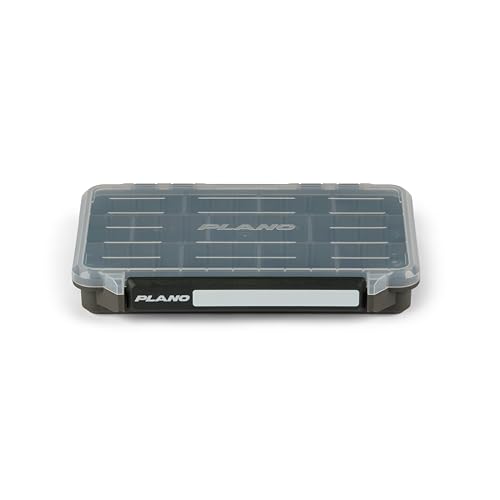
For most fishing kayaks, a tackle box measuring about 14 x 9 x 2 inches (35.6 x 22.9 x 5.1 cm) fits the main storage areas, including many center consoles, bow hatches, and crate systems. If you are storing tackle inside a milk-crate-style kayak fishing crate, a 3600-size tray is usually the safest starting point.
Before buying, measure the opening rather than the storage compartment alone. A box may fit inside a hatch but fail to pass through the opening. Leave at least 1 inch of clearance in length and width, plus about ½ inch of height, so the container is easy to remove with wet or gloved hands.
Our top picks


As an Amazon Associate we earn from qualifying purchases at no extra cost to you. Ratings are shown as listed on Amazon.
A common setup is a 13 x 13 x 13-inch crate (33 x 33 x 33 cm) holding one or more slim tackle trays. For example, a HLOGREE FlexCrate-style kayak crate measures approximately 13 inches on each side and includes rod-holder space. Standalone 3600 tackle boxes generally cost about $9 to $32, while a complete kayak crate system may cost approximately $50 to $70, depending on the brand and included accessories.
Standard Sizes
Tackle-box sizing is not perfectly standardized, so the label is only a starting point. A “3600” tray usually describes a popular lure-box footprint, while a “3700” tray is longer and wider. Always compare the product’s outside dimensions with your kayak’s usable opening.
| Storage type | Typical outside dimensions | Approximate dimensions in cm | Best use |
|---|---|---|---|
| Small utility box | 9 x 6 x 2 in | 22.9 x 15.2 x 5.1 cm | Soft plastics, hooks, terminal tackle |
| 3600-size tray | 14 x 9 x 2 in | 35.6 x 22.9 x 5.1 cm | General lure and bait storage |
| Water-resistant 3600 box | 14.25 x 9.25 x 2.25 in | 36.2 x 23.5 x 5.7 cm | Wet environments and deck storage |
| 3700-size tray | 16.5 x 10.5 x 2.5 in | 41.9 x 26.7 x 6.4 cm | Large lures and high-volume tackle |
| Kayak fishing crate | 13 x 13 x 13 in | 33 x 33 x 33 cm | Holding trays, tools, and rod holders |
The 3600 format is often the most practical compromise. Its roughly 14 x 9-inch footprint fits many crate interiors and larger hatch compartments without taking up the entire deck. A 3700 box provides more capacity, but its extra 2 to 3 inches of length and width can prevent it from passing through a narrow hatch.
Height matters as much as length and width. A low 2-inch tray can slide under a seat or into a shallow console. Boxes 3 inches tall or more may require a deeper tankwell, bow hatch, or open crate. If the storage area has a lid, check whether the lid closes with the tackle box inside; the compartment’s interior height may be less than its opening suggests.
How to Measure Your Space
- Identify the actual storage location. Decide whether the box will sit in a center console, bow hatch, tankwell crate, seat compartment, or open deck bag. Each location has different limits.
- Measure the opening first. Use a tape measure to record the narrowest usable length and width of the hatch or access hole. Measure at several points if the opening is rounded or tapered.
- Measure the interior depth. Lower the tape to the bottom of the compartment. Avoid counting molded ridges, drain channels, or curved corners as usable space.
- Check the shape. A rectangular box needs two usable straight dimensions. A round hatch may have a generous diameter but still reject a rectangular box at the corners.
- Subtract clearance. Reserve about 1 inch from the opening’s length and width and ½ inch from its height. Increase that allowance if you will remove the box while wearing fishing gloves.
- Account for handles and latches. Measure the tackle box at its widest points, including hinges, clasps, carrying handles, feet, and protective rims.
- Test with a cardboard template. Cut a rectangle to the advertised outside dimensions and try inserting it. This inexpensive test reveals interference from corners or hatch lips.
- Plan for retrieval. Leave enough room to grip the box or attach a pull tab. A box that technically fits but cannot be lifted out is too large for practical use.
By Room or Use Case
Center Console or Front Hatch
A center console usually favors a slim tackle box. Look for a maximum footprint near 14 x 9 inches and a height of 2 to 2.5 inches. A 3600 tray is often easier to organize than several small boxes, but measure the hatch lip carefully. For a narrow opening, two boxes around 9 x 6 inches may be more convenient than one wide tray.
Kayak Fishing Crate
A 13 x 13 x 13-inch crate is designed to organize several small items vertically. Choose trays that fit the crate’s internal width, not its outside width. Wall thickness, rod holders, dividers, and rails reduce usable room. A 3600-size tray can work well when placed horizontally or stacked, but leave space for your hand to remove the top tray. Keep the total load manageable; a fully packed crate can become awkward to lift and may affect kayak balance.
Tankwell or Rear Deck
The tankwell is the most forgiving location because it can accommodate larger containers. A 3700-size box measuring roughly 16.5 x 10.5 x 2.5 inches may fit, especially when carried in a soft crate or deck bag. Use a latching, water-resistant box if it will sit in spray or rain. Secure the container with straps or bungee cord so it does not slide during a turn or landing.
Day Trip or Minimal Tackle
For a short trip, a small 9 x 6 x 2-inch box is usually enough for hooks, weights, swivels, and a limited selection of lures. Smaller boxes are lighter and easier to stow under a seat. They also reduce the temptation to carry unnecessary gear. Prices for basic small organizers may start below $10, while sealed or specialty models commonly cost more.
Common Sizing Mistakes
- Measuring the compartment instead of the opening: The box must pass through the opening before it can use the larger interior.
- Using catalog dimensions as exact fit dimensions: Published measurements may exclude handles, hinges, latches, or rounded corners.
- Ignoring the lid: A box can fit the bottom of a hatch while preventing the kayak hatch from closing.
- Buying by tray number alone: 3600 and 3700 labels vary slightly by manufacturer. Compare all three outside dimensions.
- Forgetting wet-hand clearance: A snug fit is frustrating when the box is slippery or you are wearing gloves.
- Overloading a crate: More storage is not always better. Excess weight can make the crate difficult to handle and may interfere with paddling.
- Failing to secure deck storage: Even a correctly sized box can fall overboard if it is not tethered or held in a secured crate.
FAQ
What dimensions fit a kayak tackle box best?
A box around 14 x 9 x 2 inches is the most versatile choice for many kayaks. It commonly corresponds to a 3600-size tackle tray. Confirm the opening and allow at least 1 inch of clearance in the two horizontal dimensions.
Will a 3600 tackle box fit in a 13-inch kayak crate?
Often, yes, but not automatically. A 3600 tray may be about 14 inches long, so it will not fit diagonally or vertically in every 13-inch crate. Check the crate’s interior dimensions and the tray’s orientation. Rod holders and molded dividers can reduce the available space.
Is a waterproof tackle box necessary for kayak fishing?
It is helpful but not essential for every trip. A sealed or water-resistant box is worthwhile for hooks, electronics accessories, and corrosion-prone tackle. For a covered hatch or dry bag, a standard transparent tray may be adequate. Keep in mind that “water-resistant” does not necessarily mean submersible.
What size tackle box should I buy for 2026 kayak fishing trips?
Start with one 3600-size box, roughly 14 x 9 x 2 inches, unless your kayak has a notably small hatch. Add a second tray only after confirming the crate or compartment can hold it without blocking access. For large tackle collections, use a 3700-size box in the tankwell and keep a smaller working box within reach.




Write Your Review
No reviews yet. Be the first to share your experience!