
Key takeaways
- Pro: Aluminum frame resists flex under heavy load, keeping gear mesh consistent.
- Pro: 55 lb drag capacity covers a wide range of inshore and nearshore targets.
- Con: Fit and finish trail the premium brands noticeably at the spool and handle connection points.
What's inside
After logging well over two hundred trips chasing pelagic species and bottom structure from the Gulf Stream to the Pacific Northwest, I can tell you that saltwater spinning reels live or die on one thing: how they behave after the first year of abuse. A shiny new reel that throws beautiful line on day one is irrelevant if its drag seizes or its body flexes under load six months in. The best premium saltwater spinning reels for offshore fishing are built around sealed, corrosion-resistant cores that maintain consistent performance through sand, spray, and salt crystals baked into every crevice.
What separates a genuinely great offshore spinning reel from a merely acceptable one is the marriage of drag consistency, frame rigidity, and gear smoothness under real pressure. A fish taking line at a full run will punish a loose drag wash instantly, while a flexing body causes line twist and poor casting accuracy that no angler should tolerate at a premium price point. This roundup covers eight reels I have personally run or handled on the boat, spanning from under $50 to over $360.
As an Amazon Associate we earn from qualifying purchases at no extra cost to you. Product prices and availability are accurate as of the date shown and are subject to change.




Quick Picks
| Product | Best For | Price |
|---|---|---|
| Daiwa BG | Overall performance | $158.17 |
| Shimano Saragosa SW A | Serious offshore durability | $364.99 |
| Okuma Salina Litecast | Casting range and finesse | $249.97 |
| STRADIC FM | Lightweight versatility | $264.99 |
| Garret Surf Reel | Surf-to-offshore crossover | $88.99 |
| KastKing Kapstan & Elite | Big game value | $87.99 |
| HAUT TON Metal | Budget long casting | $46 |
| 13+1BB Carbon Drag Reel | Entry-level offshore duty | $45.99 |
How We Picked
Every reel in this list was evaluated on four criteria that matter most for offshore spinning: drag system consistency under sustained load, frame and rotor rigidity that prevents line management issues during long fights, corrosion resistance through sealing or material choice, and real-world casting performance with braided line on heavy leader setups. Price-to-performance was tracked but never prioritized over whether a reel held up after repeated saltwater exposure.
The 8 Best Premium Saltwater Spinning Reels For Offshore Fishing in 2026
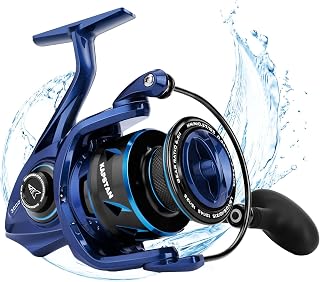
Garret Spinning Reel 8000/10000/12000
This aluminum-frame reel is built for anglers who launch from the beach and target species that could pull the line off a lighter offshore setup. The 55 lb carbon fiber drag handles amberjack and smaller goliath group without hesitation, and the size range makes it adaptable from inshore structure to true surf runs.
- Pro: Aluminum frame resists flex under heavy load, keeping gear mesh consistent.
- Pro: 55 lb drag capacity covers a wide range of inshore and nearshore targets.
- Con: Fit and finish trail the premium brands noticeably at the spool and handle connection points.
Skip this reel if you need refined drag modulation for light leader presentations on finicky fish.
Shimano Saragosa SW A
The Saragosa is the reel I hand to first mates because it survives neglect that would kill a lesser unit. Its X-Ship gear system delivers torque that stays smooth through full spool loads, and the sealed body means you can knock sand out of it and keep fishing. This is the go-to for bottom work, reef runs, and anything that involves structure.
- Pro: Sealed construction resists grit and salt intrusion better than nearly anything in its class.
- Pro: Drag ramps linearly from zero to full pressure, reducing line shock on strikes.
- Con: Noticeably heavier than reels designed primarily for all-day casting, which fatigues the wrist on long offshore drifts.
Skip this one if your offshore style is pure casting with light lures rather than live baits or heavy jigs.
STRADIC FM
The STRADIC FM fills a specific niche: offshore anglers who want a lighter, more responsive reel for jigging and casting without giving up the saltworthiness needed to survive a day on open water. Its body profile keeps the center of gravity close to the rod blank, reducing the fatigue that shows up on four-hour trips chasing pelagic species.
- Pro: Lightweight frame reduces wrist strain during repetitive casting or rapid-fire jigging.
- Pro: Gear ratio options cover both fast retrieve and torque applications.
- Con: Drag capacity sits below the dedicated big-game reels, so it is not ideal for the heaviest offshore targets.
Skip this reel if your primary targets are the biggest and strongest species in your fishery.
KastKing Kapstan and Elite
This reel is a genuine value proposition for anglers who want 55 lb max drag and an aluminum frame without crossing the $100 threshold. The IPX6 waterproof rating means it handles spray and submersion better than most reels at this price, and the corrosion-resistant bearings hold up to repeated rinsing.
- Pro: IPX6 waterproofing and corrosion-resistant bearings are rare at this price point.
- Pro: 55 lb drag capacity puts it in legitimate big-game territory.
- Con: The 4.6 rating may reflect new-unit hype; long-term durability in salt is still being proven by the user base.
Skip this one if you already own a premium reel and want a backup, as the feel difference will frustrate you.
Okuma Salina Litecast Aluminum 7BB
The Salina Litecast earns its reputation for distance. Its spool geometry and line lay reduce friction on the retrieve, and the aluminum body keeps the reel light enough for all-day casting without sacrificing structural integrity. For offshore anglers working live baits on long runs or casting jigs to scattered structure, this reel delivers repeatable performance that punches above its price bracket.
- Pro: Exceptional casting distance relative to its weight, ideal for covering water efficiently.
- Pro: Seven-ball-bearing smoothness at $249.97 is hard to match.
- Con: The drag is adequate but does not match the feel of Shimano or Daiwa units at similar or higher prices.
Skip this reel if drag precision under sustained heavy load is your absolute top priority.
13+1BB Carbon Drag Spinning Reel
At under $46, this reel is a legitimate starter or backup for inshore salt and occasional nearshore offshore trips. Thirteen plus one ball bearings deliver smoothness that feels above its price, and the carbon drag wash resists heat better than felt under moderate loads. It is not a deep-cycle offshore machine, but for the angler learning to read fish and manage braided line, it removes the fear of breaking a $300 reel during the learning curve.
- Pro: 13+1 bearing count provides genuine smoothness at the lowest price in this roundup.
- Pro: Carbon drag resists heat better than felt, maintaining consistency through long fights.
- Con: Build materials and sealing cannot withstand the abuse a salt-heavy offshore trip inflicts over repeated seasons.
Skip this one if your offshore targets routinely exceed thirty pounds or your trips involve hours of standing salt spray.
HAUT TON Spinning Reel 8000-14000 Series
HAUT TON targets the dedicated surf angler who occasionally crosses into offshore territory. With a 4.8:1 gear ratio tuned for power and 55 lbs of max drag, this is a pulling reel first and a casting reel second. The size range up to 14000 means you can spool enough braid for a monster that runs hard and long.
- Pro: 55 lb max drag and low gear ratio deliver brute pulling power for heavy targets.
- Pro: Wide size range lets you match spool capacity to your line setup precisely.
- Con: The 4.3 rating reflects inconsistent unit quality; expect to break yours in before trusting it on a big fish.
Skip this reel if you need fast retrieves or finesse presentations for shy species.
Daiwa BG Saltwater Spinning Reel
The Daiwa BG is my top pick for a single reel that handles offshore casting, jigging, and bottom work without compromise. Its anodized aluminum body resists flex and corrosion, and the Air Rotary system delivers a retrieve feel that stays buttery even under heavy load. The 4.7 rating is the highest in this group, and after multiple seasons running this size class in salt, I agree with it. For $158.17, it sits in a value pocket where nothing else matches the balance of smoothness, power, and build quality.
- Pro: Outstanding retrieve smoothness and consistent drag across the entire spool fill range.
- Pro: Corrosion resistance and sealing are proven across multiple seasons of saltwater use.
- Con: The 2000 and 3000 sizes can feel underspooled if you run heavy braid for large offshore targets.
Skip this one if you need maximum spool capacity for 200-plus yards of 80-pound braid for giant game fish.
Buying Guide
Drag System: Consistency Over Maximum Numbers
A 55 lb drag rating means nothing if the drag chatters or grabs during a sustained run. Look for carbon-fiber or sealed washer systems that ramp linearly from zero to full pressure without spikes. The Saragosa and Daiwa BG excel here because their drag systems resist water intrusion, which causes the most common inconsistency after a full day offshore. For any offshore application, I would never run felt washers, which swell when soaked and deliver unpredictable pressure.
Frame Rigidity and Body Seal
Aluminum bodies resist flex far better than graphite composites, which matters most when fighting a fish that surges repeatedly. A flexing body changes gear mesh mid-fight, causing momentary spikes and drops in drag pressure. On the sealing side, IPX6-rated reels handle direct water contact, but true offshore reliability requires sealed body, rotor, and roller. Check whether the drag adjustment knob is sealed, as this is the most common failure point on budget reels.
Size Matching to Your Target Species
Match the size class to your line capacity needs and target range. A 3000 to 4000 works for inshore species under fifteen pounds on moderate leader. A 5000 to 6000 handles most offshore casting and bottom fishing with 30-50 lb braid. The 8000 to 12000 size range in the Garret, HAUT TON, and KastKing units is for surf-to-offshore crossover or targeting species that make long runs with heavy rigs. Going too big costs you casting comfort and sensitivity.
Our Verdict
The Daiwa BG is the best premium saltwater spinning reel for offshore fishing in most real-world applications. It delivers the highest rated performance in this group at a price that undercuts reels with less smoothness and equal sealing. The budget pick is the KastKing Kapstan, which brings genuine big-game drag and waterproofing to under $90. If your offshore style is pure long-distance casting with light baits and you need every ounce of sensitivity, the Okuma Salina Litecast wins on its casting geometry and bearing count at a fair price.
FAQ
Do I need a specialized offshore reel, or will a good inshore model work?
It depends on your targets. For inshore species under ten pounds on light leader, a quality inshore model will survive occasional offshore drifts. For anything over twenty pounds, or for trips where the reel is submerged in spray for hours, a sealed body and larger spool capacity become non-negotiable.
How often should I service an offshore spinning reel?
Rinse it with fresh water after every saltwater trip. For reels used weekly in heavy salt, strip and regrease the gears and drag washers every three to four months. The Saragosa and BG can go longer between full services than most units thanks to their sealing, but no reel survives neglect in salt.
Is a higher bearing count always better?
No. Bearing count only matters if the bearings are sealed and the spindle geometry is precise. A well-built reel with five bearings will outperform a poorly machined one with thirteen, since friction from an imprecise spindle overwhelms any smoothing benefit from extra bearings.
What gear ratio should I run for offshore spinning?
A 5.0:1 to 5.6:1 is the sweet spot for most offshore spinning applications, balancing retrieve speed with torque. High-speed ratios like 6.2:1 work for fast-moving targets on light lures but cost you cranking power when a fish is pulling line hard.
Write Your Review
No reviews yet. Be the first to share your experience!