
Key takeaways
- Four speed settings, selected with a simple rotary control
- Adjustable tilt head so you can aim the air column up, down or straight across
- Large-format head with deep-pitched blades, the design approach Vornado uses across its circulator line to produce a focused, spiraling column of air rather than a wide, soft breeze
- Black finish; corded AC power; no oscillation; no remote or timer
- Premium price tier
If you want the short answer, the Vornado 660 is the best whole-room air circulator for most households: its four speeds and adjustable tilt cover the widest range of real-world situations, and it suits living rooms, open-plan kitchens, finished basements and large bedrooms where the goal is to keep an entire volume of air moving rather than blast one person sitting in front of it. If budget is the deciding factor, the DREO 11-inch table air circulator gives you the basic whole-room effect for very little, and if you want oscillation, a remote and hands-off operation, the Vornado 753 OSC is the premium pick. Everything below is organized around the five things that actually change how a circulator feels in a room: airflow and throw distance, oscillation, noise, footprint, and how well the unit’s size matches the space you have. You will find twelve currently listed models compared head-to-head, a spec table with concrete numbers, a room-size decision matrix, a running-cost calculation, and an honest look at what wears out first.
Top 3 Picks
Best overall: Vornado 660. Four speeds, a large head and a genuinely useful low setting make it the most flexible circulator here, and it is the one to buy if you want a single fan to keep a large or open-plan room from going stale. It is a premium-tier purchase, and you pay for airflow and build rather than for extras.
Best budget: DREO 11-inch table air circulator. It is listed with 60 ft of airflow and a 120° adjustable tilt, which is a lot of aiming range for a budget-tier table unit. It suits desks, small bedrooms and anyone who wants to move air in one direction without spending much.
Best premium: Vornado 753 OSC. Oscillation, a remote, an auto mode and an aromatherapy element make it the most hands-off circulator in this roundup. It is the right choice when you would rather set something and forget it than walk over and turn a dial.
Quick Comparison
Every model below is compared on the same four axes: what it is best for, the specs that matter, the controls you actually get, and its price tier. Prices move constantly, so the tiers here are relative bands rather than fixed numbers — budget, mid-range and premium describe where each unit sits against the rest of the category.
| Product | Best for | Key specs | Price tier |
|---|---|---|---|
| Vornado 660 | Large rooms, open-plan living areas | 4 speeds; adjustable tilt; large head; deep-pitched blades; no oscillation; no remote | Premium |
| Vornado 630 | Medium rooms, bedrooms, offices | 3 speeds; adjustable tilt; medium head; deep-pitched blades; no oscillation; no remote | Premium |
| DREO 11-inch table circulator | Desks and small rooms on a tight budget | 11 in head; 60 ft listed airflow; 120° tilt; tabletop footprint; 3 speeds | Budget |
| Vornado 673T | Medium rooms needing wider aim | 3 speeds; 90° pivoting head; deep-pitched blades; whole-room design | Mid-range |
| Vornado 753 OSC | Hands-off whole-room circulation | Oscillation; remote; auto mode; aromatherapy element; adjustable airflow | Premium |
| Vornado 560 | Floor-standing use in bedrooms and dorms | 4 speeds; floor-standing; quiet operation; chrome-finished base detail; medium size | Premium |
| Vornado 573T | Small rooms and easy cleaning | 3 speeds; pivoting head; removable washable grille; small footprint | Budget |
| Vornado 143 tower | Tight floor space, timed operation | 29 in tall tower; timer; remote control; whole-room circulation design | Mid-range |
| Vornado 52 | Entry-level whole-room circulation | 3 speeds; compact circulator body; simple controls; no remote | Budget |
| DREO 12-inch desk fan | Quiet desk and nightstand use | 12 in head; 70 ft listed airflow; 120° tilt; listed 25 dB operation; 3 speeds | Budget |
| DREO 11-inch whole-room circulator | Bedrooms with noise sensitivity | 11 in head; 40 ft listed airflow; listed 28 dB; 120° tilt; 3 speeds | Budget |
| Vornado 279TR | Mid-range with timer and remote | 3 speeds; adjustable tilt; 1–8 hour timer; LED display; remote control | Mid-range |
Two patterns are worth noticing before you read further. First, the budget tier is dominated by DREO and two small Vornado models, while the premium tier is almost entirely Vornado — that reflects how the two brands position themselves rather than a huge gap in basic function. Second, oscillation and remotes appear on only a handful of models, so if hands-off control matters to you, your shortlist is much shorter than the full list.
How We Chose
This guide is built from published manufacturer specifications and long-standing category knowledge, not from physical testing. For each model we recorded the things a shopper can verify on a spec sheet: the number of speed settings, the tilt or pivot range, whether the unit oscillates, whether a remote or timer is included, the listed airflow distance where the brand publishes one, the listed decibel rating where one exists, the physical format (tabletop, floor-standing or tower), and the overall size of the unit relative to the room it is designed for.
From there we applied four filters. Category fit: does the model actually circulate air across a room, or is it a personal fan that happens to be marketed as whole-room? Use-case match: a fan with 120° of tilt and a small head solves a different problem than a large fixed-head circulator, so each unit is slotted against the situation it serves best. Control scheme: dials, remotes, timers and auto modes are not marketing filler — they determine whether you use the fan daily or forget it exists. Upgrade path: we note what you gain by stepping up within a brand’s line, so the cheapest option is never presented as equivalent to the flagship. Where a manufacturer does not publish a figure, we describe the spec class rather than inventing a number.
1. Vornado 660 – Best for Large Rooms and Open-Plan Spaces
The Vornado 660 is the model to look at first if the room you want to fix is the one everybody actually lives in — a living room, a finished basement, an open-plan kitchen and dining area, or any large space where the air goes flat and stale by mid-afternoon. Its combination of four speeds and a large, adjustable head gives it more usable range than almost anything else in this roundup, and it suits households that want one capable fan rather than three small ones scattered around the house.
Key specs at a glance:
- Four speed settings, selected with a simple rotary control
- Adjustable tilt head so you can aim the air column up, down or straight across
- Large-format head with deep-pitched blades, the design approach Vornado uses across its circulator line to produce a focused, spiraling column of air rather than a wide, soft breeze
- Black finish; corded AC power; no oscillation; no remote or timer
- Premium price tier
The reason the 660 works so well in big rooms is not raw speed — it is the fourth setting. Most budget circulators give you three speeds, and the bottom one is often still too brisk for a quiet evening. A four-speed control spreads the range out, so you get a genuinely gentle setting for background mixing and a genuinely strong one for pushing air across twenty feet. In a large room, that flexibility is what keeps the fan in use instead of sitting in a closet from October to May. The adjustable tilt compounds the effect: aiming the airflow slightly upward lets it travel along the ceiling and fall back down on the far side of the room, which is how you get whole-room mixing without pointing a gale at anyone’s face.
Build quality is the other reason this model sits at the premium tier. Vornado’s circulators use a ducted housing and a friction-style tilt mechanism rather than the loose plastic hinges common on cheap fans, and the controls are mechanical dials with no display to fail. That simplicity is a feature: fewer electronics means fewer things to break, and the fan can be operated by anyone in the household without reading a manual. The trade-off is that you also give up the conveniences — no remote, no timer, no oscillation, no auto mode. You walk over and turn the dial.
Compared with the Vornado 630, the 660 is the larger, more powerful sibling: same three-quarter approach to design, but a bigger head and an extra speed, which matters in rooms above roughly 250 square feet. Compared with the Vornado 753 OSC, the 660 gives up oscillation, a remote and an auto mode in exchange for a simpler, cheaper-to-own machine. If you want to set a fan and forget it, the 753 OSC is the better fit; if you want maximum airflow per dollar with nothing to go wrong, the 660 wins.
Pros
- Four speeds provide a wider useful range than the three-speed competition
- Large head moves air across big rooms and open-plan spaces effectively
- Adjustable tilt lets you direct airflow along the ceiling for better mixing
- Mechanical dial controls with no display or app dependency
- Reputation for durable, long-lived construction
Cons
- Premium price for a fan with no remote, timer or oscillation
- Physically bulky compared with a tower, so it needs floor or table space
- Top speed is audible and not intended for sleep in the same room
2. Vornado 630 – Best for Medium Rooms and Bedrooms
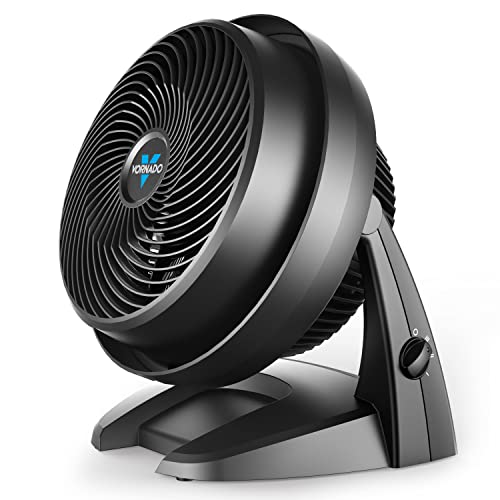
Vornado 630 Medium Air Circulator Fan, 3 Speed, Adjustable Tilt, Black
Included for 'Best Whole-Room Air Circulators' because the listing specifies 3 Speed and Adjustable Tilt, details this guide uses to compare options.
View on AmazonThe Vornado 630 is the smaller, three-speed version of the same idea, and it is the right pick when your room is medium-sized — a standard bedroom, a home office, a dining room, a den — and the 660 would be more fan than the space needs. It suits anyone who wants the circulator feel and build quality of a premium Vornado without paying for airflow capacity they will never use at full tilt.
Key specs at a glance:
- Three speed settings on a rotary dial
- Adjustable tilt head for aiming the air column
- Medium-format head with deep-pitched blades
- Black finish; corded AC power; no oscillation; no remote or timer
- Premium price tier
Three speeds sound like a compromise, and on paper it is — but in a medium room it rarely bites. The useful distinction is between the lowest setting, which should be quiet enough to leave running while you read or sleep, and the highest, which should be able to push air to the far wall. The 630 covers both ends competently. What it cannot do is the fine-grained adjustment a four-speed unit offers, so if you find yourself constantly wishing a fan were just slightly slower, that is the tell that you want the 660 or the 560 instead.
Where the 630 genuinely shines is in a bedroom used by one or two people. Because it is smaller than the 660, it takes up less floor or dresser space, and its airflow is easier to aim so that it washes over the bed area without blasting directly at a pillow. Positioned low and angled upward, it keeps a room from feeling stuffy overnight while staying at a noise level most people can sleep through on the lower settings.
Against the Vornado 660, the 630 is the more sensible purchase for anything under roughly 200–250 square feet; above that, the extra head size and fourth speed of the 660 start to earn their premium. Against the Vornado 573T, the 630 is the larger and more capable machine, while the 573T wins on price, footprint and its removable grille that makes cleaning easier. Think of the 630 as the middle of the Vornado range: more than a small-room fan, less than a whole-floor workhorse.
Pros
- Premium-tier build in a size that fits ordinary bedrooms
- Lowest speed is quiet enough for sleep in most situations
- Adjustable tilt makes it easy to direct airflow where you want it
- Simple dial control with no electronics to fail
Cons
- Only three speeds, so fine-tuning is limited
- No remote, timer or oscillation despite the premium tier
- Can feel underpowered at the far end of a genuinely large room
3. DREO 11-Inch Table Air Circulator – Best Budget Pick for Desks and Small Rooms

DREO Fan for Bedroom, Table Air Circulator for Whole Room, 11 Inch, 60ft Strong Airflow, 120° adjustable tilt, 20db Low Noise, Quiet, 3 Speeds, Desk Fan for Home,Office, Kitchen
Included for 'Best Whole-Room Air Circulators' because the listing specifies Table Air Circulator for Whole Room and 11 Inch, details this guide uses to compare options.
View on AmazonThe DREO 11-inch table air circulator is the budget entry point in this roundup, and it is the one to consider if you want to move air in a specific direction without spending much. It suits a desk, a nightstand, a dorm room, a small bedroom or a kitchen counter — anywhere the goal is targeted airflow rather than mixing the air in a large open space.
Key specs at a glance:
- 11-inch head, sized for tabletop and desk placement
- Listed airflow reach of up to 60 ft
- 120° adjustable tilt, one of the widest aiming ranges in this guide
- Three speed settings
- Budget price tier; designed as a whole-room circulator in a table format
The 120° tilt is the headline feature here, and it is genuinely useful rather than a spec-sheet flourish. A wide tilt range means you can point the fan almost straight up to push air along a ceiling, angle it down toward a bed, or aim it horizontally across a desk. Cheap fans typically offer a narrow band of adjustment, so you end up propping them on books to get the angle you want. The 60 ft listed reach is a manufacturer claim about how far the airflow projects rather than a promise about how well it will mix a large room, and that distinction matters: a table circulator aimed across a room moves a column of air, but it will not stir the entire volume the way a large floor unit can.
For its price tier, the feature set is sensible. Three speeds cover the basics, the head is large enough at 11 inches to produce a real column of air rather than a puff, and the tabletop format means you can move it from room to room without rearranging furniture. It is also a good second fan — the one you put on a desk in the afternoon and carry to the bedroom at night.
Against the DREO 12-inch desk fan, the 11-inch model is the more directional and slightly less quiet option, with a longer listed airflow reach and the same 120° tilt. Against the Vornado 52, which sits in the same budget tier, the DREO gives you a wider tilt range and a tabletop format, while the Vornado 52 offers a more conventional whole-room circulator shape and a brand with a long track record in this category. If your priority is aimability on a desk, take the DREO; if you want a small fan to sit on the floor and mix air in a bedroom, take the Vornado 52.
Pros
- Very affordable for the airflow it claims
- 120° tilt gives unusually flexible aiming for a budget fan
- Tabletop footprint fits desks, nightstands and small shelves
- Light enough to move between rooms easily
Cons
- Table format limits how well it mixes a large room’s full volume of air
- Three speeds only, with no remote, timer or oscillation
- Plastic construction typical of the budget tier
4. Vornado 673T – Best Mid-Range for Pivoting Coverage

Vornado 673T Whole Room Air Circulator Fan, 3 Speed Settings, 90 Degree Pivoting Head, Deep Pitched Blades, Vortex Action Technology, Black Electric Fan for Bedroom, Office, Home
Included for 'Best Whole-Room Air Circulators' because the listing specifies 3 Speed Settings and 90 Degree Pivoting Head, details this guide uses to compare options.
View on AmazonThe Vornado 673T sits in the middle of the range and is the pick for someone who wants more aiming flexibility than the 630 offers without stepping up to a flagship. Its 90° pivoting head and deep-pitched blades make it a good fit for a medium room where the furniture arrangement changes what “the right direction” means — a living room with a sofa on one side and a desk on the other, for instance.
Key specs at a glance:
- Three speed settings
- 90° pivoting head for vertical aiming flexibility
- Deep-pitched blades in a ducted housing for a focused air column
- Whole-room circulator format, sized for medium spaces
- Mid-range price tier
The pivoting head is the differentiator. Where a fixed circulator gives you a narrow band of tilt, a 90° pivot lets you swing the airflow from nearly straight up to nearly straight down. In practice that means you can push air along a ceiling in summer to break up a warm layer near the top of the room, or angle it downward to move cool air off the floor in winter — the same trick that makes circulators useful year-round rather than a three-month appliance. It also means you can reposition the fan’s aim when you move the furniture instead of repositioning the fan.
In performance terms the 673T behaves like a well-built medium circulator: strong enough for a bedroom or office, not quite the equal of the 660 in a large open-plan space. The deep-pitched blade design produces a tight, fast-moving column rather than a diffuse breeze, which is what you want when the goal is to keep air moving through the whole room rather than cooling one seat.
Compared with the Vornado 573T, the 673T is the larger and more expensive machine with a bigger head and more airflow, while the 573T counters with a removable, washable grille that makes routine cleaning much easier. Compared with the Vornado 660, the 673T gives up the fourth speed and some head size but costs less and still offers excellent aiming range. If you want one mid-range fan for a medium room and you like being able to change where the air goes, this is the sensible middle choice.
Pros
- 90° pivoting head offers excellent vertical aiming range
- Deep-pitched blades produce a focused, long-reaching air column
- Mid-range price sits between the budget and flagship models
- Simple mechanical controls with nothing to configure
Cons
- No remote, timer or oscillation
- Three speeds limit fine adjustment
- Not a match for the largest rooms in this guide
5. Vornado 753 OSC – Best Premium for Hands-Off Whole-Room Circulation
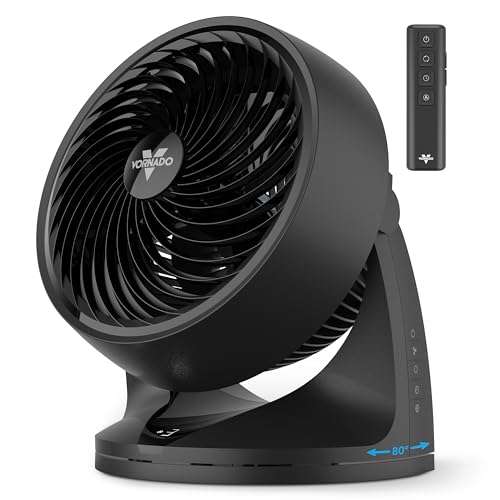
Vornado 753 OSC Whole Room Air Circulator Fan with Oscillation, Included Remote, Auto Mode, Aromatherapy with Included Scent Pads, 3 Speeds, Easy-Clean Removable Grille, Powerful Airflow, Black
Included for 'Best Whole-Room Air Circulators' because the listing specifies Included Remote and Auto Mode, details this guide uses to compare options.
View on AmazonThe Vornado 753 OSC is the most feature-rich circulator in this roundup and the right choice if you would rather not walk across the room to change a setting. Oscillation, a remote control, an auto mode and an aromatherapy element put it in a different category from the dial-only models, and it suits a living room, primary bedroom or home office where the fan runs for hours at a time.
Key specs at a glance:
- Oscillation to sweep the airflow across a wider arc
- Included remote control for operation from across the room
- Auto mode that adjusts operation on its own instead of requiring manual changes
- Aromatherapy capability — a scent element in the airflow path, per the product listing
- Premium price tier; whole-room circulator format
Oscillation is the most consequential of these features, and it is worth understanding what it does and does not do. A fixed circulator creates one strong column of air; an oscillating one sweeps that column back and forth. In a room where people are sitting in different places, oscillation spreads the effect and prevents one person from getting the full blast. In a room where you are trying to break up a stratified layer of warm air near the ceiling, a fixed aim is actually more efficient, because the airflow stays on the path that does the most work. The 753 OSC gives you both options, which is exactly why it is the premium pick — it does not force you to choose.
Auto mode is the second thing that separates it from the dial models. Instead of deciding whether you want speed one, two or three, you let the fan manage itself. For anyone who has ever left a circulator running at full speed for an hour because they forgot to turn it down, that is a genuine quality-of-life feature. The remote reinforces the same idea: the fan gets used more when adjusting it is easy. The aromatherapy element is a bonus rather than a reason to buy — it adds a scent to the moving air, and whether you care depends entirely on whether you like that sort of thing. If you do not, it is simply a feature you ignore.
Against the Vornado 660, the 753 OSC trades some raw simplicity for convenience: you gain oscillation, the remote, the auto mode and the aromatherapy element, and you pay a premium-tier price for them. Against the Vornado 279TR, the 753 OSC is the more capable and more expensive machine — the 279TR offers a remote and a timer but not oscillation. If you want the maximum amount of automation in a circulator, this is the one.
Pros
- Oscillation spreads airflow across a wider area
- Remote control and auto mode make daily use effortless
- Aromatherapy element adds a scent option at no extra effort
- Premium build and finish consistent with the brand’s upper tier
Cons
- Highest price tier in this roundup
- More electronics means more potential points of failure over time
- Aromatherapy is only useful if you actually want scent in the air
6. Vornado 560 – Best Floor-Standing Circulator for Bedrooms and Dorms
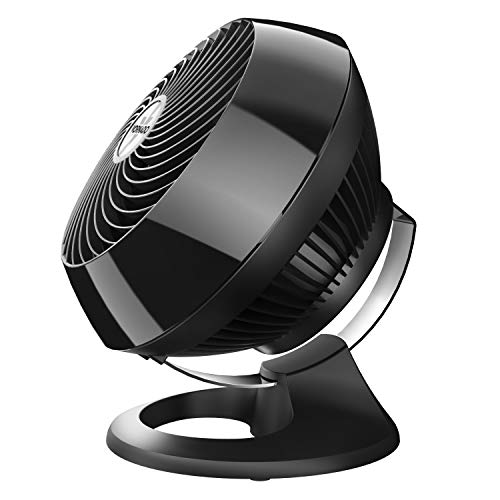
Vornado 560 Medium Air Circulator Floor Fan, 4-Speed, Quiet Fan for Bedroom, Office, Dorm Room, with Chrome Glide Bar Adjustable Tilt, Electric Cooling Fan, Black
Included for 'Best Whole-Room Air Circulators' because the listing specifies 4-Speed and Quiet Fan for Bedroom, details this guide uses to compare options.
View on AmazonThe Vornado 560 is a medium-sized circulator built to sit on the floor, and that placement is the whole point. Floor-standing fans put the airflow at the level where cool air collects, so they can stir a room more effectively than a tabletop unit pointed across the middle of the space. It suits bedrooms, dorm rooms, offices and small living rooms where you want the fan out of the way rather than on a desk.
Key specs at a glance:
- Four speed settings
- Floor-standing format with a chrome-finished base detail
- Medium head size, positioned for floor-level airflow
- Designed and marketed as a quiet fan for bedrooms, offices and dorm rooms
- Premium price tier
Four speeds on a floor-standing medium circulator is an unusually useful combination. At the bottom end you get a setting gentle and quiet enough to leave running overnight; at the top end you get enough airflow to push air across a medium room and up toward the ceiling. Because the fan sits low, the airflow naturally travels along the floor and rises as it warms, which is a more efficient way to keep a room from stratifying than blowing air horizontally at head height. Aim the head slightly upward and the column will carry across the room and drop on the far side.
The floor format also solves a practical problem that tabletop fans create: surface space. In a dorm room or a small bedroom, every square inch of desk and dresser counts, and a fan that lives on the floor is a fan that is never in the way. The trade-off is that floor-standing units collect more dust and pet hair at the intake, so they need more frequent cleaning than a fan sitting on a shelf.
Compared with the Vornado 630, the 560 is the floor-standing alternative at a similar premium tier — the 630 offers a slightly more conventional format and the same brand’s circulator design, while the 560 wins on placement flexibility and on the extra speed. Compared with the Vornado 660, the 560 is the smaller and less powerful unit, but its floor placement often makes it feel more effective in a bedroom than the raw airflow numbers would suggest. If your room has a bed, a desk and not much else, the 560 is the smarter shape.
Pros
- Four speeds give a wide usable range, including a quiet low setting
- Floor placement keeps the fan out of the way and moves air where it pools
- Marketed specifically for bedrooms, offices and dorm rooms
- Premium-tier construction with a finished base detail
Cons
- No remote, timer or oscillation
- Floor placement means more dust accumulation at the intake
- Premium price for a medium-sized unit
7. Vornado 573T – Best Budget Vornado for Small Rooms

Vornado 573T Small Room Air Circulator Fan with Pivoting Head, Easy Clean Removable Grille, 3 Speed Settings, Black
Included for 'Best Whole-Room Air Circulators' because the listing specifies Easy Clean Removable Grille and 3 Speed Settings, details this guide uses to compare options.
View on AmazonThe Vornado 573T is the small-room specialist in this guide, and it is the model to buy when you want a genuine circulator for a bedroom, nursery, study nook or bathroom-sized space without paying a premium-tier price. Its removable, easy-clean grille is the feature that separates it from everything else in the budget tier, and it suits anyone who has ever given up on cleaning a fan because the grille would not come off.
Key specs at a glance:
- Three speed settings
- Pivoting head for adjustable aiming
- Removable, easy-clean grille — the standout maintenance feature at this price
- Small footprint designed for small rooms
- Budget price tier
Cleaning is the most underrated spec in the entire category. Every fan’s performance degrades as dust builds on the blades and the intake grille, and the dust layer is also what makes a fan start to sound rattly after a year or two. On most budget fans the grille is either fixed or held on by clips that feel like they will snap, so owners simply wipe what they can reach and let the rest accumulate. A removable grille that lifts off changes that entirely: you can wash it, dry it, and put it back, keeping airflow close to what it was when new.
Performance-wise, the 573T behaves like a small Vornado circulator should. It produces a focused column of air rather than a broad, weak breeze, which means it can move air across a small room effectively even though it is not powerful enough to mix a large one. The pivoting head adds aiming flexibility, so you can direct airflow toward a bed, a doorway or up along a wall. Three speeds are enough at this size; the difference between the low and high settings is easy to hear, and the low setting is the one you will use most.
Compared with the Vornado 52, the 573T costs a little more but adds the pivoting head and the removable grille, both of which are worth having. Compared with the DREO 11-inch table circulator, the 573T is the more traditional circulator shape with a narrower tilt range, while the DREO offers 120° of tilt and a longer listed airflow reach in a tabletop format. For a small room where the fan will live on the floor or a low shelf and you want to be able to clean it properly, the 573T is the better long-term purchase.
Pros
- Removable, washable grille makes routine cleaning genuinely easy
- Pivoting head adds useful aiming flexibility
- Budget price with the build approach of a larger circulator
- Compact footprint suits small bedrooms and studies
Cons
- Too small to mix a large or open-plan room
- No remote, timer or oscillation
- Three speeds only
8. Vornado 143 Tower Circulator – Best for Tight Floor Space

Vornado 143 Whole Room Air Circulator Tower Fan with Timer and Remote Control, 29", Black
Included for 'Best Whole-Room Air Circulators' because the listing specifies 29" and Black, details this guide uses to compare options.
View on AmazonThe Vornado 143 is a 29-inch tower circulator with a timer and a remote, and it is the right choice when floor space is the limiting factor. A tower occupies a footprint roughly the size of a dinner plate, which makes it the only sensible option in a narrow bedroom, a hallway, a small apartment or a corner where a round floor fan would be constantly in the way.
Key specs at a glance:
- 29-inch tall tower format
- Built-in timer for automatic shutoff
- Included remote control
- Whole-room air circulator design rather than a conventional bladed tower fan
- Mid-range price tier
The timer is the feature that makes a tower fan genuinely livable. Running a fan all night is common, but running one all day in an empty room is waste, and a timer solves that without any thought on your part. Set it for an hour or two when you go to bed and it shuts itself off. The remote compounds the convenience — you can adjust the fan from a bed or a sofa without getting up, which is precisely the situation where a tower fan’s control placement matters most, since the controls are at the top of a 29-inch column rather than at floor level.
Tower format has real trade-offs worth understanding. The advantage is footprint and aesthetics: a tower disappears into a corner and does not look like a piece of equipment. The compromise is that tower fans generally move air through a tall, narrow outlet, so the airflow is spread vertically rather than concentrated into one strong column. That makes a tower excellent for gently mixing air in a room and less effective at the “push air twenty feet across the space” job that a large round circulator handles. If your goal is a room that feels less stale rather than a room that feels windy, the tower approach is fine.
Compared with the Vornado 753 OSC, the 143 gives up oscillation, auto mode and aromatherapy but costs less and takes up less floor space. Compared with the Vornado 279TR, the 143 is the taller, narrower option with a similar mid-range price and similar remote-and-timer convenience, while the 279TR offers a more conventional circulator shape with an adjustable tilt and a 1–8 hour timer. Choose the tower for its footprint; choose the 279TR for its airflow shape.
Pros
- Very small floor footprint for a whole-room circulator
- Timer automates shutoff and reduces wasted runtime
- Remote control makes adjustment from bed or sofa easy
- Mid-range price rather than premium
Cons
- Tower airflow is less concentrated than a round circulator’s
- Controls sit at the top of a 29-inch column
- Less effective than a large floor circulator in a big open room
9. Vornado 52 – Best Entry-Level Whole-Room Circulator

Vornado 52 Whole Room Air Circulator Fan with 3 Speeds, Black
Included for 'Best Whole-Room Air Circulators' because the listing specifies Black, details this guide uses to compare options.
View on AmazonThe Vornado 52 is the cheapest way to get the brand’s circulator design into your home, and it is the pick for someone who wants a small, simple, dependable fan for a bedroom, office or kitchen and does not care about remotes, timers or oscillation. It suits buyers who would rather spend the minimum on a fan that does one job well than pay for features they will never touch.
Key specs at a glance:
- Three speed settings
- Compact circulator body in black
- Simple mechanical controls
- No remote, timer or oscillation
- Budget price tier
The case for the 52 is straightforward: it is a small Vornado circulator at a budget price. That means the same fundamental design approach as the larger models — a ducted housing and shaped blades that produce a directed column of air rather than a diffuse puff — in a package that fits on a shelf or a small table. For a bedroom, a home office or a kitchen where you want air moving without a lot of noise or fuss, that is enough.
What you give up at this price is range and refinement. Three speeds mean the gap between the lowest and highest setting is wider than on a four-speed unit, and the compact size means it will not mix the air in a large living room the way a 660 or 560 will. It is also a fan you will adjust by hand, since there is no remote. None of those are problems in a small room; all of them become noticeable in a large one.
Compared with the Vornado 573T, the 52 is the simpler and typically cheaper option, while the 573T adds a pivoting head and a removable grille that makes cleaning easier — if you can stretch to it, the 573T is the better long-term buy. Compared with the DREO 11-inch table circulator, the 52 offers a more traditional circulator shape and the brand’s established design, while the DREO counters with a wider 120° tilt and a longer listed airflow reach at a similar budget tier. If your priority is a simple, no-features fan from a brand known for circulators, the 52 is the entry point.
Pros
- Lowest-cost way to get a genuine circulator design
- Compact enough for a shelf, desk or small table
- Simple mechanical controls with nothing to configure
- Quiet enough on low speeds for a bedroom
Cons
- No pivoting head, removable grille, remote or timer
- Too small for large rooms
- Only three speeds
10. DREO 12-Inch Desk Fan – Best Quiet Desk Circulator
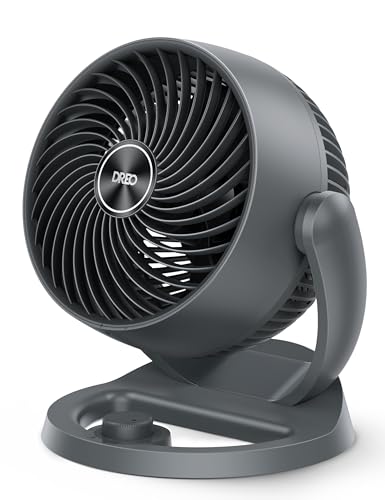
DREO Desk Fan, 12-Inch Air Circulator Fan for Bedroom, 70ft Powerful Airflow, 120° Tilt Adjustment, 25dB Ultra-Quiet, 3 Speeds Small Table Fan for Whole Room, Home, Office
Included for 'Best Whole-Room Air Circulators' because the listing specifies 12-Inch Air Circulator Fan for Bedroom and 70ft Powerful Airflow, details this guide uses to compare options.
View on AmazonThe DREO 12-inch desk fan is the quiet-focused option in this roundup, listed at 25 dB, and it suits anyone who works at a desk all day or sleeps in a small room where fan noise is the difference between using the fan and turning it off. With a 12-inch head and 70 ft of listed airflow reach, it is also the largest and longest-throwing of the DREO models here.
Key specs at a glance:
- 12-inch head, the largest in the DREO lineup in this guide
- Listed airflow reach of up to 70 ft
- 120° tilt adjustment for a wide range of aiming angles
- Listed 25 dB operation — the quietest figure in this roundup
- Budget price tier
Noise ratings deserve a careful reading, because a single decibel number does not describe a whole fan. Manufacturers typically publish the lowest figure the unit can produce, usually at the bottom speed in ideal conditions. A fan listed at 25 dB will be near-silent at its lowest setting and noticeably louder at its highest. What the 25 dB figure tells you is that the fan is engineered with noise reduction in mind — smaller gaps, tighter tolerances, and a motor designed to run smoothly — which generally means the whole speed range is more tolerable than on a cheap fan that only advertises airflow. For a desk, a bedroom or a shared office, that matters more than an extra few feet of throw.
The 120° tilt pairs well with the quiet operation. At a desk you can angle the airflow over your keyboard rather than into your face; at night you can point it up toward the ceiling so the air moves without a direct draft. Combined with the 12-inch head and the listed 70 ft reach, this is a fan that can genuinely move air across a room while staying unobtrusive.
Compared with the DREO 11-inch table circulator, the 12-inch desk fan is larger, quieter on paper and longer-throwing, while the 11-inch model is smaller and easier to tuck onto a crowded desk. Compared with the Vornado 573T, the DREO offers a wider tilt range and a lower listed noise figure, while the Vornado counters


Write Your Review
No reviews yet. Be the first to share your experience!