
Our Top Picks
 DOINUO 10x20 Black Pop Up Canopy Outdoor PartyStandard 10x20FT 6sides240 x 120 x 100.32 InchesCheck on Amazon
The best pop up canopies for parties are usually 10-by-10-foot commercial-grade shelters with a steel or aluminum frame, straight legs, a peak height of at least 9 feet, properly anchored feet, and removable sidewalls; choose a lighter aluminum model for frequent transport, a steel model for value, or a larger 10-by-20-foot canopy when guest capacity matters more than portability.
Quick picks by gathering type
| Gathering or priority | Best canopy type | Why it fits | Typical budget |
|---|---|---|---|
| Birthday party in a backyard | 10 x 10 ft steel-frame instant canopy | Good coverage, lower purchase price, and adequate stability when weighted | $100–$220 |
| Frequent events or vendor use | 10 x 10 ft commercial aluminum-frame canopy | Lighter to carry, replaceable parts, stronger roof and hardware options | $250–$700 |
| Large family gathering | 10 x 20 ft commercial-grade canopy | 200 square feet of shade for buffet tables, seating, or a food station | $250–$900 |
| Short setup and takedown time | Full-truss instant canopy with roller bag | Typically opens in 2–5 minutes with two adults | $120–$500 |
| Wind-exposed lawn or beach | Commercial frame with high-capacity anchors and vented roof | Better load distribution, but still requires proper anchoring and weather judgment | $300–$900 |
What size canopy do you need?
A 10-by-10-foot canopy provides 100 square feet of roof coverage. It can shade about six seated guests at a dining table, eight to ten people standing, or a buffet table with a narrow walking lane. A 10-by-20-foot version doubles the footprint to 200 square feet and is more practical for 12–20 guests, although furniture arrangement and local fire-safety rules still matter.

Aoxun 10x20 Pop Up Canopy Tent with 6 Sidewalls, Party Tent, White
Chosen because it specifies Party Tent and White.
View on Amazon
Quictent 10x20FT Pop Up Canopy Tent with Sidewalls
Picked as a relevant option in this category.
View on AmazonDOINUO 10x20 Black Pop Up Canopy Outdoor Party Tent with 6 Sidewalls, Wedding Party Tent Outdoor Waterproof UV50 Canopy Event Shelter Tents for Parties, 6 pcs Weight Bag,Carry Bag
Chosen because it specifies 6 pcs Weight Bag and Carry Bag.
View on Amazon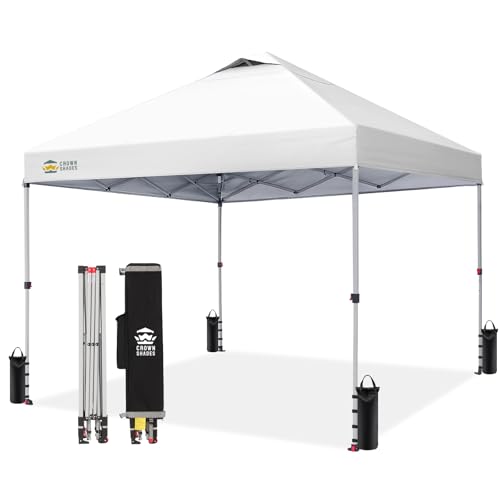
CROWN SHADES 10x10 Pop Up Canopy Tent with One Push Setup, Grid White
Chosen because it specifies Grid White.
View on AmazonRemember that the roof footprint is not the same as usable floor space. Sloping eaves, guy lines, tables, and chairs reduce the clear area. Measure the intended surface before buying, especially on patios where a 10-foot canopy may not fit between walls, fences, and tree branches.
Worked coverage calculation
Suppose a party has 12 guests, a 6-foot buffet table, and two 6-foot seating tables. Allowing roughly 8 square feet per seated guest gives 96 square feet for people. Add approximately 36 square feet for the buffet and circulation, producing a target of about 132 square feet. A 10-by-10 canopy is too tight for that layout; a 10-by-20 canopy, or two connected 10-by-10 canopies, gives substantially more usable room.
Head-to-head: steel versus aluminum frames
Steel frames
Steel is usually the best value for occasional backyard parties. It is rigid, inexpensive, and less likely to flex under a properly distributed load. The drawbacks are weight and corrosion risk. A steel 10-by-10 canopy commonly weighs about 35–55 pounds before sidewalls, while a 10-by-20 model may exceed 60 pounds.
Inspect the powder coating after each season. Scratches that expose bare steel can rust, particularly when the frame is packed damp. Dry the frame completely before storage and avoid leaving it assembled for weeks in wet weather.
Aluminum frames
Aluminum is preferable when one person frequently loads a vehicle, walks across a field, or attends multiple events. A 10-by-10 aluminum canopy often weighs about 30–45 pounds, depending on leg size and roof design. It does not rust like steel, but thin aluminum tubing can bend if the shelter is dragged, lifted by one corner, or left in a strong gust without adequate anchoring.
Commercial aluminum systems from brands such as E-Z UP, Eurmax, and ABCCANOPY commonly offer replacement truss bars, legs, brackets, and roof covers. That repairability can matter more than a small difference in advertised peak wind performance.
Peak height, setup time, and portability
Basic pop-up canopies usually have an adjustable eave height around 6 feet 8 inches to 7 feet 4 inches, with a peak around 9–10 feet. Commercial models may reach a peak near 11 feet or more. A higher peak improves headroom and air circulation but increases the sail area exposed to wind. For parties, a peak around 9 feet 6 inches to 11 feet is a useful range.
Most true instant canopies use a central truss frame and take two adults roughly 2–5 minutes to open, excluding anchoring and sidewall attachment. A 10-by-20 canopy usually requires more careful alignment and is easier with three or four adults. Roller bags improve portability across pavement, but wheels do not help much on grass, gravel, or stairs.
Check the packed dimensions as well as the weight. A long 10-by-20 bag may not fit across the trunk of a small car even when its total weight seems manageable.
Waterproofing and sidewall choices
For occasional rain protection, look for a polyester or Oxford-fabric roof described as water-resistant or waterproof, with taped or reinforced seams and a roof that slopes enough to shed water. Product listings may state ratings such as 500D or 600D fabric, but denier describes yarn thickness, not a complete waterproof performance test. A 500D canopy with good seams can outperform a heavier fabric with poor stitching.
Common sidewall configurations include:
- No walls: Best for ventilation and quick setup, but offers little protection from sideways rain or low sun.
- Two walls: Useful for blocking afternoon sun or creating a windward barrier while retaining airflow.
- Four walls: Best for privacy, light rain, and vendor displays; use doors, windows, or removable panels to prevent heat buildup.
- Mesh walls: Improve airflow and help separate a food or seating area without making the canopy feel enclosed.
- Half walls or rail skirts: Helpful for branding and visual separation but provide limited weather protection.
Do not treat sidewalls as proof that a canopy is suitable for severe weather. Fully enclosed walls can increase wind load, and standing water can stretch fabric or overload the frame. Remove accumulated water promptly and take the canopy down before thunderstorms or forecast conditions beyond the manufacturer’s limits.
Wind resistance: the anchoring matters most
There is no universally reliable wind rating for a temporary canopy because performance depends on soil, surface, roof height, sidewalls, gust direction, and anchor placement. A sturdy frame can still lift if it is not secured.
On grass, use the supplied stakes only when they are long and strong enough for the soil, then add guy lines from the upper corners. For a party canopy, many users choose approximately 40–60 pounds of ballast per leg in ordinary breezy conditions, distributed so the weight cannot slide away from the foot. Hard surfaces require purpose-built weight plates, water weights, or sandbags designed for canopy legs; never rely on chairs, coolers, or loose bricks.
Keep the roof vent open when the design includes one. Lowering the canopy one setting can reduce exposure, but it does not replace ballast. If gusts become strong, lower or dismantle the canopy rather than trying to improve it with improvised weights.
Brands and product families worth comparing
E-Z UP Instant Shelter models are established choices for straightforward setup and broad accessory availability. They are especially appealing when replacement tops and sidewalls are important. Compare the frame gauge and roof fabric between recreational and commercial lines rather than assuming every E-Z UP canopy has the same durability.
Eurmax commercial canopies often emphasize thicker roof fabrics, extensive sidewall sets, and wheeled storage bags. They can be a good fit for parties that become vendor booths or recurring event shelters, though the heavier fabric and full wall kit increase the carrying weight.
ABCCANOPY commercial and King Kong-style models commonly offer multiple leg sizes, sidewall configurations, and 10-by-10 or 10-by-20 footprints. They are worth considering when accessories and initial price are priorities, but verify that replacement fabric matches the exact frame dimensions.
Ownership details that affect long-term value
- Fabric roofs usually show wear first at corners, hook-and-loop attachment points, and areas that rub against the frame.
- Truss sliders, plastic brackets, and leg-release buttons are common failure points after repeated folding.
- Never pack the canopy wet. Mildew odor and permanent stains can develop within days.
- Clean with mild soap, lukewarm water, and a soft brush; avoid bleach, pressure washers, and aggressive solvents that can damage coatings.
- Open and close the frame with two people when possible. Forcing a crooked truss can bend bars or tear the roof.
- Store the roof dry and loose enough that sharp frame edges do not crease one area repeatedly.
For a single annual party, a weighted 10-by-10 steel instant canopy is usually the sensible purchase. For monthly gatherings, markets, or event work, spend more on a commercial aluminum frame with replaceable components and a roller bag. If the real need is seating, dining, and food service for more than ten people, skip the undersized bargain canopy and choose a 10-by-20 footprint with removable sidewalls and a serious anchoring plan.

Write Your Review
No reviews yet. Be the first to share your experience!