
Our Top Picks

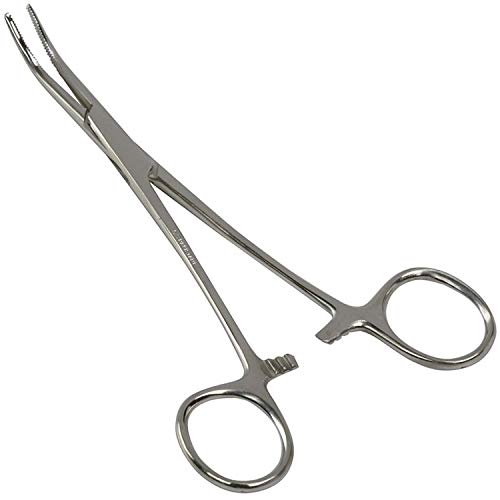

A hemostat earns its place in a tackle kit at the exact moment a fish comes to hand with a hook sitting deeper than fingers can safely reach. The narrow jaws slide past teeth and gill plates, the ratchet lock holds the hook shank without constant squeezing, and a short backward push frees the point so the fish goes back quickly. That mix of reach, grip and control is why locking forceps have moved from surgical trays into vests, boat consoles and shore bags, and why one pair rarely covers every situation an angler meets.
This guide compares five hemostats across the shapes that matter on the water: a straight pair for everyday work, a curved pair for angled approaches, a scissor clamp that trims line without a tool swap, a long pair for deep hooks, and a combo kit that bundles forceps with rigging tools. Each section sticks to the dimensions, jaw style, locking design and materials the maker publishes, plus an honest note on where that tool falls short.
As an Amazon Associate, we earn from qualifying purchases.
Quick answer
For most anglers, the SURGICAL ONLINE 5 Inch Fishing Forceps Set is the right first buy: its straight hemostat covers everyday hook removal with serrated locking jaws, and a curved twin rides in the same pack. Pick the MABIS Kelly for a single curved tool, the GLORY clamp for scissors, the 10 inch Rochester Pean set for deep hooks, and the Booms FF2 kit for a complete rigging bundle.
SURGICAL ONLINE 5 Inch Fishing Forceps Set for Straight Hook Work
The straight hemostat in this two-piece set is the tool most anglers will reach for most often, which is why the set leads this guide. Each forceps measures 5 inches, keeping the tips close to your hand for precise work on small and medium hooks while still reaching past the jaw hinge of a typical panfish, trout or bass. The listing describes stainless steel construction, serrated jaws for grip on wet hook wire, and a locking mechanism, and the maker’s line uses a three-position ratchet, so you can set a light hold for a fine-wire fly or a firmer clamp for a sturdier bait hook.
The straight jaw profile is the point of this pick. A straight tip travels in a direct line to a hook seated in the corner of the mouth, and it doubles as a barb-pinching tool: close the flat jaw section on a barb, squeeze, and the hook converts to barbless for catch-and-release water. The large finger loops suit wet hands, and at a listed set weight of just over 2 ounces the pair disappears into a vest pocket. Dimensions are listed at 5 by 2.75 by 0.44 inches, model CSO_3323.
The trade-off is the format. The straight tool is not sold on its own here; it arrives with a curved twin, a bonus for some anglers and a duplicate for others. Five inches is also a deliberate limit: hooks swallowed by larger fish sit beyond its reach, the gap the long pick later in this guide fills. As an everyday straight hemostat for bank, kayak and wading use, though, this is the most fishing-focused listing in its class.
MABIS Precision Kelly Forceps for Curved Access
A curved hemostat changes the geometry of hook removal. The bend near the tip lets the jaws approach a hook from the side while your hand stays clear of the mouth, which helps when a hook sits around the jaw corner or the head blocks a straight line in. The MABIS Precision Kelly Forceps are a clean example: a single curved tool, 5.5 inches long, in silver stainless steel, sold as a one-count pack.
Kelly forceps sit between fine mosquito forceps and heavy Pean patterns, a middle ground that suits general fishing. The jaws hold a medium hook shank without twisting, yet the tips stay slim enough for smaller hooks, and the locking clamp holds its grip once the ratchet engages, so one hand can steady the fish while the other works the hook free. The curve also improves your view of the hook point, because the handles angle away from your line of sight.
Trade-offs are real. MABIS sells this as a general-purpose precision instrument rather than a fishing tool, so there is no coated grip or eye-clearing pin in the listing; it is plain stainless steel with plain finger rings, and the silver finish is bright where some anglers prefer a darkened tool. What you get is a simple, well-defined curved hemostat from an established instrument brand: curved, 5.5 inches, stainless steel.
GLORY Fly Fishing Scissors and Forceps for Clamp and Cut in One
Scissor clamps solve a small but constant annoyance: the hook is out, the fish is released, and now the tag end needs trimming before the next cast. A separate nipper means another reach into a pocket with wet hands. The GLORY Fly Fishing Scissors and Forceps fold the cutter into the clamp itself, with a scissor section built into the jaw area so the tool that removed the hook can snip tippet or leader a moment later.
The listing describes a 5.5 inch tool in stainless steel with what the maker calls a Power Jaw: serrated tips intended to hold hook wire firmly during removal. The integrated scissors cutter handles quick line trimming, the handles carry a textured coated grip for wet use, and the locking system is described as multi-stage, letting the clamp hold at more than one grip pressure. The maker also describes the finish as rust-resistant for freshwater and saltwater use, which matters for a tool that lives in a vest and rarely gets dried properly.
The compromises follow from the combination. A scissor clamp is slightly heavier than a plain hemostat of the same length, and the lock can feel stiff when new. The cutter also shares space with the gripping jaws, so anglers who mostly fish large bait hooks may prefer a plain, deeper-serrated jaw. For fly and light-tackle anglers who re-rig often, though, the clamp-and-cut layout removes a whole tool from the vest, and 5.5 inches is a practical middle length.
SURGICAL ONLINE 10 Inch Rochester Pean Hemostat Set for Deep Hooks
Some hooks sit where a 5 inch tool cannot go: deep in the throat of a pike, a catfish that took a bait down, or a saltwater fish with a mouth built around crushing shell. Reaching in with fingers invites teeth and a thrashing head. This SURGICAL ONLINE set answers with length: two Rochester Pean hemostats at 10 inches each, one straight and one curved, so the working tip lands far from your hand while the handles stay outside the mouth.
Rochester Pean is a heavier pattern than the Kelly and mosquito styles above. The listing specifies full mouth serration: the gripping teeth run the length of the jaw rather than only part of it, helping the jaws hold a large hook shank without it sliding toward the tip under load. Three locking positions let you choose how hard the clamp bites before you push the hook back along its entry path, and the 10 inch frame gives leverage to rotate a stubborn hook out rather than pulling against the barb.
Length brings its own costs. A 10 inch hemostat is clumsy for small flies and fine-wire hooks, and it takes real space in a vest, so this is a boat bag or predator kit tool rather than an everyday carry. The pair format also repeats here: you receive both profiles whether you wanted both or not. As the long option for deep hooks, though, the listed mix of 10 inch reach, full-length serrations and a three-position lock is exactly what the job asks for.
Booms Fishing FF2 Fly Fishing Combo for Hemostat Plus Rigging Tools
The FF2 treats the hemostat as one part of a small rigging system. The kit, listed as a 4 in 1 combo under model FF2, bundles a stainless steel forceps with a tie fast combo tool, a pin-on retractor and a leader straightener. The forceps carry a curved tip, and the maker describes them as anti-rust and corrosion resistant, suitable for saltwater as well as fresh.
In practice the bundle covers the full sequence at the water’s edge. The retractor pins to a vest or pack and keeps the forceps on a short leash instead of at the bottom of the river. The forceps handle hook removal in the usual locking-jaw way. The tie fast tool then takes over the fiddly jobs the listing names: tying knots, cutting line, clearing hook eyes and untying tangles. The leader straightener pulls the curl out of a coiled leader. For a new fly angler building a first kit, that is a tidy single purchase.
The trade-off is that a bundle is only as strong as its least-used piece. Anglers who already own a good retractor and knot tool are paying for duplicates, and kit forceps rarely match the jaw finish of a dedicated premium clamp. The curved tip also makes this a complement to a straight hemostat rather than a replacement for one. As the combo entry here, though, the FF2 is the most complete hemostat-centred kit at its level.
How to choose
Match length to the fish first. Five to five and a half inches covers trout, panfish and most bass work and keeps the tool handy in a vest. Longer tools belong in predator, catfish and saltwater kits, where hooks sit deeper and mouths are bigger; a long tool used on small fish only gets in the way. Next, pick the jaw profile: straight for direct approaches and barb pinching, curved when hooks wrap around the jaw corner or your hand keeps blocking the view.
Then look at the jaws. Full serrations grip along the whole jaw and suit larger hooks; shorter serration sections give finer control on small flies. Check the lock: a three-position ratchet lets you set grip pressure instead of crushing or slipping, and it should work with one hand. Decide whether you will use scissors; frequent re-rigging makes a scissor clamp worthwhile, while bait anglers may never touch the cutter. Finally, consider carry: a retractor keeps the tool attached when a fish thrashes, and stainless steel is the baseline for anything used around water.
Who should skip
Skip hemostats entirely if your fishing centres on large saltwater hooks and heavy wire; a long-nose plier gives more leverage and a safer grip there. Skip the long 10 inch set if you only fish small streams and fine flies, where it is pure bulk. Skip scissor clamps if you already carry a dedicated nipper, since the cutter duplicates it. And skip combo kits if you are upgrading one weak link in a complete vest; a single, better hemostat serves you more.
Frequently Asked Questions
What size hemostat is best for general fishing?
A 5 to 5.5 inch hemostat is the general-purpose size. It reaches hooks in the mouths of trout, panfish and bass, fits in a vest pocket, and keeps the tips close to your hand for controlled work. Move up to 8 or 10 inches only when you regularly unhook deep-hooked or toothy fish.
Are curved or straight hemostats better for hook removal?
Neither wins outright. Straight jaws suit hooks you can approach head-on and double as a barb-pinching tool. Curved jaws approach from the side, keep your hand out of the mouth and improve your view of the point as it backs out. Many anglers carry the straight pair daily and keep a curved pair for awkward angles.
How do locking hemostats help release fish faster?
The ratchet lock holds the hook shank at a set pressure, so you are not squeezing handles while also trying to manoeuvre. With the hook held steady, a short push back along the entry path and a small turn usually frees the point, which shortens handling time and keeps the fish calmer.
Can hemostats replace fishing pliers?
For light and medium hooks, yes, and they reach places pliers cannot. For heavy-wire hooks, split rings and thick line, pliers are stronger and safer. Most complete kits carry both: hemostats for hook removal and fine work, pliers for force and cutting.
Final verdict
The SURGICAL ONLINE 5 Inch Fishing Forceps Set is the sensible default: a fishing-specific straight hemostat with serrated locking jaws, plus a curved twin in the pack. The MABIS Kelly is the pick for a single curved tool. Choose the GLORY clamp if trimming line without swapping tools appeals to you, the 10 inch Rochester Pean set when deep hooks are a regular problem, and the Booms FF2 for a complete rigging bundle.
Product and ASIN Reference
| Product | ASIN |
|---|---|
| SURGICAL ONLINE Versatile Angling Tools 2pc 5 Inch Fishing Forceps Set | B07CRNWHXY |
| MABIS Precision Kelly Forceps Locking Tweezers Clamp, Curved, 5-1/2 Inch | B00GGAAPD0 |
| GLORY Fly Fishing Scissors and Forceps 5.5 Inch Stainless Steel | B0GXX5HN2H |
| SURGICAL ONLINE Set of 2 Premium Quality 10 Inch Rochester Pean Hemostat Forceps | B09CQGL13S |
| Booms Fishing FF2 Fly Fishing Accessories and Tools Kit | B07FDZ2C8P |
FAQ
What size hemostat is best for general fishing?
Are curved or straight hemostats better for hook removal?
How do locking hemostats help release fish faster?
Can hemostats replace fishing pliers?
More from Amazon
Programs that pair well with the guide above. Offers and eligibility are set by Amazon and may change.
Free shipping on eligible items, Prime Video and more. Eligible new members can start with a free trial.
Start a Prime free trialA Prime membership for ages 18-24 with a trial period. Eligibility is set by Amazon.
See Prime for Young AdultsAudiobooks and podcasts to listen to on the go. Eligible new members can start with a free trial.
Try Audible freeAd-free music streaming. Eligible new subscribers can start with a free trial.
Try Music Unlimited freeAs an Amazon Associate we earn from qualifying purchases.
Write Your Review
No reviews yet. Be the first to share your experience!