
Our Top Picks
 Garmin Striker Vivid 4cv Fishfinder with Transducer4 Inch8 x 11.5 x 6 inches0.7 poundsCheck on Amazon
 Humminbird Helix 5 G3 GPS Fish Finder with5-Inch Display15.75 x 4.75 x 9.63 inches2.12 poundsCheck on Amazon
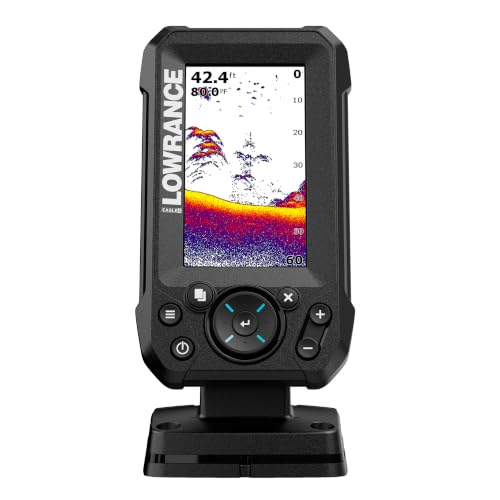 Lowrance Eagle 4X Fish Finder with Bullet Transducer4 Inch7 x 4 x 3.84 Inches2.8 poundsCheck on Amazon
 Humminbird PiranhaMAX 4 Fish Finder with TransducerOne Size3.6 x 3.9 x 6.8 inches2 poundsCheck on Amazon
The Garmin Striker Vivid 4cv is the best budget fish finder for most anglers because it pairs a bright color screen with scanning sonar, built-in GPS and a transom-mount transducer in one small package. A budget fish finder is simply a compact sonar display with a transducer that shows depth, bottom hardness, structure and fish under your boat or kayak, without the cost of a large chartplotter. The rest of this guide sorts eight options by screen size, sonar type, GPS and portability, so you can match one to your water.
Quick List
- Garmin Striker Vivid 4cv – best for all-around value with scanning sonar and GPS
- Garmin Striker Vivid 7cv – best for anglers who want a large, easy-to-read screen
- Humminbird Helix 5 G3 – best for a 5-inch CHIRP unit with GPS and a big depth reach
- Garmin Striker 4 – best for simple GPS and a flasher mode
- Lowrance Eagle 4X – best for a no-fuss, sonar-only unit with a bright screen
- Humminbird PiranhaMAX 4 – best for traditional dual-beam sonar on small boats
- Venterior wireless sensor – best for casting from shore or a kayak without running a cable
- LUCKY handheld – best for a very basic depth reading in a tiny package
Which One Is Right for You?
| If you… | Choose |
|---|---|
| want one balanced unit for a jon boat or bass boat | Garmin Striker Vivid 4cv |
| have trouble reading small screens | Garmin Striker Vivid 7cv |
| want a larger screen and deep-water reach with GPS | Humminbird Helix 5 G3 |
| want GPS and a flasher mode for ice or vertical jigging | Garmin Striker 4 |
| only need depth, structure and fish, and want a bright portrait screen | Lowrance Eagle 4X |
| fish shallow lakes and want classic dual-beam sonar | Humminbird PiranhaMAX 4 |
| fish from the bank or a kayak and want no cable to manage | Venterior wireless sensor |
| want the simplest handheld depth reader to toss in a bag | LUCKY handheld |
As a rule, spend on the transducer and sonar type first, then screen size, then GPS. A GPS adds waypoints and speed, but it will not help you find fish if the sonar picture is poor. If you are unsure, start with the Vivid 4cv and move up or down from there.
All 8 Picks in Detail
1. Garmin Striker Vivid 4cv – Best for All-Around Value
As an Amazon Associate we earn from qualifying purchases at no extra cost to you.
This is the unit most small-boat and kayak anglers should look at first. It adds ClearVu scanning sonar, which draws a near-photo picture of what is directly below the boat, on top of traditional CHIRP sonar and GPS.
- Display: about 4.3 inches diagonal, 480 x 272 pixels, with selectable Vivid color palettes (the catalog title calls it a 4-inch LCD)
- Sonar: traditional CHIRP at 50/77/200 kHz plus ClearVu scanning at 260/455/800 kHz
- Transducer: GT20-TM transom mount with a temperature sensor
- GPS: built in, with Quickdraw Contours for making your own 1-foot-contour maps and a listed 5,000-waypoint memory
- Size: roughly 11.2 ounces, IPX7 water protection
This unit suits anglers in a jon boat, bass boat or large kayak who fish brush, docks and ledges and want split-screen views without a big console. ClearVu looks straight down, so make slow passes over a target, mark it as a waypoint, then circle it with traditional sonar to see the fish. The color palettes are display settings only, so try several and keep the one you read fastest. Plan a 3-amp fast-acting fuse and a small 12-volt battery when you wire it.
Pros
- Scanning sonar shows brush, rock and docks more clearly than plain 2D
- Quickdraw Contours lets you build a map of your own lake
Cons
- ClearVu looks straight down only; it does not scan to the sides
- The screen is still small for reading in split view
Compared with the Striker 4, it gives you a larger screen, scanning sonar and contour mapping for a modest step up.
2. Garmin Striker Vivid 7cv – Best for a Large Screen

If you split the screen between sonar and a map, or fish with older eyes, the 7-inch display makes a real difference. It uses the same sonar family as the 4cv on a bigger canvas.
- Display: 7 inches, 800 x 480 pixels
- Sonar: Garmin CHIRP traditional plus CHIRP ClearVu scanning, with the GT20-TM transducer
- GPS: built in, with a listed 5,000 waypoints and Quickdraw Contours
- Connectivity: Wi-Fi to the ActiveCaptain app for waypoint transfer
- Size: about 1.7 pounds; flush or tilt-and-swivel mounting
Think of this as the 4cv with more room to read. It suits anglers with a wide dash or console, or anyone who wants sonar and a map visible together. Because there is no side imaging, you fish it the same way: pass over structure, mark it, then work the area. The Wi-Fi link to the ActiveCaptain app moves waypoints without typing. Check your power setup, since the typical draw is listed near 0.55 amps, higher than the smaller Garmin units.
Pros
- Easy to read at a glance, even with a split screen
- Wi-Fi sharing of waypoints saves typing at the dock
Cons
- Too large for most kayaks and small jon boats
- No side imaging despite the size
Choose it over the 4cv only if you have the dash space; otherwise the smaller unit shows the same sonar.
3. Humminbird Helix 5 G3 – Best 5-Inch Unit with GPS and Depth Reach
The Helix 5 sits between the small Strikers and the 7-inch Garmin. It is a good fit for anglers who fish reservoirs where bottom detail and depth both matter.
- Display: 5 inches, 800 x 480 pixels, keypad controlled (no touchscreen)
- Sonar: Dual Spectrum CHIRP with wide and narrow modes
- Depth: listed up to about 1,200 feet with the standard transducer
- GPS: built-in, with AutoChart Live and a basemap; one microSD slot for charts
- Output: 500 W RMS
This model suits reservoir and big-lake anglers who care about bottom detail and depth. Dual Spectrum CHIRP offers a wide mode of about 140 to 200 kHz for coverage and a narrow mode of about 180 to 240 kHz for detail, so you can switch between a broad search and a close look. It draws about 615 milliamps on 10.8 to 20 volts. The head unit is about 7.5 inches wide, so measure your dash before you buy.
Pros
- High-resolution screen for the size, with strong bottom detail
- Accepts premium chart cards if you want maps later
Cons
- Physical keys are slower than a touchscreen
- No scanning sonar unless you buy the DI variant, so confirm the model on the listing
Next to the Vivid 4cv, it favors deeper-water CHIRP over scanning views.
4. Garmin Striker 4 – Best for Simple GPS and a Flasher Mode

This older, compact Garmin remains useful because it is simple. It has GPS for marking spots and a flasher view, which some anglers like for vertical jigging.
- Display: 3.5 inches, 480 x 320 pixels
- Sonar: CHIRP 77/200 kHz plus traditional 50/77/200 kHz
- Depth: about 1,600 feet in freshwater and 750 feet in saltwater
- Power: about 0.23 A at 12 V; unit weighs about 8.1 ounces
- GPS: built in for waypoints and speed; confirm the waypoint limit on the listing
This is the unit for anglers who want a small, light head unit that sips power. The bundled transducer is a transom-mount type with mounting hardware and cable, and Garmin suggests a GT8 or GT15 transducer, sold separately, if you want higher-performance CHIRP later. At about 3.6 by 5.9 inches it fits on a kayak or small jon boat, and the flasher view is handy when you drop a jig straight down.
Pros
- Light on power and easy to mount
- Flasher mode suits ice and vertical presentations
Cons
- Smallest screen in this group
- No scanning sonar or contour mapping
Pick it over the 4cv only if price or flasher mode matters more than screen size and imaging.
5. Lowrance Eagle 4X – Best Sonar-Only Unit with a Bright Screen
Some anglers do not want GPS or maps at all. The Eagle 4X gives you a clear sonar picture and a bullet transducer, and not much else, which keeps it easy to learn.
- Display: 4-inch IPS in portrait orientation, 272 x 480 pixels
- Sonar: 200 kHz broadband, not CHIRP
- Transducer: bullet style with a wide beam of about 44 degrees, aimed at kayaks and small boats
- Depth: listed around 500 feet
- Extras: auto-tuning sonar, IPX7 water protection, no GPS
This model suits kayak and small-boat anglers who want to turn it on and fish. The bullet transducer mounts on a transom or bracket and the cable is about 6 meters (roughly 20 feet), so check that it reaches your display. The wide cone is best in water down to about 35 feet, which covers most small lakes. Fuse ratings differ between retailer pages (3 amps and 5 amps appear), so follow the manual for wiring.
Pros
- IPS screen stays readable at angles and with polarized glasses
- Very simple menus
Cons
- No GPS, no mapping, no CHIRP
- A wide beam gives less detail at depth
It is the pick if you would otherwise choose the PiranhaMAX 4 but prefer a brighter, taller screen.
6. Humminbird PiranhaMAX 4 – Best for Classic Dual-Beam Sonar
The PiranhaMAX 4 is a no-frills 2D sounder. It is a sensible choice for shallow lakes, ponds and small boats where you mostly want depth, bottom type and fish.
- Display: 4.3 inches, 480 x 272 pixels, color
- Sonar: dual-beam 2D at 200 and 455 kHz
- Beams: about 28 degrees at 200 kHz and 16 degrees at 455 kHz
- Depth: about 600 feet at 200 kHz and 320 feet at 455 kHz
- Navigation: none, and no CHIRP
The two beams give you options in shallow water. In 10 feet of water, a 28-degree cone covers a circle about 5 feet wide, while the 16-degree beam covers about 3 feet (using the cone formula in the buying section). The unit draws about 180 milliamps on 10.8 to 20 volts and uses a tilt-and-swivel gimbal mount, with an optional in-dash kit. It suits anglers who want to see the bottom and fish without learning a menu maze.
Pros
- Two beams let you see wide coverage and narrower detail
- Straightforward gimbal mount
Cons
- No GPS or mapping
- Older sonar than the CHIRP units in this list
Choose the Eagle 4X for a brighter screen or the Striker 4 if you want GPS at a similar size.
7. Venterior Wireless Sensor – Best for Casting from Shore or a Kayak

This rechargeable system uses a floating sensor that you cast out, with the readings sent to a handheld display. It suits bank anglers and paddlers who do not want to mount a transducer.
- Display: 2.6 inches, 240 x 320 pixels, rechargeable
- Depth: listed from about 2.6 to 164 feet; one version lists a shorter 131-foot range
- Wireless range: up to about 262 feet from sensor to screen
- Beam: listed at 105 degrees on most pages, 90 degrees on others
- Battery: sensor listed at 6 to 8 hours; display about 4 to 6 hours
Charge the sensor and the display, then cast the sensor out and let it float while the screen shows depth, temperature and fish. The manual warns that the display is not waterproof, so keep it dry, and that mud, suspended matter or heavy vegetation can confuse the readings. The listed operating temperature is about 14 to 113 degrees Fahrenheit, so it is not meant for deep cold.
Pros
- No cable, no drilling, no battery box
- Compact enough to carry in a pocket
Cons
- Very wide beam gives little detail
- The display is not waterproof, and mud or heavy weeds can confuse the readings
Compared with the LUCKY handheld, it avoids the cable but costs you detail.
8. LUCKY Handheld – Best for the Simplest Depth Reading

This is the most basic option here. The listing title says castable, but retailer specs for this FFC1108-1 describe a 25-foot cable, so confirm the setup on the listing before you buy.
- Display: about 2-inch LCD with backlight, 5 sensitivity levels
- Sonar: 200 kHz with a 45-degree beam
- Depth: about 3 to 328 feet
- Cable: about 25 feet to the transducer on most listings
- Power: 4 AAA batteries, not included
This unit suits shore, small-boat and ice anglers who just want to know how deep it is. The listed minimum depth is about 3 feet, so it will not read in very shallow water. It has five sensitivity levels, a fish alarm and a feet-or-meters setting, and the operating range is about 14 to 122 degrees Fahrenheit, so keep spare batteries warm in cold weather. The transducer is about 1.8 inches across.
Pros
- Pocket-sized and easy to use for shore or ice
- Fish alarm and bottom-type readout
Cons
- Small screen with limited detail
- Battery life is only a few hours on one set
It is simpler than the Venterior but ties you to a cable; upgrade to the Eagle 4X if you will fish from a boat.
Specs Compared
| Model | Screen | Sonar | GPS | Best use |
|---|---|---|---|---|
| Garmin Striker Vivid 4cv | About 4.3 in, 480 x 272 | CHIRP plus ClearVu | Yes | All-around small boat |
| Garmin Striker Vivid 7cv | 7 in, 800 x 480 | CHIRP plus ClearVu | Yes | Larger console or dash |
| Humminbird Helix 5 G3 | 5 in, 800 x 480 | Dual Spectrum CHIRP | Yes | Reservoirs, deeper water |
| Garmin Striker 4 | 3.5 in, 480 x 320 | CHIRP, traditional | Yes | Simple GPS, flasher |
| Lowrance Eagle 4X | 4 in IPS, 272 x 480 | 200 kHz broadband | No | Sonar-only kayak or jon boat |
| Humminbird PiranhaMAX 4 | 4.3 in, 480 x 272 | Dual-beam 2D | No | Shallow lakes |
| Venterior wireless sensor | 2.6 in, 240 x 320 | Wireless sensor, wide beam | No | Shore and kayak casting |
| LUCKY handheld | About 2 in | 200 kHz, 45 degrees | No | Basic depth checks |
No price column appears here because listing figures change often. Confirm the model number, transducer and any included mount on the product page.
How We Chose These
This guide is built from desk research alone. We compared the manufacturers’ specifications and retailer spec sheets for each listed model, then checked disagreements between sources and flagged them in the picks above. We ranked units on five points: sonar type, screen size and resolution, GPS and mapping, power and mounting needs, and fit for small boats and kayaks. Where sources disagreed, such as a unit’s listed depth or beam angle, we say so and tell you to confirm it on the listing.
What to Look For
Transducer and Cone Angle
The transducer is the part that sends and receives sound, and it often matters more than the screen. Its cone angle sets how much water you scan. A rough formula gives the circle width on the bottom: diameter equals twice the depth times the tangent of half the cone angle.
| Depth | 20-degree cone | 45-degree cone |
|---|---|---|
| 20 feet | about 7 feet | about 17 feet |
| 50 feet | about 18 feet | about 41 feet |
| 100 feet | about 35 feet | about 83 feet |
A narrow beam shows more detail around structure but covers less ground, and in under 10 feet of water a 20-degree cone is less than 3 feet wide on the bottom. A wide beam, like the 44 degrees on the Eagle 4X bullet, finds more fish and sacrifices detail.
CHIRP, Dual-Beam and Scanning Sonar
Traditional sonar sends a single frequency. CHIRP sends a sweep of frequencies, which separates targets better and gives cleaner fish arches near structure. Dual-beam units, such as the PiranhaMAX 4, give you a wide and a narrow view. Scanning sonar, such as ClearVu, adds a down-looking image of the bottom that reads like a photograph. If you fish brush piles or docks, scanning sonar is worth the small step up. If you mostly fish open water with few hard targets, plain CHIRP does the job.
Screen Size and Resolution
Pixels matter as much as inches. A 4.3-inch screen at 480 x 272 can look good at arm’s length; a 7-inch screen at 800 x 480 keeps split views legible. For kayaks and small jon boats, 4 to 5 inches is usually the practical limit because of dash space and spray. Look for an IPX7 water-resistance class and an anti-glare screen, since you will use the unit in direct sun.
Power, Mounting and Transducer Placement
Most units run on a 12-volt battery. As a worked example, a unit that draws 0.23 amps, like the Striker 4, would run about 30 hours on a 7 amp-hour battery on paper (7 divided by 0.23). A unit drawing about 0.4 amps, like the Vivid 4cv, would run about 17 hours. Real runtime is lower, so treat these as upper limits.
On a transom mount, place the transducer in clean, non-turbulent water, away from strakes, intakes and propeller wash. A common starting point is parallel to the hull bottom and about 1/8 inch below it, then lower it in small steps if you lose the bottom at speed. On a kayak, the transducer must stay fully submerged, and a scupper mount or side bracket works without drilling. Fuse the positive lead near the battery; Garmin lists a 3-amp fast-acting fuse for the Vivid 4cv, so always follow your manual.
Matching a Unit to Your Water
| Where you fish | What matters most | Good fits here |
|---|---|---|
| Small ponds and shallow lakes | Narrow beam detail, simple controls | PiranhaMAX 4, Eagle 4X |
| Brush, docks and rock piles | Scanning sonar and waypoints | Vivid 4cv, Vivid 7cv |
| Deeper reservoirs | CHIRP with strong depth reach | Helix 5 G3, Striker 4 |
| Bank fishing | Portability, no mounting | Venterior, LUCKY |
Portable and Wireless Options
Castable and handheld sensors avoid wiring, but they trade away detail. Wide beams of 90 to 105 degrees read depth well but show only broad fish returns, so use them for finding depth changes, not for picking apart structure.
Questions
Is a budget fish finder worth it?
Yes, if you want to find depth changes, bottom type and baitfish. Even a basic sonar unit reveals drop-offs and weed edges that are invisible from the surface. For tight budgets, put the money into the transducer and sonar type first.
Do I need GPS on a budget fish finder?
Not always. GPS lets you mark waypoints, see speed and, on some Garmin units, build contour maps with Quickdraw Contours. If you fish the same lake often, it helps. If you only want depth and fish, a sonar-only unit like the Eagle 4X is simpler.
Is CHIRP necessary?
It is not required, but it gives cleaner target separation than a single frequency, especially near structure and in deeper water. On shallow flats, the difference is less noticeable.
Can I use a fish finder on a kayak?
Yes. Use a small battery, a scupper or side-mount transducer, and a unit with a modest screen. Wireless sensors like the Venterior skip the wiring entirely, though they show less detail.
Which model suits ice fishing?
The Striker 4 has a flasher mode that some anglers prefer for vertical presentations. Handheld units are also common, but remember the transducer must sit in water and cold weather shortens battery life.
How deep can these units read?
Listed depths vary widely, from about 164 feet for the Venterior to over 1,000 feet for some CHIRP units. Most inland anglers rarely need more than 100 to 200 feet, so treat very large numbers as marketing headroom and confirm limits on the listing.
Update History
- October 15, 2026 – Updated with specification checks and a revised product comparison.
- Check the product page for current specifications and availability before buying.
Sources
- Garmin product pages and retailer specification sheets for the Striker 4, Striker Vivid 4cv and Striker Vivid 7cv
- Humminbird product pages for the Helix 5 G3 and PiranhaMAX 4
- Lowrance product information for the Eagle 4X
- Venterior VT-FF005 user manual and listing details
- LUCKY FFC1108 manual and retailer listings
- Hawkeye Electronics and Norcross transducer installation guides
- Lowrance sonar basics for cone angle and frequency background




Write Your Review
No reviews yet. Be the first to share your experience!