
Our Top Picks
 New Archery Products NAP Spitfire Crossbow 100 Grain100 Grains9.7 x 5.75 x 1.05 inches0.05 PoundsCheck on Amazon
The best broadheads depend on your setup: choose a durable fixed blade for maximum reliability and simple tuning, or a mechanical broadhead when a larger wound channel and forgiving arrow flight matter more than compact construction.
Best Broadheads by Hunting Situation
| Hunting situation | Best broadhead type | Useful specification | Why it fits |
|---|---|---|---|
| First-time bowhunter or difficult-to-tune bow | Compact mechanical | 2 blades, about 1.5–2 inches cutting diameter | Often groups similarly to field points when correctly installed |
| Heavy cover, steep angles, or maximum durability | Fixed blade | 3 or 4 blades, 1–1.25 inches, hardened stainless steel | There are no deployment parts to fail or open early |
| High-poundage compound bow and deer-sized game | Either type | 100-grain head with a total arrow weight commonly around 400–500 grains | Both can provide adequate penetration when matched and tuned |
| Lower-poundage bow or traditional equipment | Cut-on-contact fixed blade | 75–100 grains, depending on manufacturer and arrow setup | Efficient penetration is usually more important than maximum cutting diameter |
| Frequent practice and repeated sharpening | Replaceable-blade fixed head | Two- or three-piece blade system | Damaged blades can be replaced without discarding the ferrule |
Fixed-Blade vs. Mechanical Broadheads
Fixed-blade broadheads
Fixed blades have cutting edges that remain exposed before, during, and after impact. Their principal advantages are strength, predictable construction, and easy inspection. A quality fixed head has fewer moving parts, making it a sensible choice for thick hide, bone contact, dense brush, or hunters who want the same mechanical behavior on every shot.
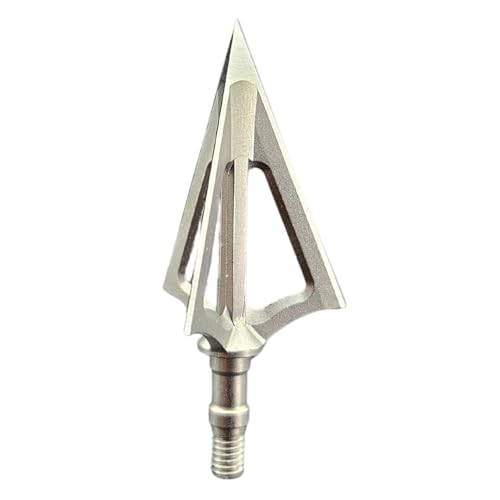
G5 Montec 1-1/16-Inch Cut Broadheads, 100 Grain, 3-Pack
Included for 'Best Broadheads for Accurate, Reliable Hunting' because the listing specifies 100 Grain and 3-Pack, details this guide uses to compare options.
View on Amazon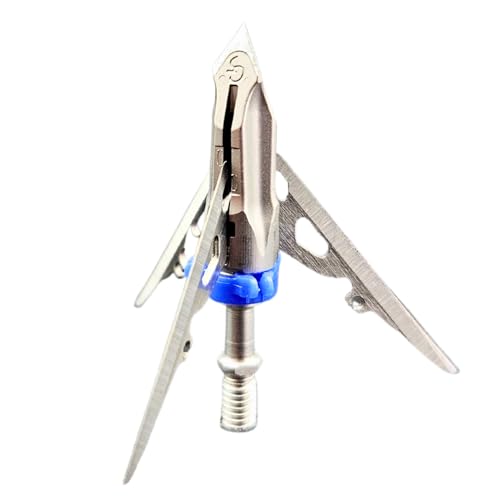
G5 Megameat 125 Grain Broadhead 3 Pk, Stainless Steel, Model Number: MM101
Included for 'Best Broadheads for Accurate, Reliable Hunting' because the listing specifies Stainless Steel and Model Number: MM101, details this guide uses to compare options.
View on Amazon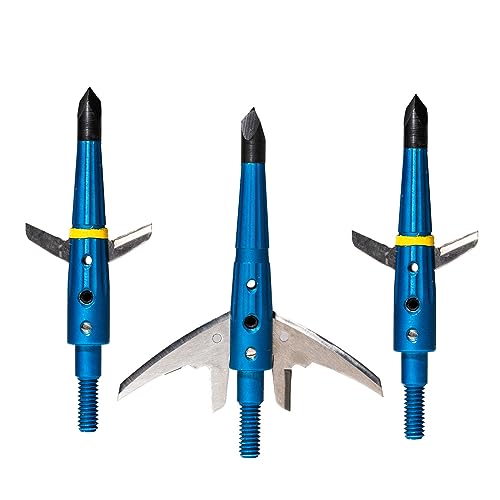
Swhacker #261 Levi Morgan Series 2-Blade Mechanical Broadheads, 100 Grain, 2.0" Cut, Expandable Broadhead, Archery Hunting Broadheads, 4 Pack, Blue
Included for 'Best Broadheads for Accurate, Reliable Hunting' because the listing specifies 100 Grain and 2.0" Cut, details this guide uses to compare options.
View on AmazonNew Archery Products NAP Spitfire Crossbow 100 Grain Mechanical Broadhead
Picked as a relevant option in this category; details come from the product listing.
View on AmazonThe tradeoff is aerodynamic drag. Large fixed blades can steer the arrow away from the point of aim, particularly with a poorly aligned rest, excessive vane contact, inadequate arrow stiffness, or imperfect nocking-point position. Compact designs such as the QAD Exodus, Slick Trick Standard, Muzzy Trocar, Magnus Stinger, and G5 Montec illustrate the main fixed-blade categories: replaceable-blade heads, cut-on-contact designs, and one-piece or highly rigid ferrules.
A one-piece head such as a steel or stainless-steel cut-on-contact design is particularly simple to maintain. Replaceable-blade models are more convenient when blades become nicked, but their retaining screws and blade slots need inspection after use.
Mechanical broadheads
Mechanical broadheads keep the blades closed during flight and deploy on impact. Their smaller flight profile can make tuning easier, while a 1.5- to 2-inch cutting diameter can create a wide entrance wound and an abundant blood trail when the shot is placed correctly. Examples include the Rage Hypodermic, SEVR 2.0, and similar two-blade or rear-deploying designs.
Mechanical heads require more scrutiny. Confirm that the blades are locked or retained as intended, the ferrule is not bent, and the deployment mechanism is not obstructed. Some designs use blades that are replaced after one impact; others allow limited reuse if the blades and ferrule remain straight. A mechanical head can be an excellent choice for a well-tuned compound bow, but it is not automatically the best solution for low-energy equipment or shots likely to encounter heavy bone.
Cutting Diameter: Bigger Is Not Always Better
Cutting diameter is the distance across the wound made by the deployed or exposed blades. A 1-inch fixed blade has a modest frontal profile and usually prioritizes penetration. A 2-inch mechanical can remove substantially more tissue, but it also places greater demand on arrow momentum and blade strength.
As a useful comparison, the circular area represented by a 1-inch diameter is about 0.79 square inches, while a 2-inch diameter represents about 3.14 square inches—four times as much geometric area. Real broadhead wounds are not perfect circles, so this is not a prediction of blood loss or recovery. It does show why a large mechanical head can lose penetration more quickly when arrow energy is marginal.
For deer-sized game, a well-built head in the 1- to 2-inch range is generally more practical than choosing the largest available diameter. For larger game, prioritize the manufacturer’s game-size and minimum-energy guidance, along with local regulations.
Blade Design and Durability
- One-piece ferrules: Usually have excellent structural simplicity and fewer parts to loosen, although sharpening can require a suitable jig or careful technique.
- Replaceable fixed blades: Make ownership easier because a bent or chipped blade can be changed. Carry spare blades and the correct driver in your field kit.
- Cut-on-contact tips: Begin penetration efficiently and are useful where conserving momentum is important. They still need to be sharp; a pointed tip is not the same as a sharp edge.
- Chisel tips: Resist damage better when contacting hard material and can be practical for tough impact conditions, though they may not penetrate as efficiently as a sharp cut-on-contact tip.
- Rear-deploying mechanicals: Keep the blades sheltered during flight and can provide a broad cut, but deployment parts and blade retention must be checked before every hunt.
- Bleeder blades: Add a second cutting plane to some fixed heads. They can improve tissue cutting but also increase surface area and tuning sensitivity.
In normal use, the tip and leading edge usually show damage first. Ferrules can bend after an angled impact, while mechanical blades may curl, crack, or fail to lock after striking bone. Never straighten a visibly bent ferrule and assume the head is safe for hunting. Replace it or follow the manufacturer’s inspection and replacement guidance.
Compatibility With Your Bow and Arrow
Compound bows
Most modern compounds can use either fixed or mechanical broadheads if the arrow is correctly spined and the bow is tuned. Start with the manufacturer’s recommended insert and broadhead weight, commonly 100 grains, then confirm that your arrow’s spine chart includes your draw length, draw weight, point weight, and arrow length. A heavier broadhead may improve front-of-center balance but can require a stiffer arrow.
Mechanical broadheads are often easier to group with field points because their closed profile creates less steering. They still require a properly aligned rest and consistent arrow assembly. If field points group well but fixed blades do not, check timing, cam synchronization, rest alignment, nock fit, and vane clearance before blaming the broadhead.
Crossbows
Crossbows generate high arrow speeds but use shorter, heavier arrows and have different manufacturer recommendations. Use only broadheads approved for the crossbow model and arrow combination. Some mechanical heads are specifically marketed for crossbow speeds; others may open prematurely or experience excessive stress if used outside their stated limits. A broadhead that is suitable for a vertical bow is not automatically suitable for a crossbow.
Traditional bows and lower-energy setups
Choose a compact, sharp, cut-on-contact fixed blade and follow the bow manufacturer’s minimum broadhead weight. Avoid assuming that a wide mechanical is an upgrade. Lower-energy setups benefit from reduced blade drag and efficient penetration, and fixed blades remove deployment uncertainty.
Tuning and Setup: A Reliable Process
- Confirm legality and specifications. Check local rules for minimum cutting diameter, number of blades, prohibited designs, and permitted game species.
- Match the arrow first. Verify total arrow weight, spine, insert compatibility, and nock fit. Broadhead tuning cannot correct an unsuitable arrow.
- Inspect every head. Check sharpness, blade seating, ferrule straightness, retaining screws, and mechanical deployment or retention.
- Install the head squarely. Clean the arrow threads, tighten the head without excessive force, and spin-test the complete arrow. A visible wobble indicates a problem with the arrow, insert, ferrule, or threads.
- Sight in with field points, then broadheads. Begin at a short distance and use a safe backstop designed for broadheads. Increase distance only when groups remain consistent.
- Keep a hunting set separate. Use practice heads for repeated target shooting. Broadheads can become dull or damaged even when a target appears to stop them cleanly.
For a fixed blade that impacts left, right, high, or low relative to field points, make small equipment or rest adjustments rather than immediately changing to a different head. For a mechanical that groups correctly, confirm deployment with a target or controlled test approved by the manufacturer before hunting.
Ownership Costs and Maintenance
General market pricing is commonly about $25–$60 for a three-pack of fixed blades and $35–$70 for a three-pack of mechanicals, with premium or specialty designs sometimes costing more. A fixed-blade owner may spend about $10–$30 on replacement blades or sharpening supplies. Mechanical users should budget for replacement blades or complete heads after significant impacts.
For example, a $45 three-pack used for nine successful practice and hunting setups costs $5 per use, but that calculation is misleading if one head is damaged on its first impact. The practical cost depends more on whether blades are replaceable and whether you reserve hunting heads for actual hunting. Store heads dry, protect the edges, and avoid leaving blood or moisture on steel components. Follow the product’s cleaning guidance; some coatings and blade finishes can be damaged by harsh chemicals.
Final Buying Recommendation
Choose a compact fixed blade if reliability, penetration, simple inspection, and durability are your priorities. Choose a mechanical if your bow is properly tuned, your arrow has adequate energy, and a larger cutting diameter is worth the added inspection and replacement cost. For many deer hunters, the best broadheads are not the widest or most expensive models—they are sharp, straight, legal, matched to the arrow, and proven to group consistently from the actual hunting setup.






Write Your Review
No reviews yet. Be the first to share your experience!