
Key takeaways
- Format: aerosol spray dye, 15 oz can — larger than the standard 11–12 oz class
- Named substrates: carpet, vinyl, fabric, upholstery
- Color: black
- Result: permanent color rather than a temporary dressing
- Application: spray, light coats, no gun or reducer required
The best vinyl dye for car interior restoration for most people is HI-TECH Big Can Black Spray Dye, a 15 oz aerosol whose listing covers carpet, vinyl, fabric and upholstery in a single can. That breadth is the point. Most interiors mix materials — a vinyl dash pad, hard plastic trim, a fabric seat bolster, a carpeted kick panel — and one black dye that bonds to all of them saves you from buying three products and trying to match three sheens. It suits anyone restoring a black or near-black interior who wants one can to handle the whole job.
If you need a factory color match across large flexible panels, SEM Color Coat Plastic & Vinyl Flexible Coating in the 1 gallon size is the premium route, because bulk liquid lets you spray a full set of panels from one batch and keep the color consistent. On a tight budget for a single faded door panel or console lid, Dupli-Color Vinyl & Fabric Spray in Gloss Black 11 oz is the sensible entry point. Everything else here solves a narrower problem — trim restorers, leather balms, beige color matching, multi-color repair kits — and each section below states exactly which interior it fits.
Top 3 Picks
Best Overall: HI-TECH Big Can Black Spray Dye (15 oz)
The one can that covers the widest range of interior surfaces: carpet, vinyl, fabric and upholstery, all named on the label. The 15 oz size is larger than a standard 11–12 oz aerosol, which matters when you are coating a dash pad, two door panels and a console in the same session. It is the pick for a restorer who wants a permanent black on mixed materials without juggling separate products.
Best Budget: Dupli-Color Vinyl & Fabric Spray, Gloss Black (11 oz)
A well-known aerosol in the 11 oz class, labeled for vinyl and fabric, in a gloss black. It is the right first purchase if you are dyeing one panel or a pair of sun-faded seat backs and want to see how the material takes color before committing to a full interior. Gloss finish is the trade-off — it will not match a factory matte dash.
Best Premium: SEM Color Coat Plastic & Vinyl Flexible Coating (1 Gallon)
Bulk liquid coating in a 1 gallon container, intended for spray-gun application rather than a rattle can, and formulated to stay flexible on plastic and vinyl. This is the choice when color match and consistency across a whole set of panels matter more than convenience. It requires reducer, a gun, and proper ventilation, so it is a premium workflow as well as a premium price tier.
Quick Comparison
| Product | Best for | Key specs | Price tier |
|---|---|---|---|
| HI-TECH Big Can Black Spray Dye | All-round black restoration across mixed materials | 15 oz aerosol; carpet, vinyl, fabric, upholstery; permanent color | Mid-range |
| Dupli-Color Vinyl & Fabric Spray, Gloss Black | Single-panel budget touch-ups | 11 oz aerosol; gloss black; vinyl and fabric | Budget |
| CAR GUYS Plastic Restorer | Reviving faded plastic and trim without dyeing | Liquid restorer; plastic, rubber, vinyl; user-friendly application | Budget |
| ExoForma Black Trim Restorer | Long-wear black on trim and exterior plastic | Dye-infused, waterproof; listing states 6+ months of durability | Mid-range |
| WERBME Leather Recoloring Balm | Small leather and vinyl scuffs, cracks, worn bolsters | Balm; leather and vinyl; hand-applied; black | Budget |
| 3D Leather, Vinyl & Plastic Conditioner | Maintaining interiors that are still in good shape | Conditioner; leather, vinyl, plastic; non-greasy; UV protection | Mid-range |
| Detail King Hi-Tech Black Vinyl Plastic & Carpet Aerosol Dye | High-volume black work on vinyl, plastic and carpet | Aerosol dye; vinyl, plastic, carpet; pro-oriented formulation | Premium |
| STARTSO WORLD Leather Recoloring Balm | DIY leather color touch-up on seats and couches | Balm kit; black; leather; hand-applied | Budget |
| SM Arnold Refinishing Spray Paint – Beige | Non-black color matching on mixed substrates | 11 oz aerosol; beige; leather, carpet, vinyl, metal, plastic, polycarbonate | Mid-range |
| SEM Color Coat Plastic & Vinyl Flexible Coating | Flexible, color-matched coverage over large areas | 1 gallon; spray-gun application; flexible coating; Yellow Oxide | Premium |
| ApexShine Leather Repair Kit for Car Seats | Multi-color DIY leather and vinyl repair | Kit; leather dye plus vinyl repair; 10 colors | Budget |
How We Chose
These picks were assembled from product documentation, manufacturer technical information and the established behavior of each product category, not from physical trials. The first filter was surface compatibility: a product only makes this list if its listing names the substrates it is intended for, because a coating that works beautifully on vinyl can fail on leather, and a carpet dye behaves nothing like a leather balm.
The second filter was finish and color capability. Restorers need to know whether a product delivers a permanent dye, a flexible coating, or a temporary restorer, and whether it comes in a single shade or a range. Third was preparation burden — some products need a full solvent wipe and an adhesion promoter, others are wipe-on. Fourth was upgrade path: the list runs from a single-can budget fix to a gallon of spray-gun coating so a reader can scale up as their project grows. Price tier reflects general market positioning, not a specific figure, since listings change constantly.
1. HI-TECH Big Can Black Spray Dye – Best for All-Round Interior Color Restoration

HI-TECH Big Can Black Spray Dye – 15oz Carpet, Vinyl, Fabric & Upholstery Restorer – Permanent Color, Won’t Crack, Peel, or Rub Off – Indoor/Outdoor Use
Included for 'Best Vinyl Dye for Car Interior Restoration' because the listing specifies 15oz Carpet and Vinyl, details this guide uses to compare options.
View on AmazonThis is the product to reach for when your interior is a patchwork of materials and you want one black to rule them all. The listing names carpet, vinyl, fabric and upholstery explicitly, which is unusual — most aerosols in this class commit to vinyl and fabric only, or vinyl and plastic only. If your restoration involves a vinyl dash pad, a fabric headliner edge, a carpeted floor mat and a plastic console lid, this can covers all four without a second purchase.
Key specs
- Format: aerosol spray dye, 15 oz can — larger than the standard 11–12 oz class
- Named substrates: carpet, vinyl, fabric, upholstery
- Color: black
- Result: permanent color rather than a temporary dressing
- Application: spray, light coats, no gun or reducer required
Strengths
The headline advantage is coverage breadth. A restorer working on a 1990s or 2000s car typically finds that the sun damage is not confined to one material. The dash top is vinyl, the A-pillars are fabric-wrapped, the console is hard plastic, the floor is carpet, and the seat bolsters may be either vinyl or cloth. Buying a can that handles all of those removes the color-matching headache entirely, because every surface ends up the same shade of black from the same batch.
The 15 oz can size is the second advantage. Category rule of thumb: an 11–12 oz aerosol lays roughly 8–12 sq ft per coat on textured vinyl at a light pass, while a 15–16 oz can reaches roughly 12–18 sq ft. That extra third of a can is the difference between finishing a dash pad and two door panels on one can and running out mid-panel, which forces you to blend a fresh can into a half-cured surface — one of the most common causes of blotchy results.
Because it is a permanent dye rather than a restorer, it does not need refreshing every few months the way a wipe-on trim product does. Once cured, it is color, not a coating sitting on top of color, which is what makes it appropriate for high-contact surfaces like a driver’s armrest.
Pros
- One product covers carpet, vinyl, fabric and upholstery
- 15 oz can gives more working time per can than the standard size
- Permanent color — no recurring reapplication on most surfaces
- No reducer, gun or compressor needed
Cons
- Black only, so it cannot match a tan, gray or burgundy interior
- Aerosol output makes fine control on small areas harder than a balm
- Fabric and carpet fibers can stiffen slightly if coats are applied too heavily
How it compares
The nearest alternative is Detail King Hi-Tech Black Vinyl Plastic & Carpet Aerosol Dye, which covers a similar substrate list but sits a tier higher in price and is positioned toward professional and high-volume use. If you are dyeing one interior, the HI-TECH Big Can is the better value. If you are running several cars through a shop, the Detail King aerosol’s pro orientation may justify the step up. Against the budget Dupli-Color Vinyl & Fabric Spray, the HI-TECH wins on substrate range and can size, while Dupli-Color wins on price and shelf availability.
2. Dupli-Color Vinyl & Fabric Spray, Gloss Black, 11 oz – Best for Budget Single-Panel Touch-Ups

Dupli-Color Vinyl & Fabric Spray, Gloss, Black, 11 oz
Included for 'Best Vinyl Dye for Car Interior Restoration' because the listing specifies Gloss and Black, details this guide uses to compare options.
View on AmazonThis is the entry ticket. Dupli-Color’s vinyl and fabric spray is a mainstream, widely stocked aerosol in the 11 oz class, and it does one job cleanly: it puts a gloss black back onto faded vinyl and cloth. It suits the restorer who has a specific, contained problem — a sun-bleached rear parcel shelf, a pair of faded seat backs, a scuffed door panel insert — and does not want to spend mid-range money before knowing whether dyeing is even the right answer for their interior.
Key specs
- Format: aerosol, 11 oz
- Named substrates: vinyl and fabric
- Finish: gloss
- Color: black
- Application: spray in thin coats; no primer required on clean vinyl
Strengths
The finish is the defining characteristic. A true gloss black reads very differently from a factory matte or satin interior, so this product is genuinely useful on surfaces that were glossy to begin with — some vinyl seat bolsters, certain dash bezels, older truck door panels — and genuinely wrong on a modern matte dash pad. Knowing which you have before you buy is the whole decision.
Its second strength is availability and price predictability. As a budget-tier aerosol from a major refinishing brand, it is the product you can buy locally on a Saturday morning, try on a hidden area, and decide from there. That low-commitment testing loop is underrated: dyeing a full interior with the wrong product is an expensive mistake, and an 11 oz can is a cheap way to find out how your particular vinyl takes color.
Like other aerosols in this category, coverage runs roughly 8–12 sq ft per coat on textured vinyl, so a single can handles a door panel and a console lid with a coat or two to spare, but not a full interior.
Pros
- Lowest-cost way to try interior dyeing before committing
- Gloss black is correct for originally glossy vinyl and plastic
- Widely available and easy to re-buy mid-project for a consistent batch
- Simple spray application with no mixing or equipment
Cons
- Gloss finish will not match a matte or satin factory dash
- 11 oz can is small for anything beyond one or two panels
- Substrate list stops at vinyl and fabric — no carpet, no hard plastic, no leather
How it compares
Against HI-TECH Big Can Black Spray Dye, this is the narrower, cheaper tool: two materials instead of four, 11 oz instead of 15 oz, and a gloss finish instead of a general-purpose black. Choose Dupli-Color when the job is small and glossy; choose HI-TECH when the job spans carpet, plastic and fabric as well. Against ExoForma Black Trim Restorer, the split is permanence versus convenience — Dupli-Color is a dye, ExoForma is a dye-infused restorer that the listing states lasts 6+ months, so it will need refreshing but is far more forgiving to apply on exterior trim.
3. CAR GUYS Plastic Restorer – Best for Reviving Faded Plastic and Trim Without Dyeing

CAR GUYS Plastic Restorer | Bring Plastic, Rubber, and Vinyl Back to Life! | User-Friendly Trim Restorer | Safe Auto Detailing Supplies | 8 Oz Kit with Foam Applicator
Included for 'Best Vinyl Dye for Car Interior Restoration' because the listing specifies Bring Plastic and Rubber, details this guide uses to compare options.
View on AmazonNot every faded interior needs dye. Sometimes the plastic is structurally fine and only the surface has gone chalky, and that is the problem CAR GUYS Plastic Restorer is built for. The listing positions it as a user-friendly trim restorer that brings plastic, rubber and vinyl back to life. It suits the owner who wants the interior to look right without committing to a permanent color change, and who values an application that does not demand perfect technique.
Key specs
- Format: liquid restorer, wipe-on application
- Named substrates: plastic, rubber, vinyl
- Function: restores color depth rather than laying down new dye
- Positioning: user-friendly, forgiving application
- Reapplication: periodic, as the finish fades
Strengths
The main advantage is reversibility and risk. A restorer darkens and evens out faded plastic without permanently altering it. If you dislike the result, or if you later decide to sell the car, you have not locked the surface into a dye job that a buyer may not want. For a leased vehicle, a car being sold within a year, or an interior you are not fully committed to restoring, that flexibility is worth more than durability.
It is also the right tool for hard plastic that a dye would struggle to hold. Interior plastics — door pulls, kick panels, seat-side trim, center console shells — are frequently polypropylene or ABS blends, and many of them resist color coatings unless you first apply an adhesion promoter. A restorer sidesteps that entire preparation chain. Wipe it on, work it into the grain, buff off the excess.
Because it is not a dye, it also handles the textured, grained surfaces where spray dye tends to pool in the valleys and leave an uneven sheen. On a heavily pebbled plastic, a wipe-on product distributes far more evenly than an aerosol.
Pros
- No dye commitment — the surface can be returned to a natural state over time
- Skips adhesion promoter and solvent-prep steps that hard plastics otherwise need
- Even results on deep-grain textured plastic where aerosols pool
- Budget tier, so a low-risk experiment on one panel
Cons
- Not permanent — expect to reapply as the finish fades
- Will not restore a surface whose color has worn through to a different layer
- Not a color-change product; it deepens existing color rather than matching a new shade
How it compares
Its closest relative here is ExoForma Black Trim Restorer. Both restore rather than dye, but ExoForma’s listing states 6+ months of durability and describes it as dye-infused and waterproof, which makes it the stronger choice for exterior trim and for a deeper, darker result. CAR GUYS is the gentler, more flexible option, and the better fit for interior plastic you may want to return to stock. If you need an actual color change on hard plastic, neither is right — you want a coating like SEM Color Coat over an adhesion promoter.
4. ExoForma Black Trim Restorer – Best for Long-Lasting Black on Trim and Exterior Plastic

ExoForma Black Trim Restorer - Lasts 6+ Months, Dye Infused Waterproof Plastic Restorer for Cars - Perfect for Faded Bumpers, Trim & Vinyl on Jeeps, Truck Beds, Avalanches & ATVs | 4oz Kit
Included for 'Best Vinyl Dye for Car Interior Restoration' because the listing specifies Lasts 6+ Months and Dye Infused Waterproof Plastic Restorer for Cars, details this guide uses to compare options.
View on AmazonExoForma’s Black Trim Restorer is a dye-infused, waterproof restorer whose listing claims 6+ months of durability. That durability claim is the whole reason to buy it. Where a plain restorer fades in a few washes, this one is built to hold a dark, even black on the plastic and trim that gets hit by sun, rain and car washes. It suits the owner whose faded trim is on the outside of the car as much as the inside — bumper inserts, mirror caps, window surrounds, wiper cowls, rocker trim — plus interior hard plastic that sees heavy wear.
Key specs
- Format: wipe-on restorer with dye content
- Durability: listing states 6+ months
- Resistance: waterproof
- Positioning: suitable for exterior plastic trim as well as interior surfaces
- Result: deepened, even black rather than a fresh coat of paint
Strengths
Six months of durability changes the economics of trim restoration. A conventional wipe-on dressing may need refreshing every four to eight weeks through a summer, which means four to six applications a year and a steady consumable cost. A product that holds for half a year cuts that to one or two applications, and — more importantly — keeps the trim dark through the period when UV is doing its damage rather than letting it gray out again between coats.
The waterproof claim matters for exterior use specifically. Trim on a daily driver gets rained on, sprayed at the car wash, and hit with road grime. Products that are not water-resistant streak and wash away in patches, leaving a mottled finish that looks worse than the original fade.
Because it contains dye rather than only an oil or silicone, it darkens faded plastic instead of simply wetting it. That distinction is visible immediately: an oil-based dressing looks good wet and returns to gray as it dries, while a dye-infused restorer leaves actual pigment behind.
Pros
- Listing states 6+ months of durability, reducing reapplication frequency
- Waterproof, so it survives rain and car washes on exterior trim
- Dye-infused, so it darkens rather than temporarily wetting the surface
- Wipe-on application needs no spray equipment or masking
Cons
- Still a restorer, not a permanent dye — it will eventually need refreshing
- Dye content means you must mask adjacent paint and glass carefully
- Mid-range tier, so it costs more than a basic plastic restorer
How it compares
Against CAR GUYS Plastic Restorer, ExoForma trades flexibility for staying power: you get a darker, longer-lasting result and exterior-grade water resistance, but you take on masking work and a higher price. Against Dupli-Color Vinyl & Fabric Spray, the comparison is restorer versus dye — Dupli-Color is permanent on vinyl and fabric but will not help on hard exterior plastic, while ExoForma handles trim but needs refreshing. If your trim is heavily chalked and you want it black for good, neither is the final answer; that is SEM Color Coat territory.
5. WERBME Leather Recoloring Balm – Best for Small Leather and Vinyl Scuffs
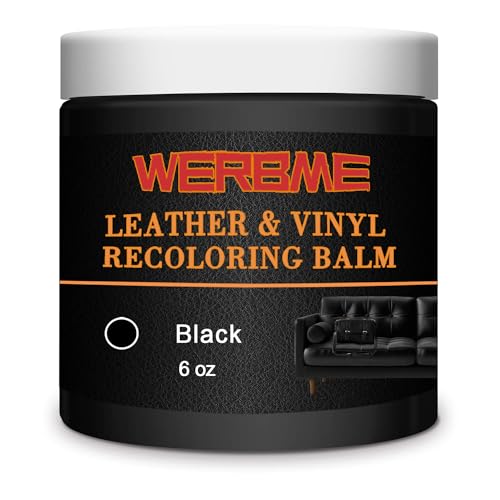
WERBME Leather Recoloring Balm - Leather & Vinyl Repair Balm for Furniture, Couches,Car Seats, Auto Interior & Accessories, Restores Faded, Worn, Scratched and Cracked Leather Surfaces(Black)
Included for 'Best Vinyl Dye for Car Interior Restoration' because the listing specifies Leather & Vinyl Repair Balm for Furniture and Couches, details this guide uses to compare options.
View on AmazonLeather and vinyl damage is usually local: a scuffed bolster, a cracked panel on the side of a seat, a worn patch where a driver slides in and out, a faded armrest edge. WERBME’s Leather Recoloring Balm is aimed squarely at that scale of problem. It is a hand-applied balm for leather and vinyl, sold at a budget tier, and it suits the owner who wants to darken and disguise small wear areas without spraying anything.
Key specs
- Format: balm, hand-applied with a cloth, sponge or applicator
- Named substrates: leather and vinyl
- Color: black
- Typical uses: car seats, auto interiors, furniture and couches
- Application surface: small to medium wear areas, seams and edges
Strengths
Control is the advantage. A balm goes exactly where you put it. On a seat with light-colored stitching, a perforated panel, or a two-tone design, that precision is essential — an aerosol dye will color the stitching along with the leather, and there is no clean way back. With a balm you can work color into the leather grain and leave the thread alone.
Balm also penetrates rather than sits on top. On dry, slightly porous leather that has lost its surface pigment, a balm can restore depth in a way that a film-forming coating cannot, because it moves into the fiber rather than bridging over it. On vinyl it behaves more like a surface colorant, but it still applies evenly with hand pressure and a little working time.
The practical benefit is that it requires no masking, no ventilation setup and no drying equipment. You can do a scuffed bolster in ten minutes in a garage with the doors open. That makes it the natural first purchase for someone who has one visible problem area and no interest in a full restoration project.
Pros
- Precise application — color stays off stitching and perforations
- No overspray, so no masking of glass, paint or adjacent panels
- Budget tier and usable on leather, vinyl and furniture leather
- Works into grain and small cracks rather than bridging over them
Cons
- Impractical for large areas — a full seat takes real time and elbow work
- Hand-applied balms can leave a slightly uneven tone on big flat panels
- Not a filler; deep cracks still need a repair compound before color
How it compares
The direct alternative is STARTSO WORLD Leather Recoloring Balm, another budget-tier hand-applied black balm for leather. Both solve the same problem the same way, and the difference between them is largely formulation and kit contents rather than approach — if one is unavailable, the other fills the role. If your wear is more extensive, or you need colors other than black, step up to the ApexShine Leather Repair Kit, which includes leather dye and vinyl repair materials in a 10-color range and gives you far more matching capability at a still-budget price.
6. 3D Leather, Vinyl & Plastic Conditioner – Best for Maintaining Interiors That Are Still Healthy

3D Leather, Vinyl & Plastic Conditioner | Restores, Conditions & Protects Car Interiors | Non-Greasy UV Protection for Seats, Steering Wheels, & Trim |16 oz
Included for 'Best Vinyl Dye for Car Interior Restoration' because the listing specifies Vinyl & Plastic Conditioner and Restores, details this guide uses to compare options.
View on AmazonThis is the product that belongs in the routine, not the rescue. 3D’s conditioner is listed for leather, vinyl and plastic, and is positioned as restoring, conditioning and protecting car interiors with a non-greasy finish and UV protection. It suits the owner whose seats and dash are still in decent shape and who wants to keep them that way — which is, statistically, the cheapest possible approach to interior restoration, because conditioned surfaces fade far more slowly than neglected ones.
Key specs
- Format: liquid conditioner, wipe-on
- Named substrates: leather, vinyl, plastic
- Finish: non-greasy — does not leave a slick or wet look
- Protection: UV protection claimed on the listing
- Positioning: maintenance rather than color restoration
Strengths
The non-greasy claim is the practical one. Many conditioners leave a sheen that makes a leather seat look wet and makes a plastic dash reflect sunlight into the driver’s eyes. A non-greasy formula dries down to a natural, factory-adjacent finish, which is what you want on a dashboard and a steering wheel — surfaces where a slick residue is an actual driving hazard, not just an aesthetic problem.
UV protection is the second reason it earns a place here. Interior fading is a sunlight problem. Dash tops, rear parcel shelves, the top of the rear seat back and the outboard bolsters all take direct UV through the glass, and they are consistently the first areas to gray, crack or chalk. A conditioner applied every couple of months slows that process measurably, and it is far less work than dyeing the same surfaces later.
Because it covers leather, vinyl and plastic, one bottle handles the whole cabin — seats, dash, door cards, console, even rubber seals at a push. That simplicity is why it works as a routine product: a single bottle on the shelf gets used, whereas three specialized bottles do not.
Pros
- Non-greasy finish suits dashboards and steering wheels where slickness is a problem
- UV protection targets the exact cause of interior fading
- One bottle covers leather, vinyl and plastic across the whole cabin
- Cheapest long-term route — prevention costs less than restoration
Cons
- Will not restore color that has already worn through
- Requires regular reapplication to be effective
- Not a solution for cracks, tears or scuffs, which need a repair product
How it compares
Against CAR GUYS Plastic Restorer, this is a maintenance product rather than a corrective one: CAR GUYS darkens plastic that has already faded, while 3D slows the fading in the first place. Used together they cover both halves of the problem. Against WERBME Leather Recoloring Balm, the distinction is prevention versus correction — the balm adds color to worn leather, the conditioner protects leather that still has its color. If your interior is already badly faded, start with a color product and add a conditioner afterward to protect the result.
7. Detail King Hi-Tech Black Vinyl Plastic & Carpet Aerosol Dye – Best for High-Volume Black Restoration

Detail King Hi-Tech Black Vinyl Plastic & Carpet Aerosol Dye
Included for 'Best Vinyl Dye for Car Interior Restoration' as a relevant option in this category; details come from the product listing.
View on AmazonThis is the professional-leaning aerosol in the group: a black dye from Detail King, listed for vinyl, plastic and carpet. It suits the restorer who is doing this repeatedly — a detail shop, a flipper working through several cars, or an enthusiast with a project car plus a daily driver — and who wants a consistent, high-solids black that behaves predictably across a mixed set of surfaces. It sits at a premium tier, and the justification is volume and repeatability rather than a single-can experiment.
Key specs
- Format: aerosol dye
- Named substrates: vinyl, plastic and carpet
- Color: black
- Positioning: professional and high-volume detailing use
- Result: permanent color rather than a dressing
Strengths
The substrate list — vinyl, plastic and carpet — is the key detail. Carpet is the odd one out in most dye lineups. Floor carpet and floor mats take the worst of interior wear: foot traffic, grit, spilled drinks, and sun through the rear glass on the parcel shelf carpet. A dye that handles carpet alongside vinyl and plastic means a restorer can address the entire lower cabin without switching products, which is exactly what a shop wants.
Professional positioning usually implies a formulation built around high solids and consistent output. In practice that means fewer coats to reach full opacity, less risk of a streaky first pass, and a more predictable color from can to can — all of which matter when you are doing the same job repeatedly and your reputation depends on the result looking the same every time.
It also pairs naturally with the rest of a detailing workflow. A shop already has carpet cleaning, extraction and trim dressing products; adding a single aerosol dye that covers three substrates keeps the consumables list short and the process repeatable.
Pros
- Covers vinyl, plastic and carpet with one aerosol
- Professional orientation suits repeat and high-volume work
- Permanent black rather than a dressing that fades
- Short consumables list — no reducer, gun or compressor
Cons
- Premium tier pricing is harder to justify for a one-off single panel
- Black only, so it is useless for tan, gray or colored interiors
- Aerosol coverage still limits how much carpet you can do per can
How it compares
The obvious comparison is HI-TECH Big Can Black Spray Dye. Both cover a broad substrate range, but the HI-TECH listing adds fabric and upholstery, while Detail King focuses on vinyl, plastic and carpet and positions itself for pro use. For a single interior, HI-TECH is the better buy. For someone dyeing multiple cars a month, Detail King’s professional orientation and repeatability are the reason to pay more. Against SEM Color Coat, the split is aerosol convenience versus bulk color-matching: Detail King is faster to start, SEM gives you a gallon and a true color-match workflow.
8. STARTSO WORLD Leather Recoloring Balm – Best for DIY Leather Color Touch-Up

STARTSO WORLD Leather Recoloring Balm, Black Leather Repair Kit for Furniture, Leather Dye, Leather Color Restorer for Couches, Leather Couch Paint | Repair, Restore Faded & Scratched Leather
Included for 'Best Vinyl Dye for Car Interior Restoration' because the listing specifies Black Leather Repair Kit for Furniture and Leather Dye, details this guide uses to compare options.
View on AmazonA budget-tier black leather recoloring balm sold as a repair kit for furniture, leather and car seats. It is the direct functional twin of the WERBME balm: hand-applied, black, aimed at worn and scuffed leather, and intended for someone who wants to fix a visible problem without buying spray equipment. It suits the DIY owner with a scuffed driver’s bolster, a worn armrest, or a leather couch that has gone shiny and pale at the contact points.
Key specs
- Format: balm, hand-applied
- Color: black
- Named substrate: leather, with vinyl applications typical of the category
- Typical uses: car seats, furniture and couches, leather goods
- Positioning: budget-tier DIY touch-up
Strengths
The core value is that it lets you address leather wear without a spray setup, masking, or ventilation planning. Leather seats in older cars typically fail in predictable places: the outer bolster where you slide across it, the seam where the side panel meets the cushion, the top of the rear seat back where UV hits. All of those are small, localized areas, and a balm is exactly the right tool for localized work.
Black is also the most forgiving color to touch up by hand. On a black leather seat, a hand-applied balm blends into surrounding grain and looks natural even if the coverage is slightly uneven, because there is no hue shift to betray you. The same job in tan or gray demands far more precision, which is why black balms dominate this category.
The budget tier makes it a low-risk purchase. If the balm does not produce the result you want, you have spent very little and learned whether hand application suits your interior before investing in a kit or a spray system.
Pros
- No overspray, no masking, no ventilation setup
- Precise enough to work around stitching and perforations
- Black hides minor application unevenness on black leather
- Usable on car seats and household leather furniture alike
Cons
- Slow going on large panels; a full seat is a real time commitment
- Will not fill cracks or tears — those need a repair compound first
- Black only, so no matching for tan, gray or brown interiors
How it compares
Against WERBME Leather Recoloring Balm, this is close to a coin flip — both are budget black balms for leather and vinyl, and the practical difference comes down to formulation and applicator contents. Against the ApexShine Leather Repair Kit, STARTSO is the simpler, cheaper option for one black touch-up, while ApexShine costs more but adds 10 colors and vinyl repair materials, making it the better buy if you need matching or you have a tear rather than just wear.
9. SM Arnold Refinishing Spray Paint – Beige, 11 oz – Best for Non-Black Color Matching

SM Arnold Refinishing Spray Paint - BEIGE 11 Oz. - For Leather, Carpet, Vinyl, Metal, Plastic, Polycarbonate, Polypropylene, Acrylic, Lexan, Fiberglass | Pro Grade Aerosol Refinisher, 11 Ounce (Pack of 1)
Included for 'Best Vinyl Dye for Car Interior Restoration' because the listing specifies BEIGE 11 Oz. and For Leather, details this guide uses to compare options.
View on AmazonMost of this list is black, because most interior restoration is black. This product exists for the rest of the market. SM Arnold’s refinishing spray is an 11 oz aerosol in beige, and its substrate list is unusually broad: leather, carpet, vinyl, metal, plastic and polycarbonate. It suits the restorer with a tan, beige or cream interior — a common palette in 1990s and 2000s domestic cars, trucks and minivans — who cannot use any of the black products above.
Key specs
- Format: aerosol, 11 oz
- Color: beige
- Named substrates: leather, carpet, vinyl, metal, plastic, polycarbonate
- Application: spray in light coats
- Positioning: color refinishing rather than a dressing
Strengths
The substrate range is the standout feature. Metal and polycarbonate are unusual additions to an interior refinishing spray, and they broaden where the can is useful — seat frames, brackets, plastic lenses, trim bezels. Polycarbonate in particular is difficult to coat, because many solvents attack it; a product that names it on the label is formulated with that compatibility in mind.
Beige is a genuinely useful shade to have in a restoration lineup. Tan and beige interiors show wear differently from black: they go pale, chalky and shiny at the same time, and the contrast between worn and unworn areas is far more visible because the color is light. A beige refinishing spray lets you even out a faded door panel or a scuffed kick panel without attempting to dye the whole interior black, which would be a drastic change on a beige car.
The 11 oz format keeps it manageable for panel-level work, and it sprays like a conventional refinishing aerosol — thin coats, short flash time, build gradually.
Pros
- Beige color covers an interior palette the black products cannot touch
- Broad substrate list including leather, metal and polycarbonate
- Useful beyond interiors — brackets, bezels and trim hardware
- Aerosol convenience with no mixing or spray gun
Cons
- Light colors show uneven coverage and overlap marks more than black
- 11 oz can is small for anything beyond a panel or two
- A single beige shade will not match every tan or cream interior exactly
How it compares
Its nearest alternative is SEM Color Coat, which is also aimed at color matching but arrives as a 1 gallon liquid for spray-gun application and in a specific shade (Yellow Oxide) rather than an aerosol beige. SEM gives you bulk, consistency and a flexible coating chemistry; SM Arnold gives you a can you can shake and spray today. If your beige interior needs one panel corrected, buy the aerosol. If it needs a full set of panels in a matched shade, the gallon route is more controllable. For black work, none of these beat the HI-TECH Big Can.
10. SEM Color Coat Plastic & Vinyl Flexible Coating, Yellow Oxide, 1 Gallon – Best for Flexible, Color-Matched Large Areas

Color Coat - Plastic & Vinyl Flexible Coating, Yellow Oxide, 1 Gallon
Included for 'Best Vinyl Dye for Car Interior Restoration' because the listing specifies Plastic & Vinyl Flexible Coating and Yellow Oxide, details this guide uses to compare options.
View on AmazonSEM Color Coat is the serious option: a plastic and vinyl flexible coating in a 1 gallon container, listed in Yellow Oxide. It is not a rattle can and it is not a restorer. It is a bulk coating designed to be sprayed through a gun, and its defining property is flexibility — it moves with the vinyl or plastic underneath rather than cracking when the material flexes. It suits the restorer doing a full interior color change or a large-area match, and it sits at the premium tier because both the product and the equipment are a real investment.
Key specs
- Format: liquid coating, 1 gallon container
- Application: spray gun — typically requires reduction and a compatible flexible additive per the maker’s technical data sheet
- Named substrates: plastic and vinyl
- Color: Yellow Oxide
- Key property: flexible coating that moves with the substrate
Strengths
Flexibility is not a marketing word here; it is the difference between a job that lasts and a job that cracks. Vinyl seat bolsters, dash pads and door panel inserts flex every time someone gets in the car. A rigid coating sprayed onto a flexible substrate develops hairline cracks along the flex lines within a season or two, and once cracked it cannot be repaired invisibly — the whole panel has to be stripped and redone. A flexible coating is engineered to bend with the substrate instead.
Bulk quantity is the second advantage. A gallon is roughly 128 fl oz, and category estimates put a ready-to-spray coating of this type at roughly 150–250 sq ft of coverage at a 2-mil dry film, depending on reduction and spray technique. Compare that with an aerosol at roughly 10 sq ft per coat. For a full interior — dash, console, four door panels, kick panels and trim, easily 40–60 sq ft requiring two or three coats — the gallon is not just cheaper per square foot, it is the only practical way to keep one continuous batch of color across every panel.
Spray-gun application also gives you control an aerosol cannot: adjustable fan pattern, adjustable fluid flow, and the ability to blend a repair area into a surrounding panel invisibly.
Pros
- Flexible chemistry resists cracking on vinyl and plastic that flexes
- 1 gallon covers a full interior set of panels from one consistent batch
- Spray-gun control allows invisible blending and even, adjustable coats
- Far lower cost per square foot than aerosols on large jobs
Cons
- Requires a spray gun, compressor, reducer and proper ventilation
- Premium tier — a significant outlay before you spray anything
- One specific shade per container, so matching requires care and possibly custom mixing
How it compares
Against SM Arnold Refinishing Spray Paint, the trade is scale and control versus simplicity. SEM is the better choice for a full interior or any panel that flexes; SM Arnold is the better choice for one beige panel and no equipment. Against Detail King Hi-Tech Aerosol Dye, the split is the same: aerosols win on setup time, bulk coating wins on cost per square foot, batch consistency and flexibility on large, moving panels. If you are doing one car and you own a gun already, SEM is the professional-grade answer.
11. ApexShine Leather Repair Kit for Car Seats, 10 Colors – Best for Multi-Color DIY Leather and Vinyl Repair

Leather Repair Kit for Car Seats, Leather Dye & Vinyl Repair, 10 Colors
Included for 'Best Vinyl Dye for Car Interior Restoration' because the listing specifies Leather Dye & Vinyl Repair and 10 Colors, details this guide uses to compare options.
View on AmazonThe only multi-color product on this list. ApexShine’s kit bundles leather dye and vinyl repair materials across 10 colors, at a budget tier, and it exists to solve the problem that defeats single-shade products: matching. If your interior is gray, tan, brown, burgundy or any shade other than black, a kit with a color range is the only realistic DIY path to a repair that does not announce itself. It suits the owner with a specific damaged area — a scuff, a small tear, a worn patch — who needs the repair to disappear rather than simply be covered.
Key specs
- Format: kit — leather dye plus vinyl repair materials
- Colors: 10-color range
- Named substrates: leather and vinyl
- Typical uses: car seats, automotive interior leather and vinyl
- Positioning: budget-tier DIY repair
Strengths
Color range is the entire value proposition. Ten colors means you can blend toward a match rather than accepting the nearest single shade. On a gray leather seat, the difference between a repair that matches and one that does not is usually a small adjustment in warmth or depth, and having multiple pigments lets you make that adjustment. This is why kits of this type are common in furniture and auto leather repair — matching is the hard part, not applying the color.
Bundling vinyl repair with leather dye is the second advantage. Real interior damage rarely respects material boundaries. A seat bolster tear may run through a leather panel and into a vinyl side panel, or a console lid may be vinyl while the surrounding trim is leather. A kit that covers both means one purchase handles the whole repair area, including any filler or patch material needed to bridge a tear before color is applied.
At a budget tier, it is also the most economical way to own a color range. Buying ten individual dye shades separately would cost many times more.
Pros
- 10 colors allow blending toward a real match on non-black interiors
- Covers both leather and vinyl, so one kit handles mixed damage
- Budget tier despite the color range
- Repair-oriented — suited to tears and scuffs, not just fading
Cons
- Matching a specific factory color by eye takes patience and test patches
- Small quantities per color, so large-area work will exhaust the kit
- Hand application is slower than spraying for anything beyond a localized repair
How it compares
Against the single-shade balms — WERBME and STARTSO WORLD — ApexShine is the better buy whenever your interior is not black, because those balms offer no matching capability at all. If your interior is black and the damage is simple wear, a single black balm is faster and cheaper. If you have an actual tear rather than faded color, the kit’s repair materials make it the only sensible choice in this group.
How to Choose
The single biggest determinant of success is not the brand you buy — it is whether you correctly identified the material you are coating. Interior dye failures are overwhelmingly compatibility failures, not application failures. Work through the following in order.
Step 1: Identify the material, precisely
Automotive interiors use five materials, and they behave differently:
- Vinyl (PVC): dash pads, door panel inserts, seat side panels, headliners in older cars. Takes dye well, flexes, and needs a flexible coating if the panel moves.
- Hard plastic (ABS, polypropylene, polycarbonate): consoles, kick panels, pillar trim, seat-side trim, bezels. The hardest group to coat. Many need a dedicated adhesion promoter before any coating will bond.
- Leather and coated leather: seat facings, steering wheel rims, shift boots. Needs a leather-specific colorant — coatings that work on vinyl often crack on leather, and vice versa.
- Fabric: cloth seat inserts, headliners, pillar wraps
Affiliate disclosure. As an Amazon Associate we earn from qualifying purchases at no extra cost to you. Prices accurate as of the date shown.Best Vinyl Dye for Car Interior RestorationCheck price on Amazon




Write Your Review
No reviews yet. Be the first to share your experience!