
Our Top Picks
The best monoculars for most travelers and hikers are compact 8×32 or 8×36 models, while wildlife observers who regularly watch at longer distances should choose a brighter 8×42 or 10×42 model.
Quick picks by situation
| Use case | Best specification | Why it works | Typical market range in 2026 |
|---|---|---|---|
| Light travel and city sightseeing | 6x to 8x, 20–25 mm objective, under 200 g | Small enough to carry every day and quick to steady | $30–$150 |
| General hiking | 8x, 30–36 mm objective, 250–400 g | Good balance of brightness, field of view, and pack weight | $60–$250 |
| Birding and wildlife | 8x or 10x, 42 mm objective, ED glass preferred | Better edge detail and low-light performance at dawn and dusk | $150–$700 |
| Rainy or coastal trips | Nitrogen-purged, sealed, waterproof construction | Resists internal fogging and accidental immersion | $100–$700 |
| Tracking or range work | 8x with a reticle or ranging scale | Useful for estimating distance and observing terrain features | $100–$300 |
What the numbers mean
Magnification: 8x is the safest starting point
An 8x monocular makes a subject appear eight times closer than it does to the unaided eye. It is easier to hold steady than 10x, usually offers a wider view, and remains useful in forests, streets, and mountain landscapes. That makes 8x the best general-purpose choice for most people.

TOPDON TS004 Thermal Imaging Monocular, 13mm 50Hz Night Vision
Chosen because it specifies 13mm 50Hz Night Vision.
View on Amazon
TOPDON TS004 Pro Thermal Imaging Monocular, 19mm 50Hz Night Vision
Chosen because it specifies 19mm 50Hz Night Vision.
View on AmazonChoose 10x when you frequently watch distant animals across open water, plains, or valleys. The extra magnification can reveal more detail, but hand shake becomes more noticeable and the field of view is normally narrower. Magnification above 10x is difficult to use comfortably without support and is rarely the best travel choice.
Objective size: brightness versus bulk
The objective is the front lens. A 25 mm objective keeps a monocular exceptionally compact, but it gathers less light than a 36 or 42 mm lens. A 42 mm model is more comfortable around sunrise, sunset, and heavily shaded woodland, although it adds weight and occupies more space.
For a simple comparison, the geometric light-gathering area is proportional to the square of the objective diameter. A 42 mm lens has about 2.8 times the area of a 25 mm lens (42² ÷ 25²). Real-world brightness also depends on glass quality, coatings, pupil size, and your eyes, so this is not a direct brightness guarantee.
Field of view: especially important for moving animals
Field of view is commonly listed as the width visible at 1,000 yards or in degrees. A wider view makes it easier to find a bird after it flies from a branch and gives a more relaxed impression when scanning a trail. Higher magnification and compact optical designs often reduce field of view.
As a practical target, look for roughly 6–8 degrees, or about 315–420 feet at 1,000 yards, for an 8x model. A 10x monocular with a field of view near 5 degrees can still be excellent for distant observation, but it requires more deliberate aiming.
Close focus: a hidden advantage for travel
Close-focus distance determines how near an object can be while remaining sharp. A distance of 5–6 feet is useful for butterflies, flowers, museum details, and nearby birds. Models that focus only from 15–20 feet away may be fine for landscapes but feel limiting on a general trip.
Head-to-head: compact versus full-size monoculars
| Characteristic | Compact 8×25 class | Mid-size 8×32/8×36 class | Full-size 8×42/10×42 class |
|---|---|---|---|
| Typical weight | 120–220 g | 250–400 g | 350–650 g |
| Typical length | 90–115 mm | 125–155 mm | 145–180 mm |
| Low-light comfort | Fair in daylight; limited at dusk | Good for most daytime hiking | Best in shade, dawn, and evening |
| Typical field of view | 5.5–7 degrees | 6–8 degrees | 5–7.5 degrees |
| Typical close focus | 2–10 feet | 4–10 feet | 6–15 feet |
| Packability | Excellent | Very good | Moderate |
A compact model is the right choice if it will otherwise remain at home. A slightly heavier monocular that is actually carried will outperform a larger instrument left in a suitcase. For regular wildlife watching, however, the larger exit pupil of an 8×42 or 10×42 can make the view more comfortable and forgiving.
Optical coatings and low-light performance
Look for fully multi-coated optics, meaning multiple anti-reflective coating layers are applied to air-to-glass surfaces. These coatings improve light transmission, contrast, and resistance to flare. “Coated” or “multi-coated” without the word “fully” may indicate a less complete treatment.
Extra-low-dispersion glass, often labeled ED glass, helps control color fringing around high-contrast edges such as a bird against a bright sky. ED glass does not automatically make a monocular sharper; lens design, alignment, and quality control still matter. It is most worthwhile for wildlife viewing and detailed landscapes.
For low-light use, compare exit pupil as well as objective size. Divide objective diameter by magnification: an 8×42 produces a 5.25 mm exit pupil, while a 10×25 produces only 2.5 mm. The larger exit pupil generally makes the view easier to align and more comfortable in dim conditions, though it cannot create detail that the optics do not resolve.
Notable choices by design
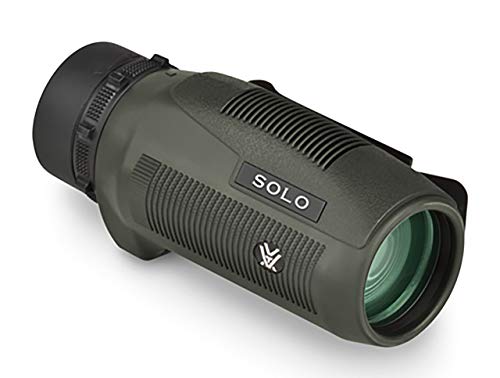
Vortex Solo 8×36
The Vortex Solo 8×36 represents the practical mid-size format: more useful in shade than a pocket 8×25 and still manageable for hiking. The rubber-armored body and simple focus system suit general outdoor use. It is a sensible choice when durability and moderate weight matter more than premium edge sharpness.
Vortex Solo 10×25
This compact option favors portability and reach over low-light performance. It fits a jacket pocket and works well for landmarks, daytime sightseeing, and occasional trail use. Its small objective makes steady positioning and good daylight essential, especially at 10x.
Vortex Solo R/T 8×36
The R/T version adds a reticle intended for observation and range estimation. That feature is useful for terrain, fieldwork, and tracking distances, but unnecessary for ordinary sightseeing. Choose it when the reticle solves a real task rather than because more markings appear sophisticated.
Leica Monovid 8×20
The Leica Monovid 8×20 is a premium pocket monocular aimed at travelers who want high-quality construction in a very small format. Its compact objective is best suited to daylight, while its close-focus capability can be valuable for nearby details. The premium price makes sense mainly when minimum size, finish, and optical refinement are priorities.
Hawke Endurance ED 8×42
An ED 8×42 design such as the Hawke Endurance ED emphasizes brightness and detail for birding and wildlife. It is less pocketable than a compact monocular but better suited to long observation sessions, changing weather, and shaded habitats. Check the exact generation for its supplied case, dimensions, and waterproof rating.
Waterproofing and durability: what survives real use
Water-resistant is not the same as waterproof. For hiking, look for a stated waterproof rating, sealed housing, and nitrogen or argon purging. Purging helps prevent internal fog when moving between warm and cold environments; it does not stop external lenses from fogging.
Rubber armor protects against minor knocks and improves grip, but it can scuff, loosen, or become tacky after years of heat and sunscreen exposure. Focus wheels and eyecups are common wear points. A stiff or gritty focus wheel is a warning that dirt or moisture has entered the mechanism.
Use the neck lanyard, keep the objective cap attached when practical, and store the monocular dry rather than sealed in a wet pouch. Never leave it on a hot dashboard. Heat can damage lubricants, adhesives, coatings, and rubber components.
Cleaning and setup that preserve the view
- Remove loose grit first. Use a blower or soft lens brush. Wiping sand across the lens can create scratches.
- Clean fingerprints with lens-safe fluid. Apply fluid to a microfiber cloth, not directly into the housing.
- Set the eyecup position. Eyeglass wearers generally fold or twist eyecups down; non-eyeglass users usually extend them until the full field is visible.
- Focus at a distant subject. Use the main focus control slowly, then fine-tune rather than forcing the wheel.
- Check the strap and caps. A secure attachment prevents the most expensive form of damage: a drop onto rock.
Avoid household glass cleaner, shirt sleeves, compressed air held too close, and repeated cleaning when the lens is merely dusty. A few particles are less harmful than aggressive wiping.
Bottom line
Choose an 8×25 if size determines whether you carry it, an 8×32 or 8×36 for the best hiking balance, and an 8×42 or 10×42 for serious wildlife observation and dim conditions. Prioritize fully multi-coated optics, a useful field of view, close focus under 10 feet, and sealed waterproof construction before chasing maximum magnification. The best monoculars are the ones whose optical strengths match your landscape, light, and carrying habits.




Write Your Review
No reviews yet. Be the first to share your experience!