
Key takeaways
- Adjustable thermostat: Look for a control that lets you maintain a stable freezer temperature rather than a vague low, medium, and high dial.
- Temperature alarm: Helpful in a detached garage, especially if a tripped breaker or poorly closed lid could go unnoticed.
- Power-on indicator: A basic light can reveal that the outlet has power, although it does not confirm that the food is cold.
- Removable baskets: Essential on chest models for separating frequently used food from long-term storage.
- Lock: Useful for households with children or for preventing accidental lid opening, but never treat it as a substitute for safe installation.
- Door-open clearance: Upright doors may need several extra inches beside the cabinet to open fully and allow drawers to slide out.
The best garage freezers for 2026 are garage-ready uprights or chest freezers rated for the temperature swings in your space, with enough usable capacity to avoid overpacking and energy use you can afford year-round.
Quick picks by garage and shopping situation
| Situation | Best choice | Useful target | Why it fits |
|---|---|---|---|
| Small garage or apartment storage | Compact garage-ready upright | 5–8 cu. ft.; 24–28 in. wide | Uses less floor space and keeps food visible |
| Lowest purchase cost and maximum bulk capacity | Chest freezer | 7–14 cu. ft.; about 33–48 in. wide | Usually offers good capacity per dollar and efficient cold retention |
| Frequent access to organized food | Full-size upright | 14–21 cu. ft.; roughly 30–34 in. wide | Shelves and bins make inventory easier to manage |
| Unheated garage with severe winter cold | Freezer specifically rated for low ambient temperatures | Confirm operation near 0°F, or the maker’s stated minimum | Reduces the risk of poor cycling or temperature alarms in winter |
| Hot garage in a warm climate | Garage-ready unit with a high ambient rating | Confirm operation at 100–110°F if applicable | Designed to keep running when the surrounding air is hot |
What “garage-ready” should mean
Garage-ready is more than a marketing phrase about durability. A suitable freezer is designed to operate across a wider ambient-temperature range than a standard indoor appliance. Depending on the model, the approved range may be approximately 0°F to 110°F, while some units have a narrower minimum or maximum. Check the installation section of the product manual before buying because the exact rating differs by model.
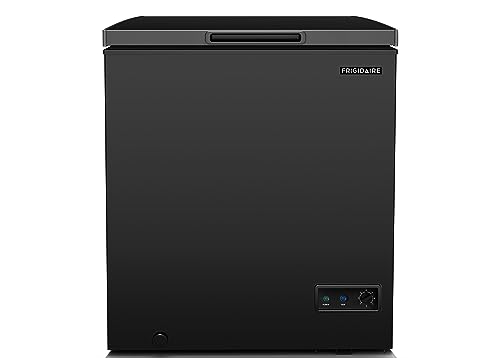
FRIGIDAIRE EFRF5003-BLACK Chest Deep Freezer-Garage-Ready, 5.0 Cu. Ft. Capacity, Black-Adjustable Thermostat-Removable Vinyl Coated Wire Basket-Easy Defrost Drain
Included for 'Best Garage Freezers for Extra Food Storage' because the listing specifies 5.0 Cu. Ft. Capacity, details this guide uses to compare options.
View on Amazon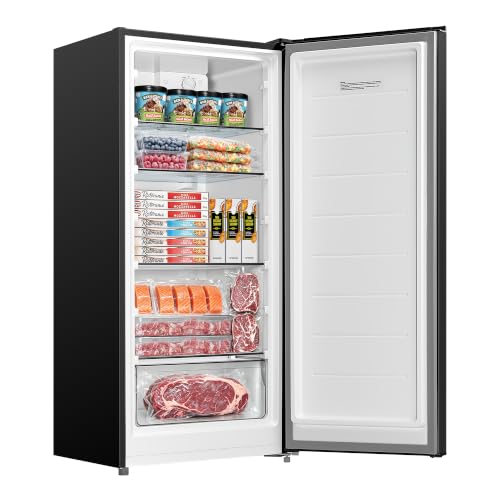
Midea 7.1 Cu.ft Upright Freezer, Fridge Freezer Convertible, Black
Included for 'Best Garage Freezers for Extra Food Storage' because the listing specifies Fridge Freezer Convertible and Black, details this guide uses to compare options.
View on Amazon
Midea 3.5 Cu.ft Chest Freezer, Fridge Freezer Convertible with LED Light
Included for 'Best Garage Freezers for Extra Food Storage' because the listing specifies Fridge Freezer Convertible with LED Light, details this guide uses to compare options.
View on Amazon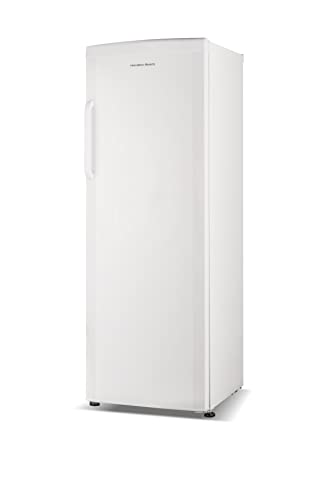
Hamilton Beach HBFRF1100, 11 cu ft, Upright Freezer, White
Included for 'Best Garage Freezers for Extra Food Storage' because the listing specifies 11 cu ft and Upright Freezer, details this guide uses to compare options.
View on AmazonCold weather can be surprisingly troublesome. In an unheated garage, the air around the freezer may fall below the appliance’s intended operating range. The compressor may run less often, and some freezer designs can allow food to warm even though the surrounding garage feels cold. In extreme heat, the compressor runs longer, energy use rises, and inadequate ventilation can shorten component life.
A garage-ready freezer does not make an uninsulated garage harmless. Keep the cabinet out of direct sun, leave the manufacturer’s required clearance around it, and avoid placing it beside a water heater, furnace, dryer vent, or other heat source.
Upright versus chest: the access decision
Choose an upright when access matters most
Upright freezers open from the front and use shelves, drawers, or door storage. That makes them the better choice if you retrieve small items often, rotate frozen meals, or want to see what you own without moving several packages. They also occupy less floor area for a given footprint, although they typically lose more cold air whenever the door opens.
Many upright freezers use manual defrost, which can reduce purchase price and sometimes simplify the design. Frost builds up gradually, however, so expect to empty and defrost the cabinet when ice becomes thick enough to restrict storage or prevent the door from sealing.
Choose a chest freezer when efficiency and bulk storage lead
Chest freezers open from the top, so cold air tends to remain inside rather than spilling onto the floor. They are often efficient choices for long-term storage of meat, garden produce, and large packages. Baskets help with frequently used items, but food at the bottom can disappear from your inventory.
A chest freezer is a poor fit if you have limited lifting ability, need quick access, or frequently store differently sized packages. Before buying, measure both the footprint and the lid’s opening path. A freezer that fits between two walls may still be unusable if the lid cannot open fully.
Capacity: buy usable space, not just the advertised number
Manufacturers quote interior volume in cubic feet, but baskets, shelves, drawer rails, evaporator housings, and rounded corners reduce the space you can actually load. As a practical planning estimate, allow roughly 1 cubic foot for every 30–35 pounds of food, depending on packaging and how efficiently you stack it. This is only a storage guideline, not a food-safety rule.
A 7-cubic-foot chest freezer may suit a small household that buys occasional bulk items. A 14–16-cubic-foot unit is more appropriate for regular bulk shopping or seasonal harvests. Households storing large quantities of boxed food may prefer a 17–21-cubic-foot upright, provided the garage has enough depth and the electrical circuit can support it.
Do not fill every gap immediately. A freezer works best when reasonably full, but tightly compressing packages can block air circulation and make inventory difficult. Leave the clearance specified in the manual around vents and interior walls.
Energy use and a simple operating-cost estimate
The yellow EnergyGuide label gives an estimated annual electricity use in kilowatt-hours. To estimate cost, multiply that figure by your electricity rate:
Annual cost = annual kWh × electricity price per kWh.
For example, a freezer labeled at 420 kWh per year would cost about $71 annually at $0.17 per kWh: 420 × $0.17 = $71.40. Actual use can be higher in a hot garage, during frequent door openings, or when the cabinet has poor ventilation. It can also vary with the freezer’s size, insulation, compressor design, and defrost system.
Manual-defrost models often have lower listed energy use than automatic-defrost models because they do not periodically heat the evaporator to remove frost. Automatic defrost is more convenient but may consume more electricity and can add another control or heater component. Compare annual kWh rather than assuming that a smaller-looking appliance is always cheaper to operate.
Temperature control, alarms, and useful features
- Adjustable thermostat: Look for a control that lets you maintain a stable freezer temperature rather than a vague low, medium, and high dial.
- Temperature alarm: Helpful in a detached garage, especially if a tripped breaker or poorly closed lid could go unnoticed.
- Power-on indicator: A basic light can reveal that the outlet has power, although it does not confirm that the food is cold.
- Removable baskets: Essential on chest models for separating frequently used food from long-term storage.
- Lock: Useful for households with children or for preventing accidental lid opening, but never treat it as a substitute for safe installation.
- Door-open clearance: Upright doors may need several extra inches beside the cabinet to open fully and allow drawers to slide out.
A separate freezer thermometer is inexpensive insurance. Place it where it represents the stored food, not directly against a wall or in the warmest door area. If your model supports an alarm, set it according to the manual rather than choosing an unnecessarily sensitive threshold that creates nuisance alerts.
Installation checklist for seasonal performance
- Measure the route first. Record the doorway, stairway, garage bay, and final location. Include the appliance’s packaging dimensions if delivery is required.
- Use a grounded outlet. Follow the manual’s electrical requirements, and avoid extension cords or power strips unless the manufacturer explicitly permits them.
- Level the cabinet. An uneven freezer can stress the door or lid seal and may prevent an upright door from closing correctly.
- Provide ventilation clearance. Maintain the specified space around the back, sides, and top. Compressor heat must escape into the garage.
- Allow it to settle after moving. Keep the freezer upright for the period stated in the manual before powering it on, particularly if it was transported on its side.
- Pre-cool before loading. Let the cabinet reach its target temperature first, then load food in manageable batches instead of adding a large warm mass all at once.
- Check the seal. Close the door or lid on a sheet of paper. If it pulls out with almost no resistance at several points, inspect the gasket and cabinet alignment.
Defrosting and ownership realities
Manual defrosting is the main maintenance task. When frost approaches roughly 1/4 inch, transfer food to another freezer or insulated coolers, unplug the appliance, and let the ice melt naturally. Put towels around the base to catch water. Never chip ice with a knife or heat it with an open flame; both can damage the liner or create a safety hazard.
Clean spills promptly with mild soap and water, then dry the interior before restarting. Vacuum dust from accessible condenser areas when the manual allows it. A dirty condenser, blocked airflow, damaged gasket, or freezer packed against a wall can cause long run times and higher electricity use.
The parts most likely to create ownership problems are door or lid gaskets, hinges, baskets, thermostat controls, and the compressor-start components. A basket is usually inexpensive to replace; a sealed-system or compressor repair may not be economical on a basic unit. Keep the model and serial information, warranty documents, and manual where you can find them before a problem occurs.
Bottom line
The best garage freezers match the climate, access pattern, and available floor space rather than simply offering the largest advertised capacity. Choose a garage-ready upright for organized, frequent access; choose a chest freezer for efficient bulk storage and strong cold retention; and prioritize a verified ambient-temperature range when your garage becomes very hot or very cold. Compare usable layout, annual kWh, defrost requirements, clearance, and serviceability together, then select the smallest unit that comfortably handles your real storage routine.




Write Your Review
No reviews yet. Be the first to share your experience!