
Key takeaways
- Solid wood: Usually repairable and warm-looking, but it can dent, expand, or contract with humidity. Use coasters and wipe spills promptly.
- Veneer: Gives a real-wood surface at a lower cost. Water that reaches a damaged edge can cause bubbling, so avoid standing moisture.
- Laminate or melamine: Easy to wipe and often inexpensive. Damaged corners are difficult to repair, and swollen particleboard cannot usually be restored.
- Tempered glass: Resistant to ordinary heat and impact better than untreated glass, but still vulnerable to edge strikes. Never drag ceramic or gritty objects across it.
- Metal: Strong for its size and useful for thin frames. Powder coating can chip at corners, allowing rust on steel underneath.
Best Coffee Tables for Small Spaces
The best coffee tables for small spaces are usually 35–40 inches wide, no deeper than 20–24 inches, and leave at least 16–18 inches between the table and surrounding seating; choose a slim fixed table for the smallest room, a storage table for clutter, or a lift-top and nesting design if the table must serve several purposes.
Quick picks by living-room situation
| Situation | Best table type | Useful target dimensions | Why it fits | Typical market range |
|---|---|---|---|---|
| Very tight room or apartment sofa | Slim rectangular table | 35–40 in W × 18–22 in D × 15–18 in H | Preserves walking clearance while holding drinks and a remote | $40–$150 |
| Need hidden storage | Lift-top or lidded storage table | 36–42 in W × 20–24 in D × 17–20 in H | Replaces a tray, desk, and toy basket | $120–$350 |
| Frequent guests | Nesting tables | Large table about 30–36 in W; smaller table 18–24 in W | Separate the tables when serving and stack them afterward | $100–$400 |
| Long, narrow seating area | Oval or narrow oval table | 36–48 in W × 18–24 in D × 15–18 in H | Provides surface area without sharp corners at the walkway | $100–$500 |
| Work, dining, and television use | Lift-top coffee table | 38–44 in W × 20–24 in D × 17–20 in H closed | Raises a work surface while concealing storage below | $150–$450 |
How to choose the right dimensions
Start with clearance rather than the table’s appearance. Measure from the front edge of the sofa or chair to the farthest point available in the room. Subtract 16–18 inches for a comfortable passage between the seating and table. For an occasional table used mainly for drinks, 12–14 inches can work, but less than that makes reaching and cleaning awkward.

OLIXIS Wooden Coffee Table, Lift Top Coffee Table with Large Hidden Compartment and Ample Storage Shelf, Lift Tabletop Dining Table for Living Room, Home Small Space, Rustic
Included for 'Best Coffee Tables for Small Spaces' because the listing specifies Lift Tabletop Dining Table for Living Room and Home Small Space, details this guide uses to compare options.
View on Amazon
Smuxee Nesting Coffee Table Set of 2, 23.6" Round Coffee Table Wood Grain Top with Adjustable Non-Slip Feet, Industrial End Table Side Tables for Living Room Bedroom Balcony Yard
Included for 'Best Coffee Tables for Small Spaces' as a relevant option in this category; details come from the product listing.
View on Amazon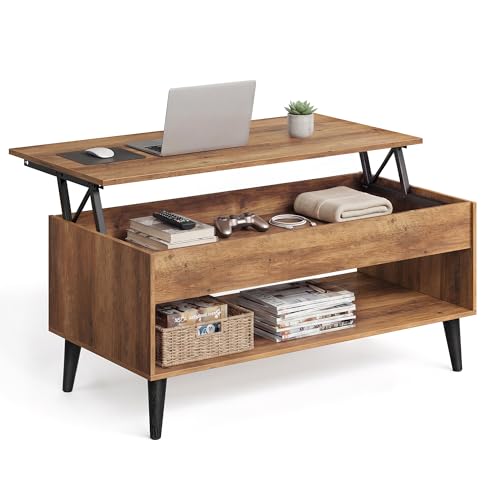
VASAGLE Lift Top Coffee Table with Hidden Storage, Gas Spring
Included for 'Best Coffee Tables for Small Spaces' because the listing specifies Gas Spring, details this guide uses to compare options.
View on Amazon
HOOBRO Coffee Table for Living Room, Oval Small Coffee Table with 2-Tier Open Storage Shelf, Industrial Cocktail Tea Table, Wooden Desktop Center Table, Farmhouse, Home Office, Rustic Brown BF09KF01
Included for 'Best Coffee Tables for Small Spaces' because the listing specifies Oval Small Coffee Table with 2-Tier Open Storage Shelf and Industrial Cocktail Tea Table, details this guide uses to compare options.
View on AmazonFor example, if the space from the sofa to the opposite wall is 58 inches, an 18-inch passage leaves 40 inches for the table’s depth and the remaining furniture tolerance. A 20-inch-deep table is a sensible choice; a 28-inch model may technically fit but will make the room feel blocked.
Table height should generally be level with the sofa seat or slightly lower. If the sofa seat is 18 inches high, look for a table around 16–18 inches high. A table much higher than the cushions can obstruct sight lines and feel uncomfortable when reaching forward. For low-profile sofas, a 14–16-inch table may be more proportional.
Best small-space table designs compared
Slim fixed tables: best for the tightest footprint
A simple rectangular table has the least to break and is often the best value. IKEA’s LACK coffee table is a familiar example, measuring approximately 35 3/8 inches wide, 21 5/8 inches deep, and 17 3/4 inches high. Its lightweight construction makes it easy to move, while the open area underneath keeps the floor visually clear.
This design suits renters, occasional use, and rooms where the table needs to be moved for cleaning. The trade-off is limited durability under heavy loads. Hollow or honeycomb-style panels can resist normal use but may not tolerate repeated sitting, concentrated weight, or screws installed in the wrong locations. General pricing for basic flat-pack tables is about $40–$150.
Open metal-and-glass tables: best for visual lightness
IKEA’s VITTSJÖ coffee table is approximately 35 3/8 inches wide, 19 5/8 inches deep, and 17 3/4 inches high. Its tempered-glass top and dark metal frame occupy little visual space, making it useful in a studio or room with limited natural light.
Glass does not make a table physically smaller, but it can make the floor and rug remain visible. It does require more upkeep: fingerprints, dust, and water rings show quickly. Check that the glass is tempered, and use felt or silicone pads beneath objects that could scratch the surface. This category commonly costs $60–$200.
Lift-top tables: best when one table must do several jobs
A lift-top table is a strong choice when the living room also functions as an office or dining area. The top rises toward the user, and many designs include a compartment beneath it. Look for a closed depth of 20–24 inches, a raised work height of roughly 25–29 inches, and a tested lifting capacity of at least 20–30 pounds.
The mechanism is the important specification. Metal hinges and synchronized supports usually last longer than thin, poorly aligned hardware. Avoid filling the compartment so heavily that the top becomes difficult to lift. A lift-top table generally costs more than a fixed table, often $150–$450, but it can replace a small desk and separate storage bin.
Nesting tables: best for guests and flexible layouts
Nesting tables give you one compact footprint during everyday use and two or three surfaces when visitors arrive. Select a set with a height difference of at least 2–4 inches so the smaller table slides fully underneath instead of catching on the upper frame.
They are particularly useful beside an L-shaped sofa, where a single central table may be too large. Their weakness is storage: because they are usually open and lightweight, they do not hide chargers, controllers, or magazines. Expect to pay about $100–$400 depending on the wood, stone, or metal construction.
Lidded and shelf-storage tables: best for clutter control
A lidded table can hold blankets, toys, books, or game controllers without adding another cabinet. IKEA’s HOL storage table is an example of the compact lidded format, measuring approximately 38 5/8 inches wide, 19 5/8 inches deep, and 19 5/8 inches high.
Ventilation and access matter. Do not use an enclosed compartment for damp textiles, and check whether the lid has a safety gap or soft-close support. Hinges, lid edges, and the underside of the top typically show wear first. A removable fabric liner makes cleaning easier and prevents small items from falling through slats.
Materials: what holds up in everyday use
- Solid wood: Usually repairable and warm-looking, but it can dent, expand, or contract with humidity. Use coasters and wipe spills promptly.
- Veneer: Gives a real-wood surface at a lower cost. Water that reaches a damaged edge can cause bubbling, so avoid standing moisture.
- Laminate or melamine: Easy to wipe and often inexpensive. Damaged corners are difficult to repair, and swollen particleboard cannot usually be restored.
- Tempered glass: Resistant to ordinary heat and impact better than untreated glass, but still vulnerable to edge strikes. Never drag ceramic or gritty objects across it.
- Metal: Strong for its size and useful for thin frames. Powder coating can chip at corners, allowing rust on steel underneath.
Decision matrix for compact living rooms
| Your priority | Choose | Avoid |
|---|---|---|
| Lowest budget and occasional use | Basic laminate or engineered-wood table under 40 inches wide | Heavy stone tops and complex mechanisms |
| Daily use with children or pets | Rounded corners, sealed surface, stable legs, and no easily tipped pedestal | Sharp glass corners and narrow, top-heavy bases |
| Small room with frequent rearranging | Lightweight fixed or nesting table under 35 pounds | Solid stone or oversized hardwood models |
| Remote work several days per week | Lift-top model with a 25–29-inch raised surface | Low tables that force prolonged bending |
| Maximum hidden storage | Lidded or lift-top table with at least 4–6 inches of internal depth | Open shelves that quickly become visual clutter |
Ownership details buyers often miss
Check the table’s weight, not just its dimensions. A 60-pound table may be difficult to move around a rug or vacuum, while an extremely light table can slide when someone rests an elbow on it. Adjustable feet are useful on uneven floors, and a wide leg stance is generally more stable than four legs positioned close to the center.
Inspect the assembly instructions before buying. Small tables often fail because bolts loosen, not because the material is inherently weak. Retighten fasteners after a few weeks, use the

Write Your Review
No reviews yet. Be the first to share your experience!