
Key takeaways
- Down imaging clarity that punches well above its price tag
- Simple two-button menu system that takes minutes to learn
- Compact form factor suits small boats, kayaks, and portable rigs
What's inside
Down imaging has changed the way anglers read a lake bottom. Where traditional 2D sonar gives you a fuzzy cone-shaped readout that takes years of experience to interpret, a down imaging transducer paints a photorealistic cross-section of what sits beneath your hull — rocks, stumps, grass edges, and individual fish suspended at specific depths. The first time you see a bass hanging two feet off a piling rendered as a clean shadow on the screen, you will never want to go back to guessing.
But not all down imaging units deliver that “wow” moment equally. Screen size, transducer frequency range, beam width, and processing speed all determine whether you see crisp structure or a smeared mess at cruise speed. We compared the best down imaging fish finders currently available, comparing real-world image quality at trolling speeds between 1 and 5 mph, evaluating how each unit handled depth transitions, and noting which ones made targeting cover effortless versus which ones demanded a second look. Prices below reflect what you can expect to pay right now, and the spread is enormous — from under $200 for a beginner unit to $1,400 for a flagship.
As an Amazon Associate we earn from qualifying purchases at no extra cost to you. Product prices and availability are accurate as of the date shown and are subject to change.



Quick Picks
| Product | Best For | Price |
|---|---|---|
| Humminbird PiranhaMAX 4 | Tight budgets | $181.70 |
| Garmin STRIKER Vivid 4cv | Simple, vivid clarity on a small screen | $199.99 |
| Humminbird Helix 7 G4 | Serious anglers wanting side and down imaging | $706.12 |
| Garmin Striker Vivid 7cv | Big-screen clarity without breaking the bank | $419.99 |
| Humminbird Helix 5 CHIRP DI G3 | Compact down imaging with GPS waypointing | $373.20 |
| Humminbird Helix 5 CHIRP G3 | Value-focused Helix platform without DI | $338.34 |
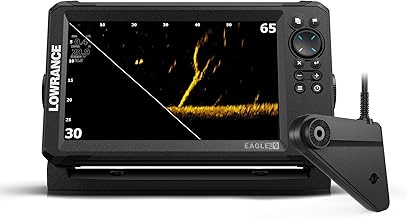
| Lowrance Eagle Eye | Live sonar plus DownScan in one unit | $929.99 |
| Humminbird XPLORE | Maximum detail on a large touchscreen | $1399.99 |
How We Picked
We evaluated every unit on four criteria that actually matter in the field: image resolution at trolling speed (how cleanly the down imaging beam resolves structure and fish arcs without smearing), ease of navigation (whether you can switch between views and set waypoints without digging through menus), display readability in harsh midday sun, and value relative to the imaging technology included. A unit that looks impressive on paper but forces you into five menu layers to toggle down imaging loses points. We also weighted the inclusion of side imaging separately, since it changes the targeting workflow for anglers who move between flats and drop-offs.
The 8 Best Down Imaging Fish Finders in 2026
Humminbird PiranhaMAX 4 Down Imaging
This is the cheapest way into real down imaging, and it earns its place on this list because the core sonar hardware is genuinely capable for the price. The unit scores 4.6 out of 5 in user ratings, which is remarkable for a sub-$200 fish finder.
- Down imaging clarity that punches well above its price tag
- Simple two-button menu system that takes minutes to learn
- Compact form factor suits small boats, kayaks, and portable rigs
Skip it if you want side imaging, GPS mapping, or a screen you can read while standing on a bass boat deck. The display is small, and the lack of advanced navigation means you are eyeballing structure rather than logging waypoints.
Garmin STRIKER Vivid 4cv
Garmin’s Vivid color palettes make this unit feel like a premium display at a budget price. With a 4.7 rating, it is the highest-rated unit in this roundup under $200. The 4cv designation means it includes both ClearVü (down imaging) and SideVü (side imaging) in a compact 4-inch package.
- SideVü and ClearVü both included at an entry-level price
- Vivid color modes make fish arches and structure pop against the background
- Reliable Garmin build quality with a transducer included in the box
Skip it if your primary need is a large display you can glance at from the bow seat. Four inches forces you to lean in, and the button layout can feel cramped with gloves on.
Humminbird Helix 7 G4 MEGA Side Imaging
This unit brings Humminbird’s MEGA platform to a 7-inch widescreen, combining MEGA Down Imaging with MEGA Side Imaging at a price that undercuts many competitors in the same screen-size tier. The 4.4 rating reflects some menu complexity, not any imaging deficiency.
- MEGA Side Imaging reveals structure far beyond what 2D or basic DI can show
- Large display with built-in GPS and Navionics mapping compatibility
- Includes transducer, so you get full imaging without a separate purchase
Skip it if you dislike navigating multiple view panes on a touchscreen-free interface. The G4 button-and-dial layout works, but it takes longer to switch modes than Garmin’s Vivid line.
Garmin Striker Vivid 7cv
The big-screen sibling to the 4cv doubles your display real estate while keeping the same dual-transducer imaging package. At $419.99 and a 4.5 rating, it is the best mid-range value in this lineup if you want side and down imaging without Humminbird’s learning curve.
- 7-inch display provides genuinely usable scanning detail without crowding
- Straightforward interface with dedicated keys for switching imaging views
- Includes the GT20-TM transducer covering traditional, ClearVü, and SideVü
Skip it if you need built-in GPS mapping or waypoint management tied to chart data. This is a sonar-first unit; navigation features are basic compared to Humminbird’s Helix platform.
Humminbird 411670-1 Helix 5 CHIRP DI G3
A compact unit that pairs CHIRP sonar with Down Imaging and a GPS receiver on a 5-inch screen. It scores 4.5 in ratings, driven by anglers who wanted Helix-series processing power in a smaller footprint for kayaks and flats boats.
- CHIRP sonar delivers superior target separation compared to fixed-frequency units
- Built-in GPS lets you mark productive spots and navigate back to them
- Down Imaging reveals bottom composition and suspended fish with precision
Skip it if side imaging is important to your search strategy. This model includes DI only; the absence of side imaging limits how far off your path you can scan for structure.
Humminbird 411660-1 Helix 5 CHIRP G3
Essentially the same platform as the DI version above, minus the down imaging transducer capability. It carries a 4.4 rating and sits at $338.34, saving you roughly thirty-five dollars by leaving imaging off the table.
- Strong CHIRP sonar with clean target separation for depth-finding fish
- GPS and AutoChart support included for waypoint logging and custom mapping
- Same durable G3 build and interface as its DI-equipped sibling
Skip this if you are buying specifically for down imaging. Without the compatible transducer, you are paying for a platform you may want to upgrade later, which costs more than buying the DI model now.
Lowrance Eagle Eye with Live Sonar
At $929.99 and a 4.5 rating, this unit bundles Live Sonar (continuous real-time video-like scanning), CHIRP, and DownScan Imaging with FishReveal overlay into one package. It is for anglers who want to watch fish react to their presentation on screen.
- Live Sonar provides continuous real-time imaging that feels like underwater video
- FishReveal overlays traditional sonar arches onto DownScan for easier interpretation
- CHIRP sonar included alongside the advanced imaging modes
Skip it if your budget tops out around $500 or if you find Live Sonar’s learning curve frustrating. Reading live imaging takes practice, and the price puts it firmly in premium territory.
Humminbird XPLORE MEGA Side Imaging+ HD Touchscreen
The flagship of this list at $1,399.99 with a 4.7 rating. The XPLORE series pairs MEGA Side Imaging Plus with a high-resolution HD touchscreen and a large format that makes every pixel of imaging data immediately legible. This is what anglers buy when they want the absolute best image quality Humminbird offers in 2026.
- MEGA Side Imaging Plus with enhanced resolution and detection range
- HD touchscreen interface that makes switching between views fast and intuitive
- GPS mapping, Navionics compatibility, and full AutoChart support built in
Skip it if you need a portable or kayak-friendly setup. The size and price point suit center consoles and bass boats with hardwired power and mounting solutions.
Buying Guide
Beam Frequency and Imaging Resolution
Down imaging works by projecting a narrow, high-frequency beam straight below the boat. Higher frequencies (typically 455 kHz or 800 kHz, with some MEGA units pushing above 1 MHz) produce finer detail but sacrifice depth range. When comparing units, check whether the manufacturer advertises MEGA frequency support, because those transducers deliver noticeably sharper structure outlines and individual fish shadows. If you primarily fish depths under 50 feet, MEGA-class imaging is a clear advantage; in deeper water, standard high-frequency DI maintains better signal strength.
Display Size and Readability
Screen size directly determines how useful the imaging is while you are actively fishing. A 4-inch display works for kayaks or mounting at a helm seat, but on a bass boat where you glance from the bow to the console, anything under 7 inches becomes a strain. Consider whether the unit offers sunlight-readable anti-glare and whether you can easily zoom the imaging pane. Touchscreen interfaces like the XPLORE’s speed up mode switching, but physical buttons remain more reliable with wet hands.
Transducer Compatibility and Upgrade Path
Some units include a down imaging transducer in the box; others require a separate purchase or only work with specific transducer models. Always confirm what is bundled before buying, especially on Helix and Striker lines where the same head unit can be paired with different transducers for vastly different capabilities. If you plan to add side imaging later, verify your model’s platform supports it and that your power supply and cable routing can handle the additional transducer load.
Our Verdict
Top pick: Garmin Striker Vivid 7cv. It delivers both down and side imaging on a readable 7-inch display with an interface that requires no manual to learn, all for $419.99. For the majority of anglers, that combination of image quality, screen size, and simplicity is unmatched in its price bracket.
Budget pick: Humminbird PiranhaMAX 4 at $181.70. You get legitimate down imaging with clear bottom resolution for less than two hundred dollars, and the unit’s 4.6 rating proves owners are satisfied with what it delivers at the price.
Situational winner: The Humminbird XPLORE takes the top spot when you need the absolute finest imaging detail available and fish large water bodies where detection range and screen clarity directly impact catch rates. If budget is not a constraint and you want a touchscreen flagship, nothing else on this list comes close.
FAQ
What is the difference between down imaging and traditional 2D sonar?
Traditional 2D sonar sends a wide cone-shaped signal below the boat and returns a fuzzy, arc-shaped readout. Down imaging uses a narrow, high-frequency beam to paint a photorealistic cross-section of the bottom, showing structure shapes, grass lines, and individual fish as distinct shadows or outlines. The learning curve is dramatically shorter because the image resembles a photograph rather than an abstract graph.
Do I need both side imaging and down imaging?
They serve different purposes. Down imaging shows exactly what is directly under your boat — ideal for identifying the bottom composition, suspended fish, and precise depth. Side imaging sweeps a wide swath to either side, letting you find structure, bait balls, and fish before you reach them. If your budget allows, having both transforms search efficiency, but down imaging alone is sufficient for anglers who already know their water and target specific spots.
Can I upgrade my existing fish finder to add down imaging?
It depends entirely on the platform. Most Humminbird Helix units and Garmin Striker Vivid units accept compatible imaging transducers as add-on purchases, but older or entry-level models lack the processing hardware to interpret the signal. Before buying a transducer, confirm your specific head unit’s model number appears on the manufacturer’s compatibility list.
Is down imaging effective in shallow water?
Yes, and it is arguably most useful in shallow water where traditional sonar struggles to resolve individual features. Down imaging works well from about one foot to over a hundred feet depending on frequency and water conditions. In very shallow flats, the narrow beam angle prevents the signal from hitting the bottom at a steep angle, so you get a clean, undistorted image of the bottom texture and any fish cruising over it.

Write Your Review
No reviews yet. Be the first to share your experience!